




























Views
Downloads

Essential Grade 4 Separating Mixtures Science Worksheet

Paste this activity's link or code into your existing LMS (Google Classroom, Canvas, Teams, Schoology, Moodle, etc.).
Students can open and work on the activity right away, with no student login required.
You'll still be able to track student progress and results from your teacher account.
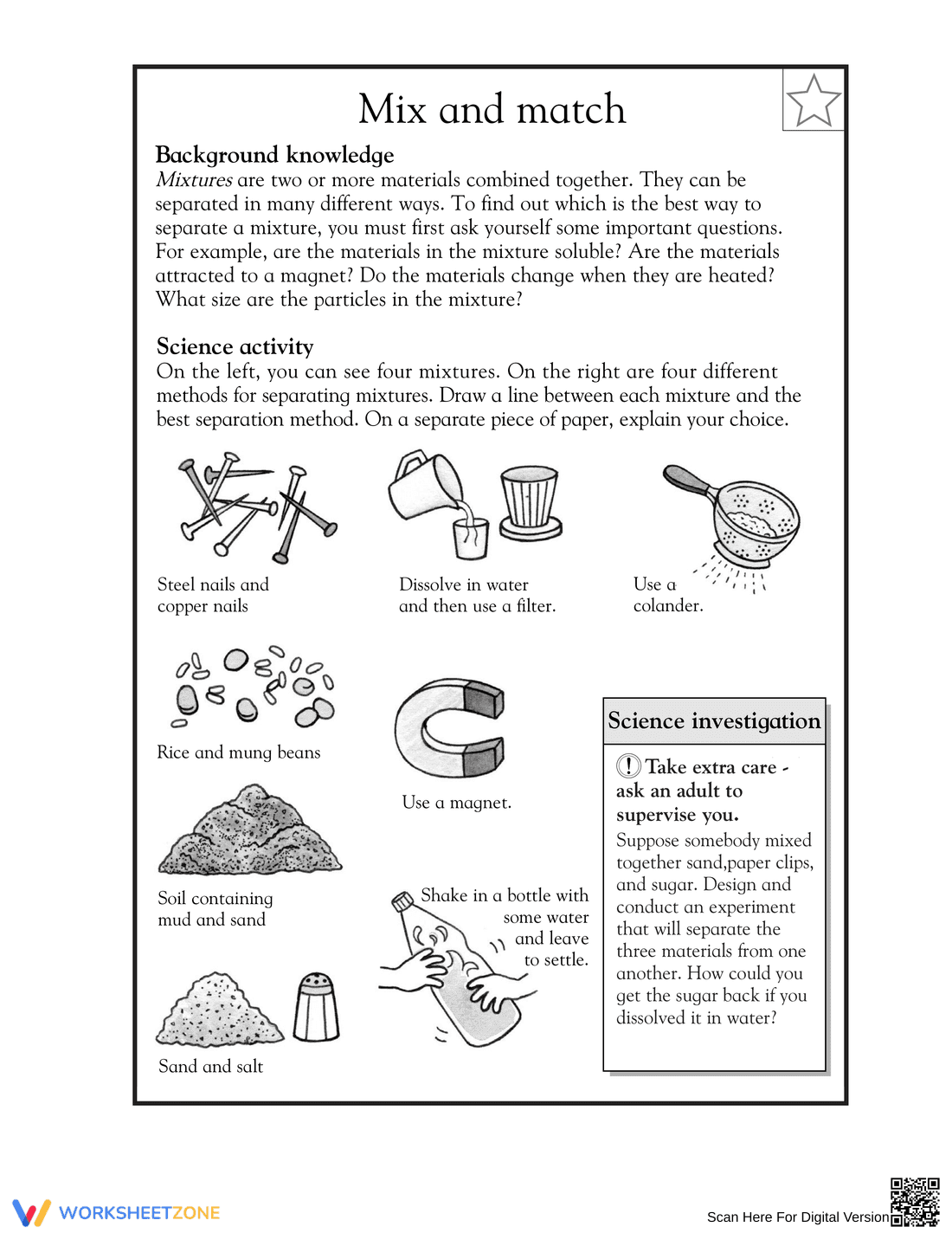
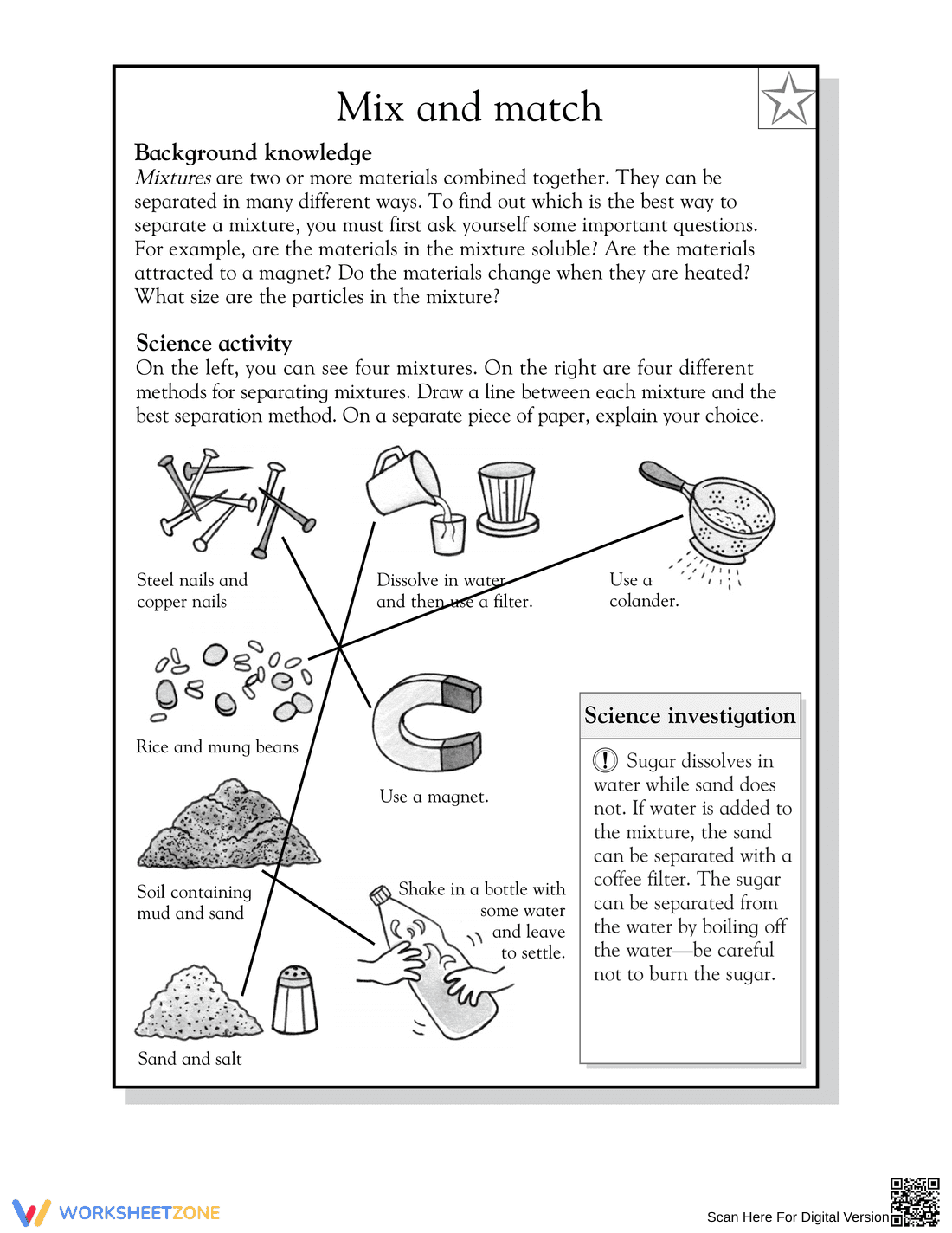
This Grade 4 science worksheet helps students master the physical properties of matter by identifying the best methods for separating common mixtures. Students analyze four distinct scenarios—from magnetic separation of steel nails to the filtration of salt and sand—to understand how solubility, magnetism, and particle size dictate specific laboratory techniques and tool selection.
At a Glance
- Grade: 4 · Subject: Science
- Standard:
5-PS1-3— Identify materials based on their properties to determine effective separation methods- Skill Focus: Physical Properties & Mixtures
- Format: 1 high-quality page · 5 focused tasks · Full answer key included · PDF
- Best For: Independent practice, emergency sub plans, or science centers
- Time: 15–20 minutes
What's Inside
This high-utility printable contains a concise background knowledge section defining mixtures and the critical questions scientists ask before choosing a separation tool. The primary activity features a matching task involving steel vs. copper nails, rice and beans, soil, and salt-sand combinations. It concludes with a "Science Investigation" challenge requiring students to design a multi-step experiment for a triple-component mixture involving sand, paper clips, and sugar.
Zero-Prep Workflow
Teachers can integrate this resource into their daily schedule with zero lead time. Print the single-page PDF (30 seconds), distribute it during your physical science block (1 minute), and facilitate a quick class review of the results (5 minutes). Its self-contained instructional text and clear visual icons make it an ideal choice for emergency substitute plans or independent morning work rotations during the matter unit.
Standards Alignment
The content is meticulously aligned to 5-PS1-3, which requires students to make observations and measurements to identify materials based on their properties. By evaluating which tools—such as magnets, colanders, or filters—are appropriate for specific combinations, students demonstrate a practical application of physical science principles. This standard code can be copied directly into lesson plans, IEP goals, or district curriculum mapping tools.
How to Use It
Use this worksheet as a formative assessment after a direct instruction lesson on physical properties. Have students complete the matching section independently, then use the "Science Investigation" prompt as a collaborative partner task to encourage scientific discourse. A great formative-assessment observation tip is to watch for students who struggle to distinguish between filtration and sedimentation in the soil vs. salt examples.
Who It's For
This resource is designed for Grade 4 classrooms but serves as an excellent scaffolded review for Grade 5 students preparing for state testing. It supports diverse learners through clear visual cues and vocabulary support. It pairs naturally with a hands-on lab using real magnets, sieves, and water to verify the worksheet's theoretical predictions in a real-world classroom environment.
The science of separating mixtures is a foundational component of upper elementary physical science, bridging the gap between basic observation and complex chemical analysis. According to Fisher & Frey (2014), providing students with structured "Mix and Match" tasks reinforces the gradual release of responsibility by moving from conceptual definitions to applied problem-solving. This Grade 4 resource specifically addresses standard 5-PS1-3 by requiring students to utilize observable facts—such as magnetism in steel or the solubility of salt—to select the correct tool for separation. By engaging with these five distinct tasks, learners build the cognitive frameworks necessary for more advanced engineering and design challenges. The inclusion of a multi-component investigation prompt ensures that students are not merely memorizing facts but are applying their knowledge to complex, real-world scenarios. This printable is an essential tool for any science educator looking to drive mastery in the properties of matter.


