


























Views
Downloads


Printable Sentences or Fragments Worksheet | Grade 1 ELA
Paste this activity's link or code into your existing LMS (Google Classroom, Canvas, Teams, Schoology, Moodle, etc.).
Students can open and work on the activity right away, with no student login required.
You'll still be able to track student progress and results from your teacher account.
Sentence structure is the foundation of clear communication. This Grade 1 English Language Arts worksheet focuses on the critical distinction between complete sentences and fragments. By identifying missing subjects or verbs, students develop the syntactical awareness necessary to express whole thoughts clearly in their early writing endeavors.
At a Glance
- Grade: 1 · Subject: ELA
- Standard:
CCSS.ELA-LITERACY.L.1.1.J— Produce and expand complete simple and compound sentences in response to prompts- Skill Focus: Sentence vs. Fragment Identification
- Format: 5 pages · 30 problems · Answer key included · PDF
- Best For: Grammar centers and independent writing practice
- Time: 15–25 minutes
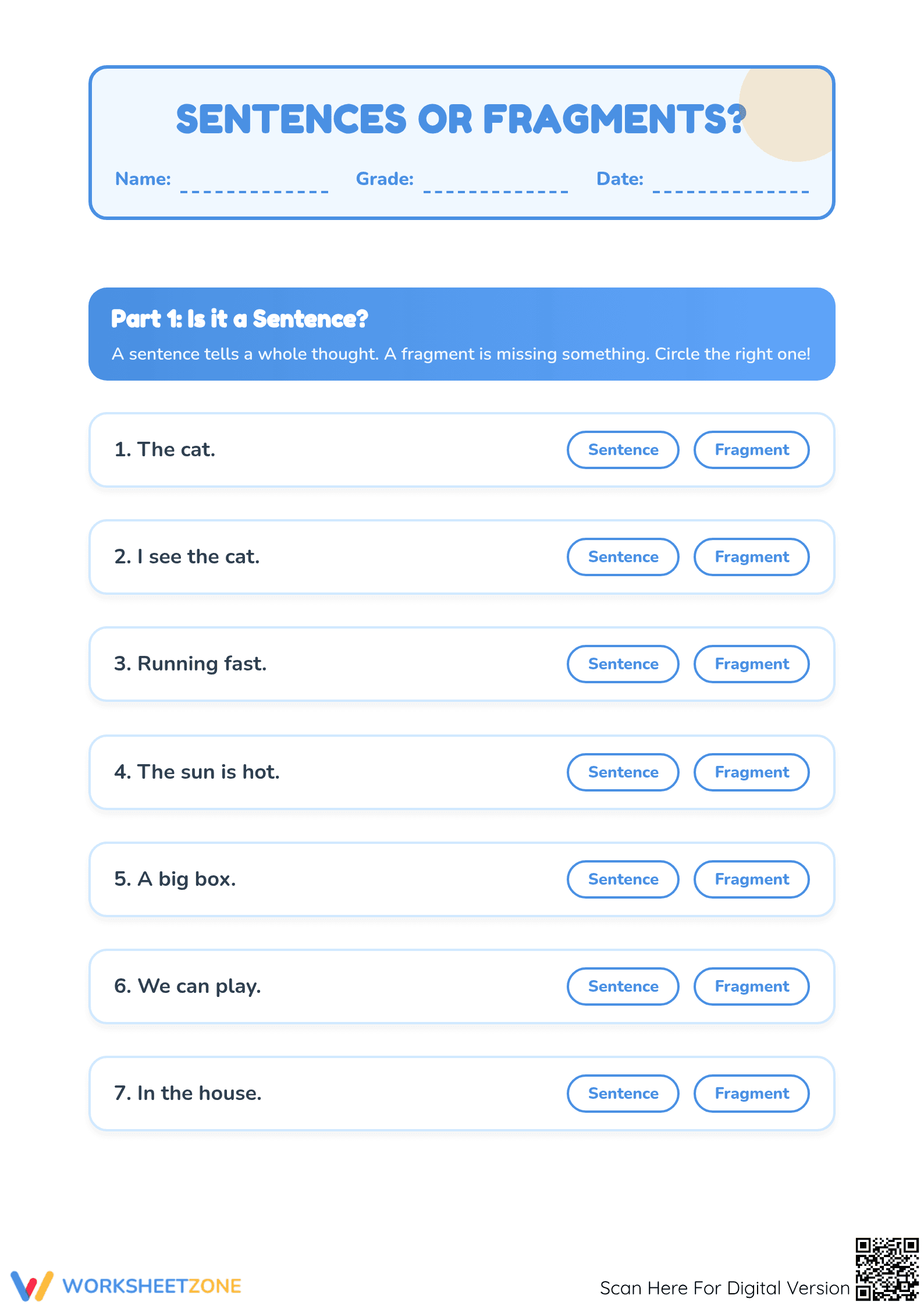
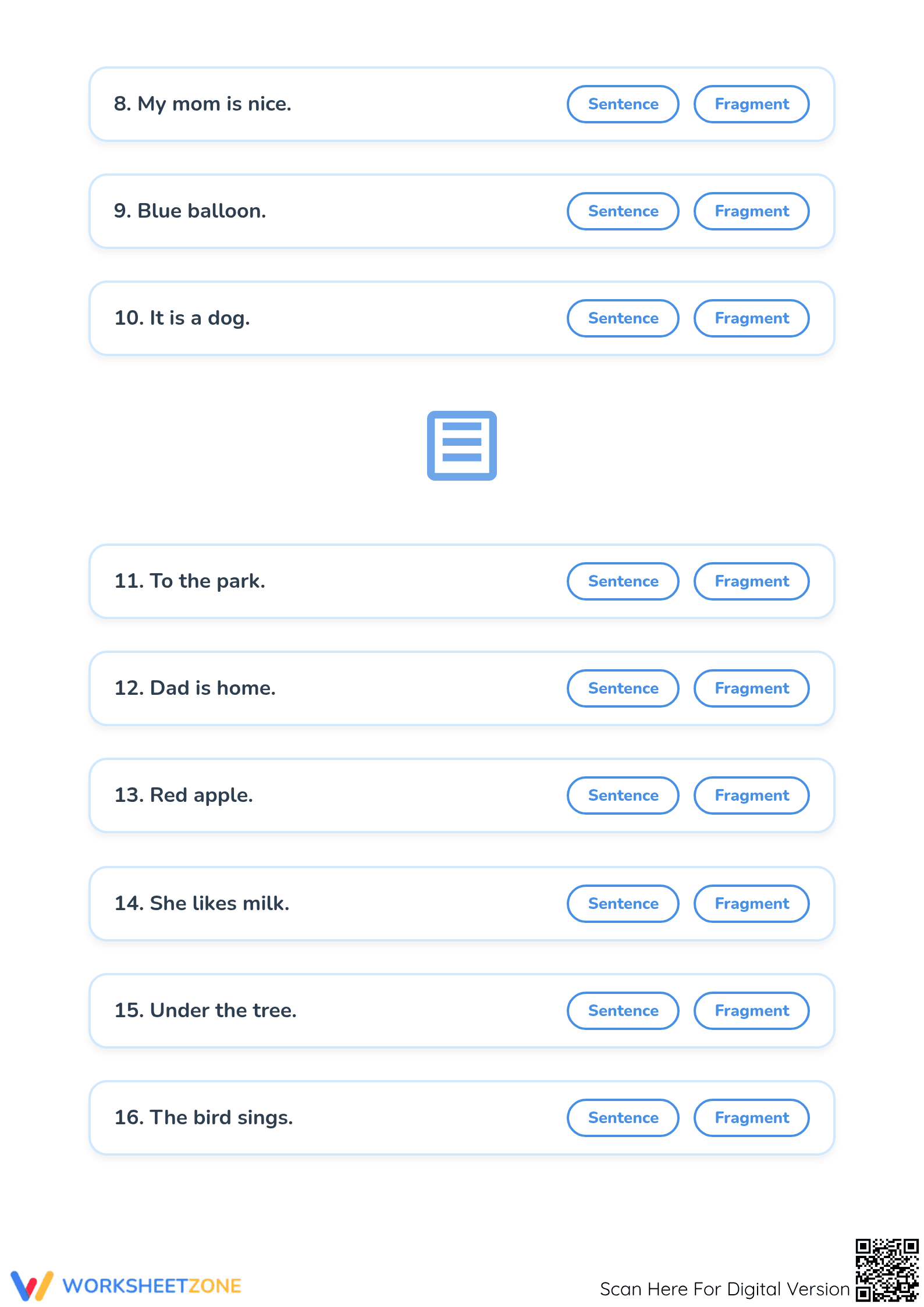
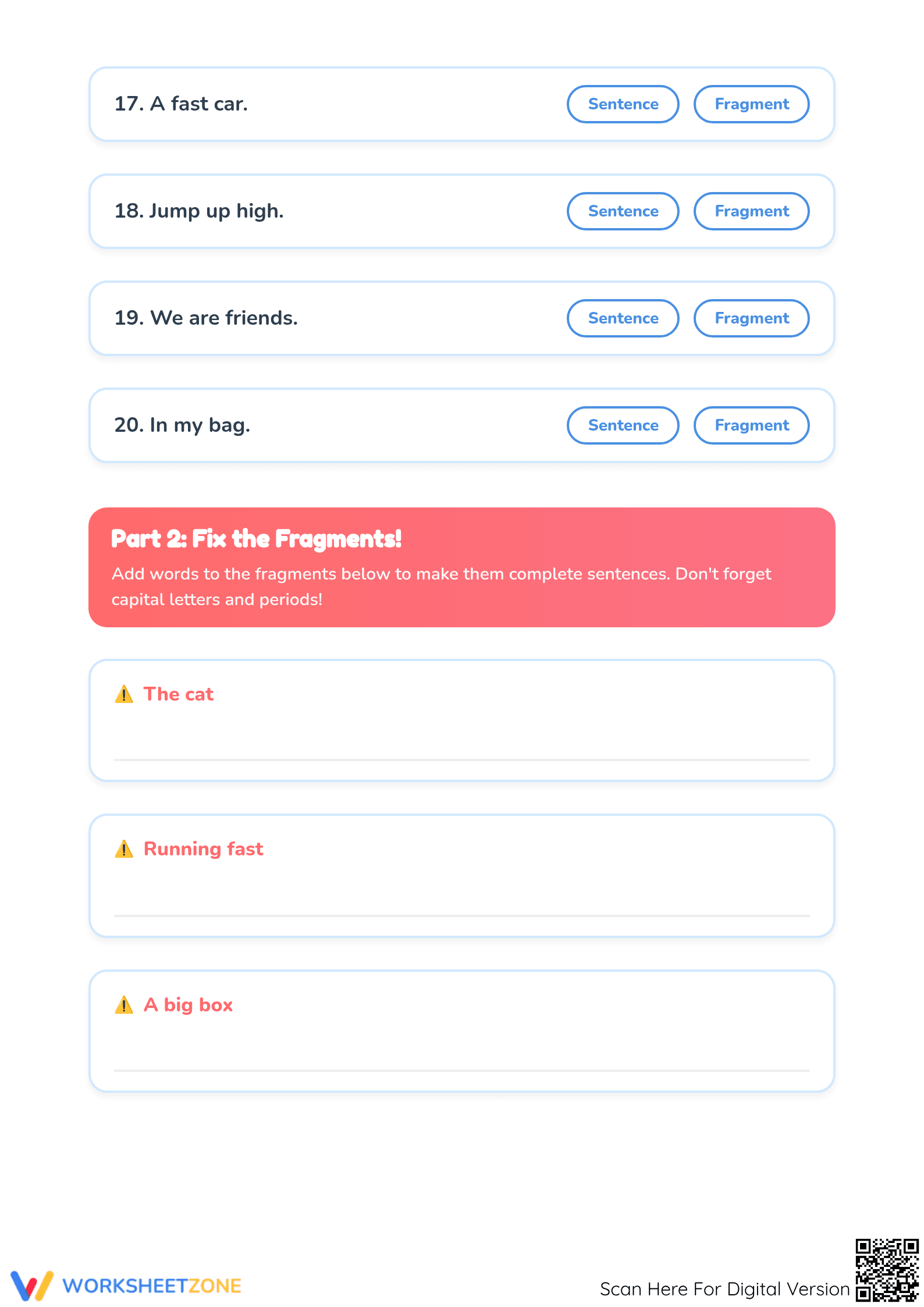
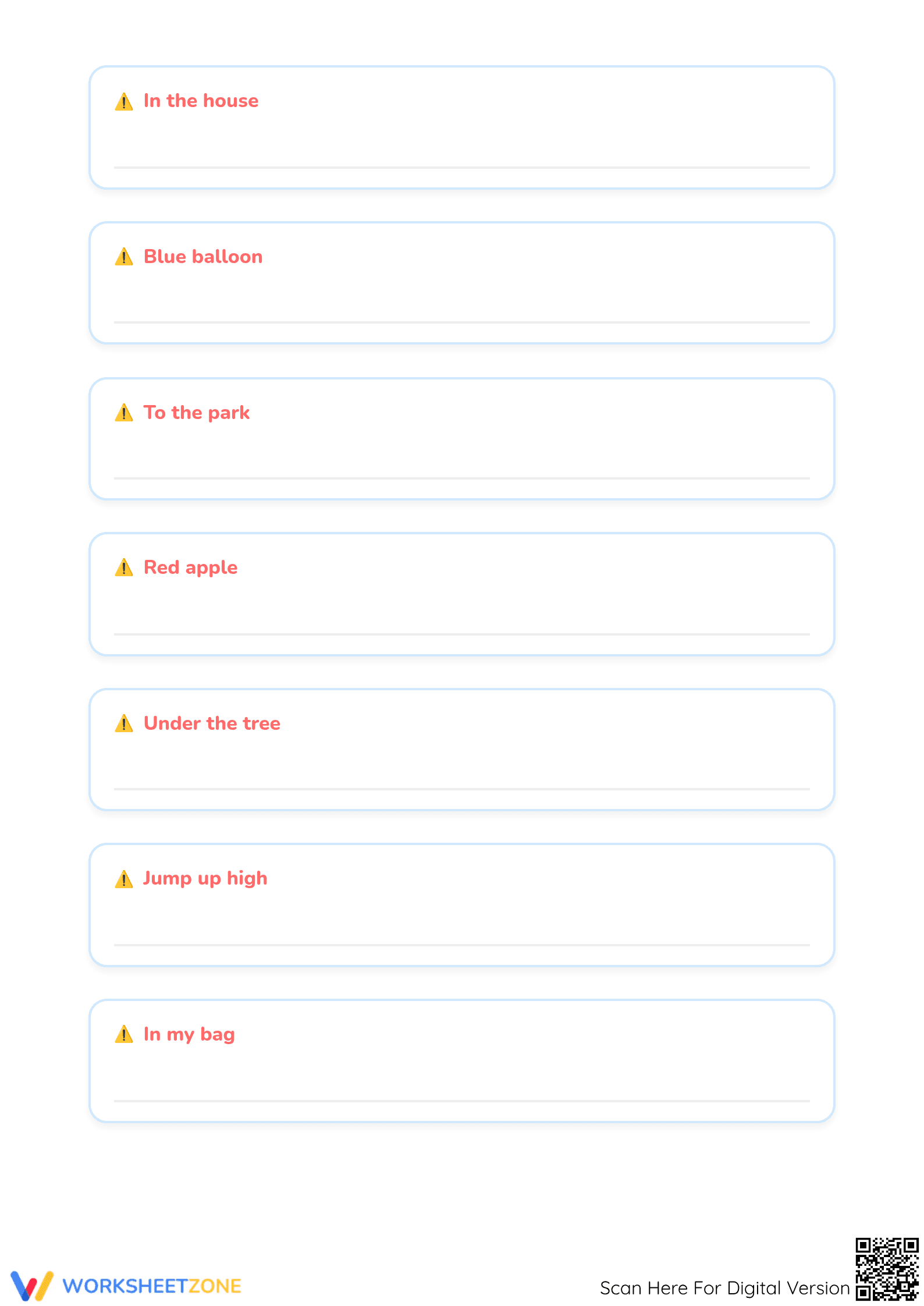
This comprehensive 5-page PDF package contains two distinct learning phases designed to build mastery. It begins with 20 identification tasks where students analyze provided phrases to determine if they constitute a "Sentence" or a "Fragment." This is followed by 10 correction prompts requiring students to rewrite fragments as complete sentences. A full answer key ensures efficient grading.
Skill Progression
- Guided Recognition: The first 10 items provide clear, contrasting examples that highlight the presence or absence of a verb and subject.
- Supported Analysis: Items 11 through 20 introduce more varied phrase structures, challenging students to look deeper into the "whole thought" requirement.
- Independent Application: The "Fix the Fragments" section removes the multiple-choice safety net, asking students to generate original language to complete the syntax.
This gradual release approach ensures students are never left without a clear structural model before being asked to create their own.
Standards Alignment
This resource is explicitly aligned with `CCSS.ELA-LITERACY.L.1.1.J`, which requires first-grade students to "Produce and expand complete simple and compound declarative, interrogative, imperative, and exclamatory sentences in response to prompts." By isolating the concept of a fragment, students learn the essential components required to fulfill this standard. This standard code can be copied directly into lesson plans, IEP goals, or district curriculum mapping tools.
How to Use It
Incorporate this worksheet during the practice phase of a direct instruction lesson on sentence structure. Alternatively, use Part 1 as a quick bell-ringer to check for understanding before a writing workshop. For a formative assessment, observe students as they complete Part 2; if a student consistently adds subjects but omits verbs, it indicates a specific grammatical gap to address. Expect completion in roughly 20 minutes.
Who It's For
This resource is designed for first-grade students beginning to write multi-sentence narratives or reports. It also provides excellent remediation for second graders struggling with fragment usage. Pair this worksheet with a mentor text from a Grade 1 reading passage to help students see how authors use complete sentences to convey meaning effectively in real literature.
Effective writing instruction in the primary grades relies on developing a student's internal sentence sense. Research by Fisher & Frey (2014) emphasizes the importance of gradual release models when introducing complex linguistic structures like the complete sentence. This worksheet applies those principles by transitioning students from simple identification to active correction. By addressing `CCSS.ELA-LITERACY.L.1.1.J` through 30 targeted tasks, the resource ensures that Grade 1 learners internalize the necessity of a subject and a predicate before they move to more complex paragraph construction. This structured approach helps prevent the habituation of fragment-based writing, a common hurdle identified in national writing assessments. Educators can cite this resource as a valid tool for building the syntactical foundations required for meeting the rigorous demands of early elementary literacy frameworks and standardized writing benchmarks.


