


























Views
Downloads
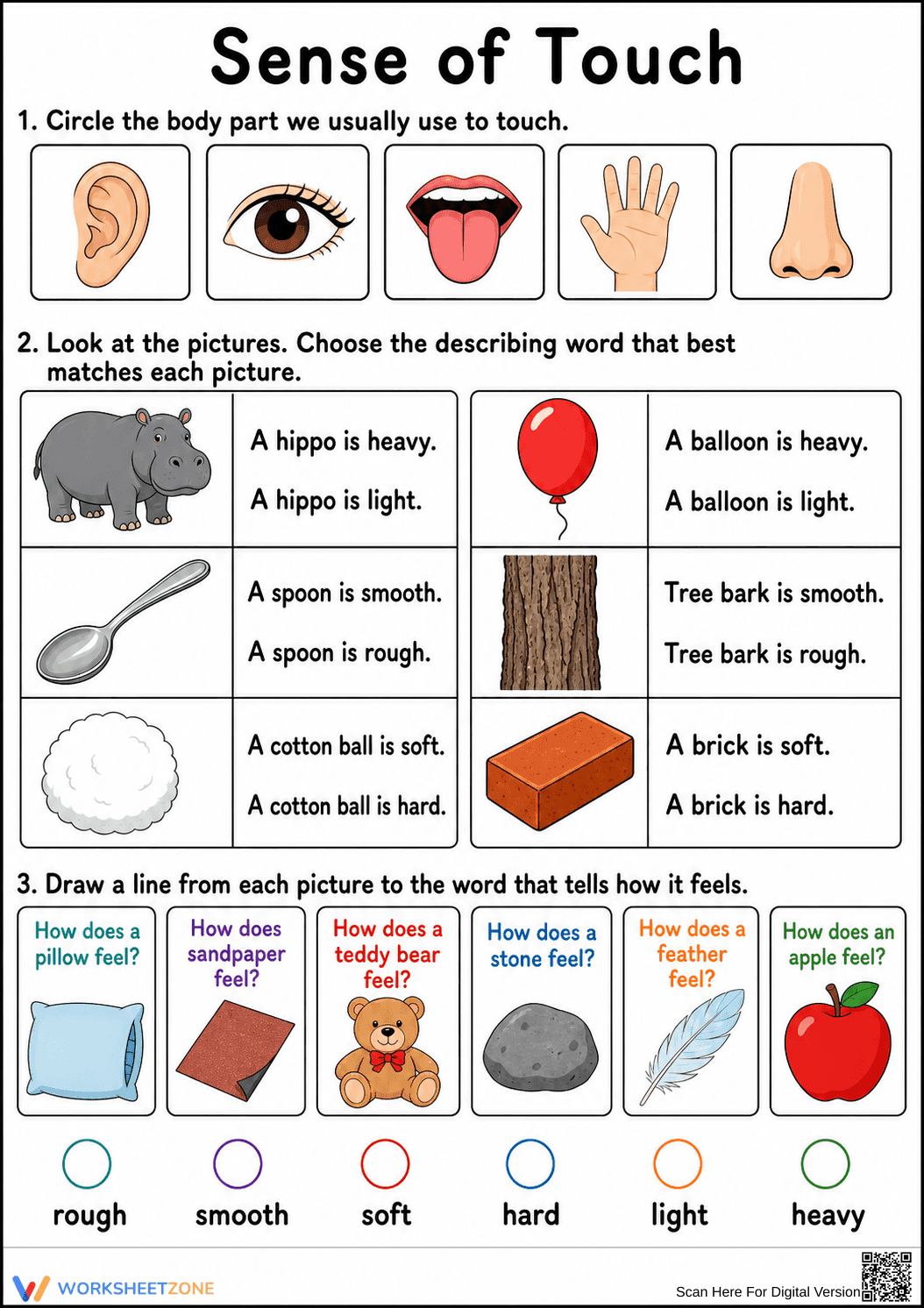

Essential Sense of Touch Worksheet | Kindergarten ELA Ready
Paste this activity's link or code into your existing LMS (Google Classroom, Canvas, Teams, Schoology, Moodle, etc.).
Students can open and work on the activity right away, with no student login required.
You'll still be able to track student progress and results from your teacher account.
This Essential Sense of Touch worksheet helps early learners connect tactile experiences with descriptive vocabulary. Students identify the primary organ for touch and practice using antonyms like rough and smooth or hard and soft to describe common objects. This resource provides a direct path to mastering foundational language skills through observable science concepts.
At a Glance
- Grade: Kindergarten · Subject: ELA
- Standard:
CCSS.ELA-LITERACY.L.K.5.C— Identify real-life connections between words and their use- Skill Focus: Sense of Touch & Descriptive Adjectives
- Format: 1 page · 13 problems · Answer key included · PDF
- Best For: Independent practice and science integration
- Time: 15–20 minutes
What's Inside
The worksheet features three distinct sections across one printable page. It begins with a body part identification task, followed by six sentence-selection problems that challenge students to choose the best descriptive adjective for items like elephants, tables, and rocks. The final section includes six color-coded matching questions where students connect images to tactile feelings, ensuring comprehensive coverage of core sensory vocabulary.
Zero-Prep Workflow
- Print: Click print and generate copies in less than 30 seconds. No complex margins or double-sided settings required.
- Distribute: Hand out to students as a stand-alone activity; the clear visual cues allow for immediate engagement.
- Review: Use the included answer key to check for understanding in under 1 minute.
This layout is ideal for emergency sub plans or quick morning work sessions where teacher preparation time is at a premium.
Standards Alignment
This resource aligns with CCSS.ELA-LITERACY.L.K.5.C, which requires students to identify real-life connections between words and their use. It also supports science standards related to human body systems and observational patterns. Both standard codes can be copied directly into lesson plans, IEP goals, or district curriculum mapping tools.
How to Use It
Assign this worksheet during a science rotation after a hands-on "mystery bag" activity where students feel different textures. It serves as an excellent formative assessment to see if students can translate physical sensations into written adjectives. Expect most Kindergarten students to complete the 13 tasks independently within 20 minutes.
Who It's For
This printable is designed for Preschool, Kindergarten, and Grade 1 students. It is particularly effective for English Language Learners (ELLs) who benefit from the high-quality image support when learning descriptive adjectives. It pairs naturally with a sensory table or an anchor chart about the five senses.
This Sense of Touch worksheet provides essential vocabulary development for early learners, focusing on the standard CCSS.ELA-LITERACY.L.K.5.C. By identifying real-life connections between words and their use, students categorize objects based on tactile properties such as rough, smooth, hard, and soft. Research from Fisher & Frey (2014) emphasizes the importance of visual-to-textual mapping in the gradual release of responsibility model, which this worksheet utilizes through its three-stage task progression. The first task establishes the anatomical connection to the sense of touch, the second requires sentence-level discrimination of antonymous pairs, and the third reinforces learning through color-coded matching. This structured approach ensures that preschool, kindergarten, and first-grade students build a robust lexical foundation while developing critical observational skills. Educators can confidently integrate this resource into ELA or science units to provide evidence-based practice that aligns with foundational literacy requirements and instructional best practices in early childhood education.


