




























Views
Downloads

Printable Angles & Angle Relationships Worksheet (8-10)

Paste this activity's link or code into your existing LMS (Google Classroom, Canvas, Teams, Schoology, Moodle, etc.).
Students can open and work on the activity right away, with no student login required.
You'll still be able to track student progress and results from your teacher account.
This comprehensive geometry worksheet empowers students to master angle properties and relationships through structured practice. By engaging with definitions, calculations, and algebraic challenges, learners develop the foundational skills necessary for advanced geometric proofs and spatial reasoning. It provides a clear pathway from basic classification to complex transversal analysis.
At a Glance
- Grade: 8-10 · Subject: Geometry
- Standard:
CCSS.MATH.CONTENT.8.G.A.5— Establish facts about angles created when parallel lines are cut by a transversal- Skill Focus: Angle Relationships and Transversals
- Format: 5 pages · 11 problems · Answer key included · PDF
- Best For: High school geometry foundation and reinforcement
- Time: 45–60 minutes
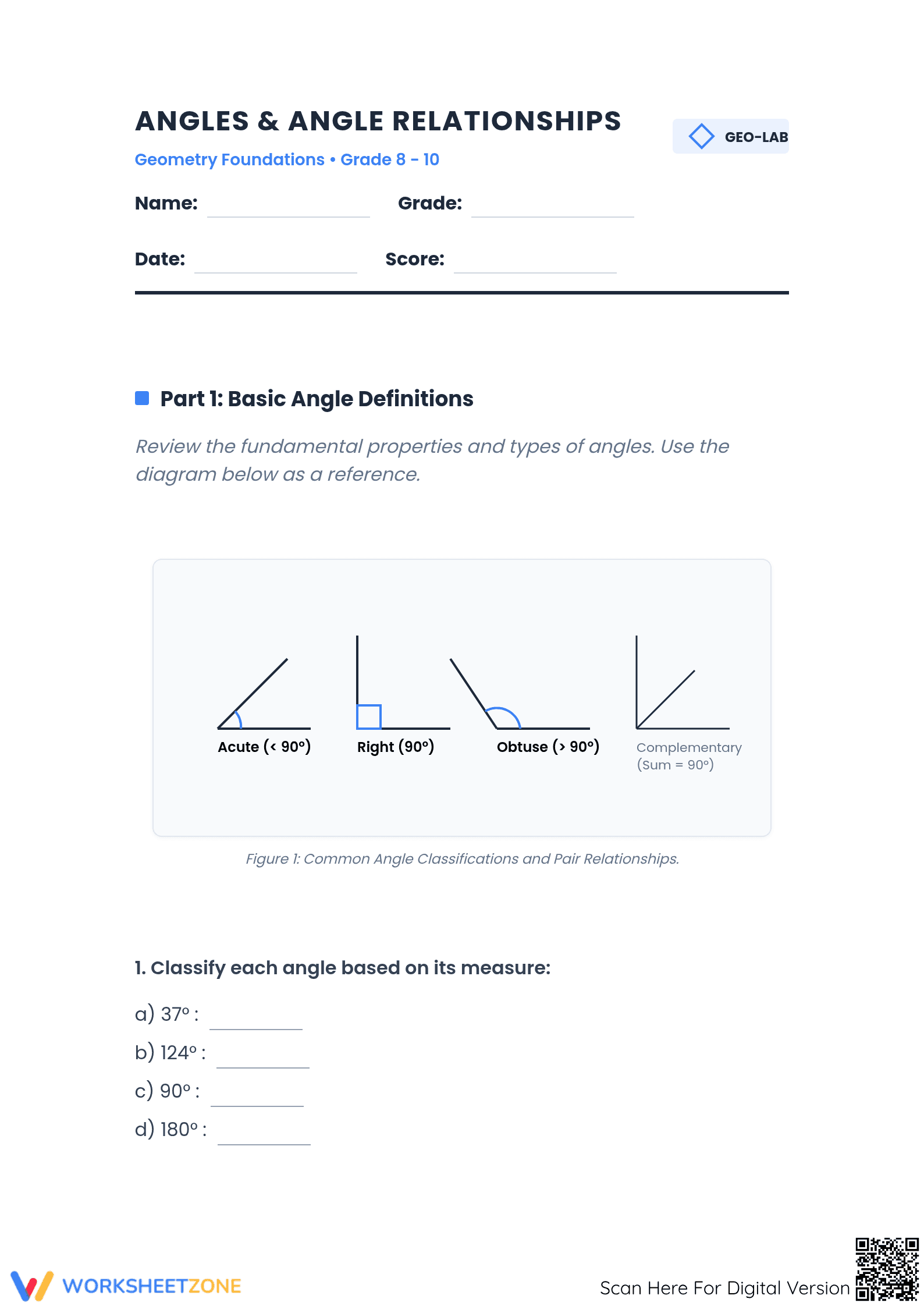
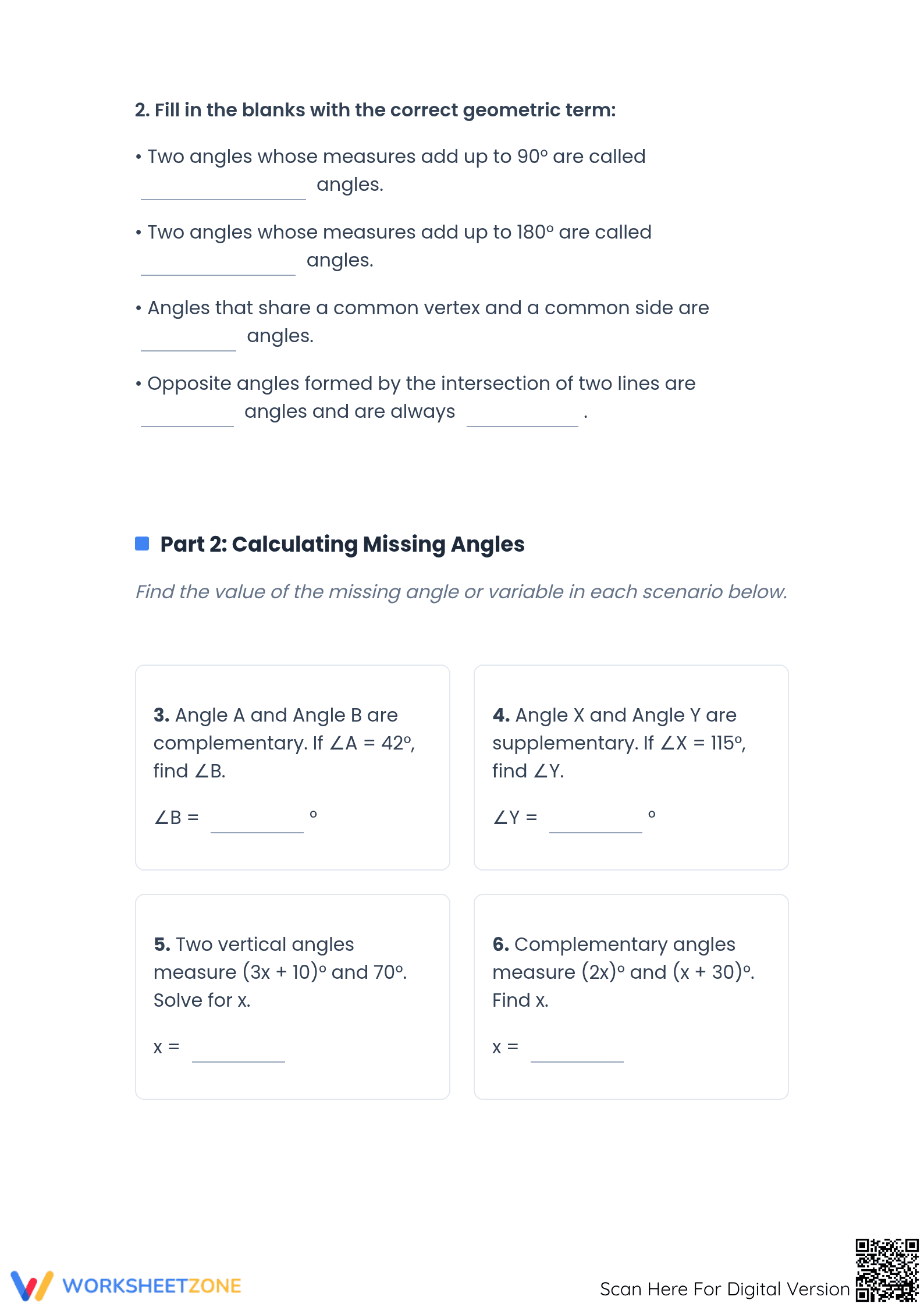
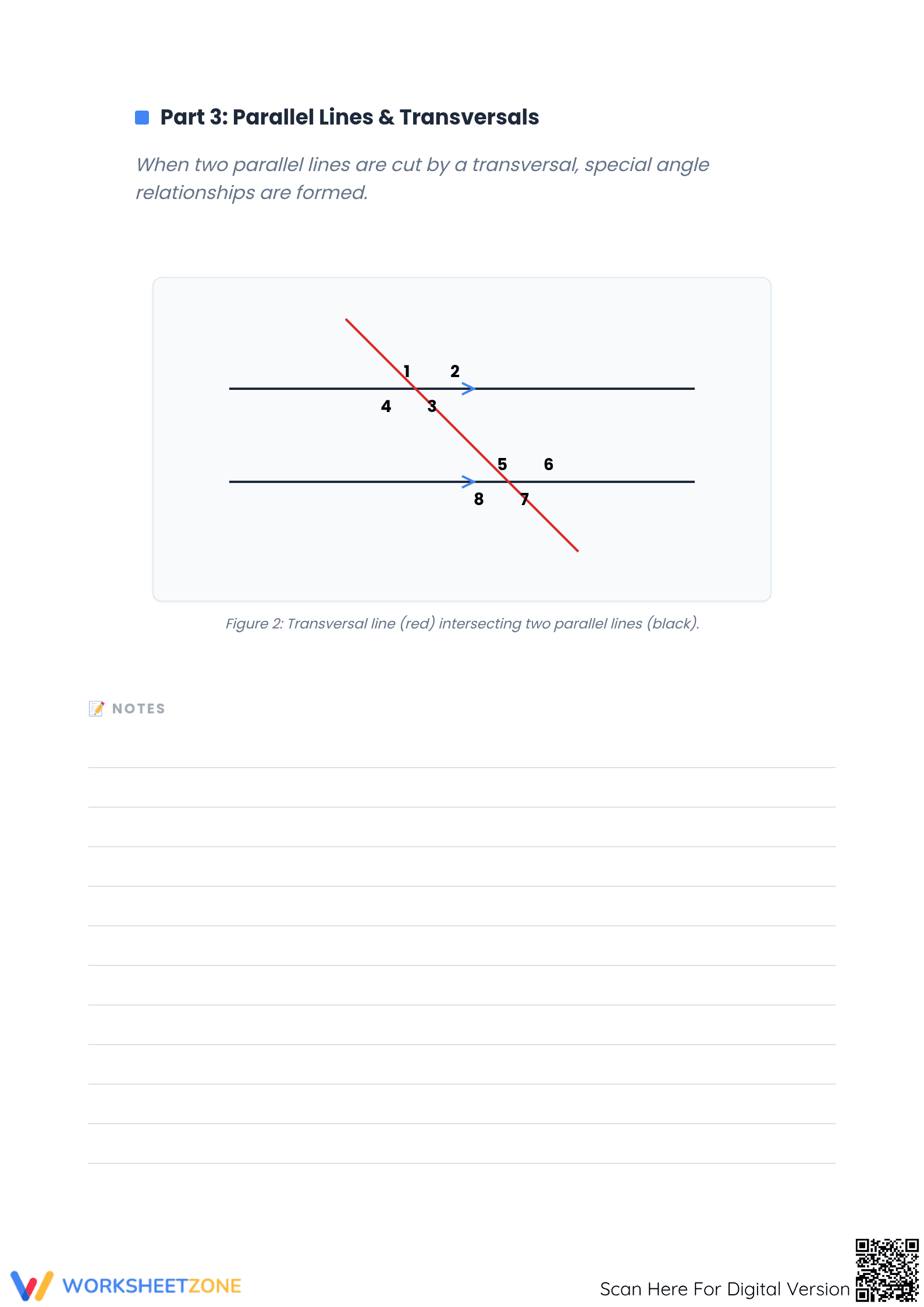
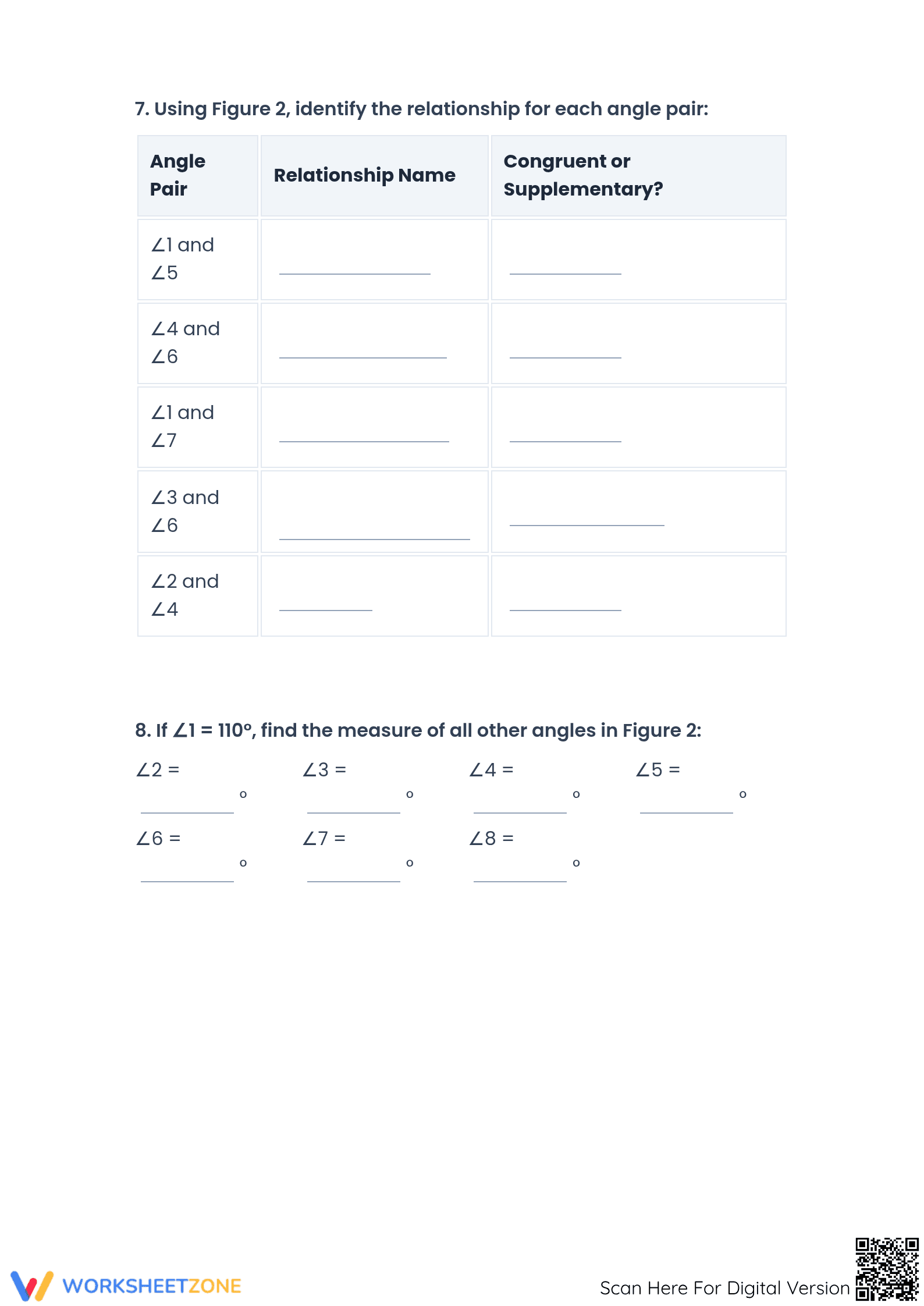
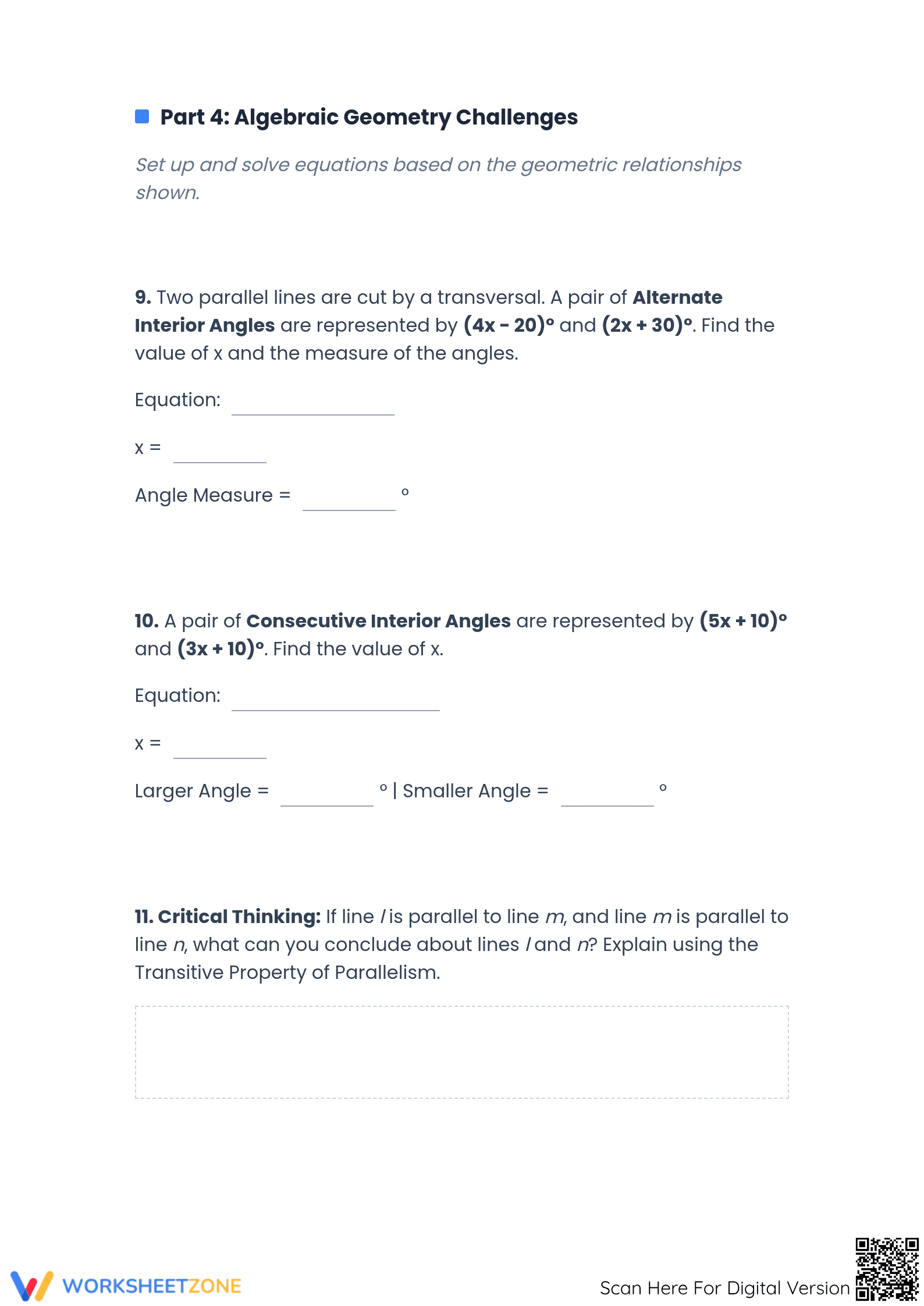
The 5-page PDF contains 11 multi-part tasks designed for a deep exploration of geometric principles. It includes visual reference diagrams for angle types, fill-in-the-blank vocabulary exercises, missing angle calculations involving complementary and supplementary pairs, and a detailed section on parallel lines cut by transversals. The final pages present algebraic challenges where students solve for variables using geometric theorems.
Skill Progression
- Guided Practice: Students begin with visual classification and vocabulary reinforcement, identifying acute, right, and obtuse angles across 4 initial tasks to build confidence and terminology.
- Supported Practice: The middle section provides 4 calculation-based problems where students apply complementary, supplementary, and vertical angle properties to find missing values with numeric and simple variable cues.
- Independent Practice: Learners tackle 3 advanced challenges involving parallel line transversals and multi-step algebraic equations, requiring them to synthesize multiple theorems to solve for unknown variables and justify their reasoning.
Standards Alignment
The primary focus is CCSS.MATH.CONTENT.8.G.A.5, which requires students to use informal arguments to establish facts about the angles created when parallel lines are cut by a transversal. Additionally, it supports CCSS.MATH.CONTENT.7.G.B.5 by requiring the use of facts about supplementary, complementary, vertical, and adjacent angles in multi-step problems.
How to Use It
This resource is ideal for use during the "We Do" phase of direct instruction to model the application of angle theorems. Teachers can also assign specific sections as formative assessments after a lesson on parallel lines to observe student mastery of transversal relationships. Expected completion time is approximately 45 to 60 minutes depending on student familiarity with algebraic substitution.
Who It's For
This worksheet is designed for Grade 8-10 students in foundational geometry or Algebra 1 courses. It provides necessary scaffolding for learners who need visual reminders of angle types while offering rigorous extensions for students ready for algebraic geometry. It pairs naturally with an anchor chart on parallel line theorems or a digital interactive geometry tool.
This Grade 8-10 geometry resource focuses on the essential skill of identifying and calculating angles and angle relationships. By integrating vocabulary, visual models, and algebraic problem-solving, the worksheet aligns with CCSS.MATH.CONTENT.8.G.A.5 and prepares students for higher-level proofs. According to a Fisher & Frey (2014) analysis of instructional design, the use of a scaffolded approach that moves from simple identification to complex algebraic application is critical for developing mathematical fluency and conceptual depth. The inclusion of parallel line transversals ensures that students can establish facts about interior and exterior angles, a key requirement for secondary mathematics success. This printable packet serves as a versatile tool for classroom instruction, homework, or targeted intervention, providing the structured practice necessary to move learners toward independent mastery of geometric foundations.


