


























Views
Downloads



Essential Segment Addition Postulate Practice | Grade 9
Paste this activity's link or code into your existing LMS (Google Classroom, Canvas, Teams, Schoology, Moodle, etc.).
Students can open and work on the activity right away, with no student login required.
You'll still be able to track student progress and results from your teacher account.
This comprehensive three-page worksheet provides essential practice for students learning the Segment Addition Postulate in high school geometry. By working through eighteen scaffolded problems, learners will move from basic conceptual understanding to applying algebraic logic to solve complex segment length equations. This resource ensures students master the relationship between collinear points and their segment sums effectively.
At a Glance
- Grade: 9-10 · Subject: Geometry
- Standard:
HSG.CO.A.1— Apply precise definitions of line segments and points to find lengths- Skill Focus: Segment Addition Postulate
- Format: 3 pages · 18 problems · Answer key included · PDF
- Best For: High school geometry curriculum reinforcement
- Time: 45–60 minutes
What's Inside
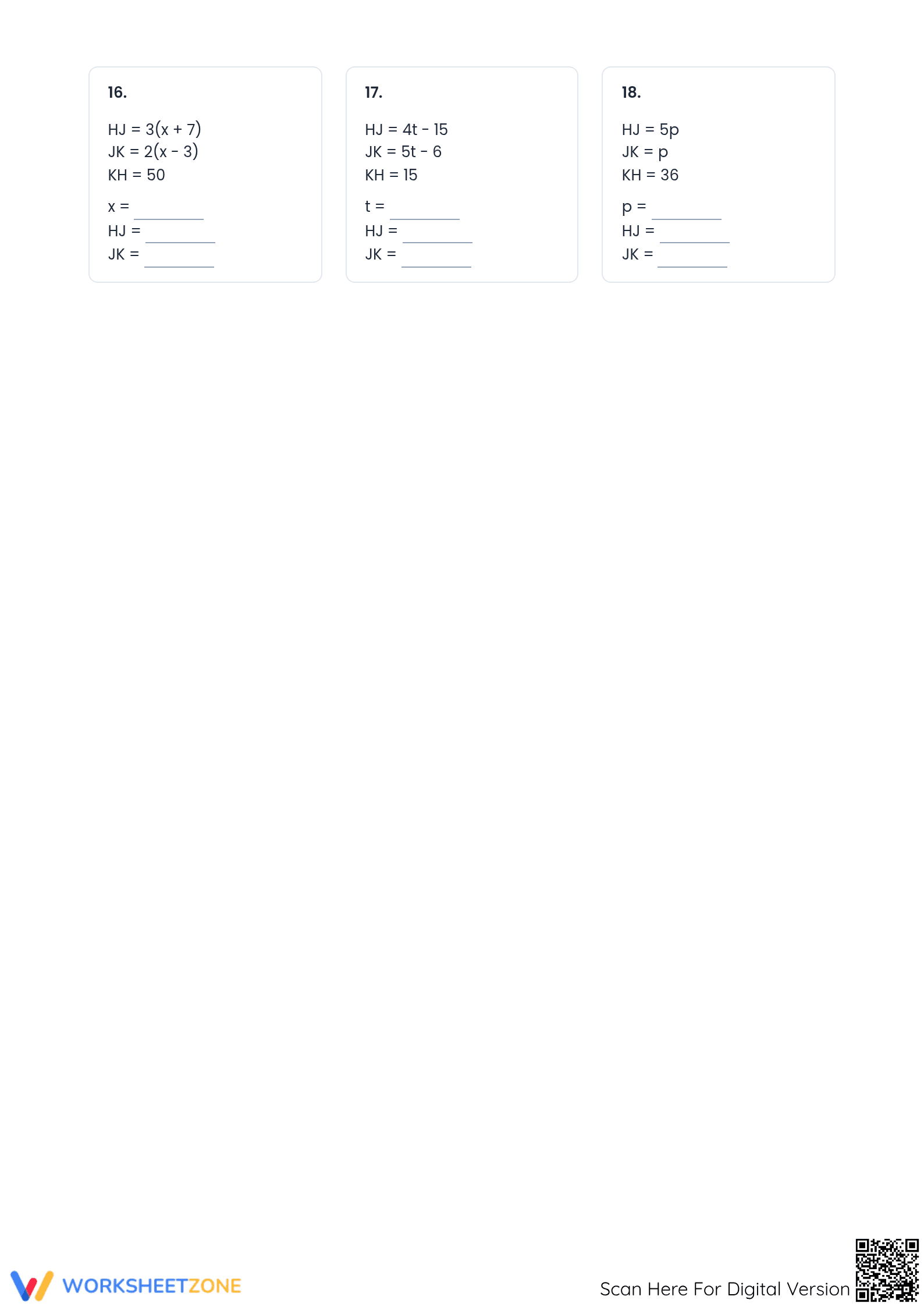
This resource contains three distinct pages of practice. Page one focuses on the transition from linguistic descriptions of points to mathematical equations, featuring four "Writing the Postulate" exercises and six tasks analyzing collinear points on a number line. Page two introduces word problems requiring student-drawn diagrams and three algebraic application sets. Page three concludes with three additional complex algebraic challenges involving variable solving and segment substitution.
Mastery Evidence
Each section of this worksheet is designed to map directly to sub-skills within the geometry standards. Tasks 1 through 10 assess basic procedural fluency and the ability to interpret geometric notation. Tasks 11 and 12 require higher-order synthesis as students must visualize and sketch diagrams from text. The final six algebraic applications serve as evidence of mastery, showing that students can bridge the gap between geometric theory and linear equation solving. Performance on these tasks can be directly entered into gradebooks as progress toward standard mastery.
Standards Alignment
The primary alignment is `CCSS.MATH.CONTENT.HSG.CO.A.1`, which requires students to know and use precise definitions of geometric elements. This worksheet focuses specifically on the relationship between points on a line segment. This standard code can be copied directly into lesson plans, IEP goals, or district curriculum mapping tools to ensure instructional continuity.
How to Use It
This worksheet is most effective when used as a guided practice resource immediately following a direct instruction lesson on segment postulates. Teachers should monitor students during the transition from Part 2 to Part 3, observing whether they can accurately sketch collinear points. It also serves as an excellent formative assessment for identifying students who may struggle with algebraic substitution within a geometric context. Expected completion time is roughly one class period.
Who It's For
This resource is specifically designed for Grade 9 and 10 students enrolled in Geometry CP or Algebra-integrated math tracks. It provides the necessary scaffolding for learners who need a clear progression from simple to complex tasks. It pairs naturally with an introductory lesson on the ruler postulate or an anchor chart detailing segment addition properties.
The Segment Addition Postulate represents a foundational concept in Euclidean geometry, serving as a critical bridge between numerical measurement and spatial reasoning. According to EdReports 2024, high-quality instructional materials that integrate algebraic applications with geometric postulates significantly improve student retention of abstract mathematical concepts. This worksheet directly addresses CCSS.MATH.CONTENT.HSG.CO.A.1 by requiring students to demonstrate that the whole of a segment is equal to the sum of its parts. By progressing from simple identification of collinear points to solving complex linear equations with multiple variables, students develop the rigorous proof-based logic necessary for advanced mathematics. The inclusion of word problems and diagrammatic analysis ensures that learners are not merely memorizing a formula but are instead applying the postulate to solve for unknown variables in real-world geometric configurations. This systematic approach aligns with modern pedagogical standards for deep conceptual understanding and procedural fluency in secondary education.


