




























Views
Downloads
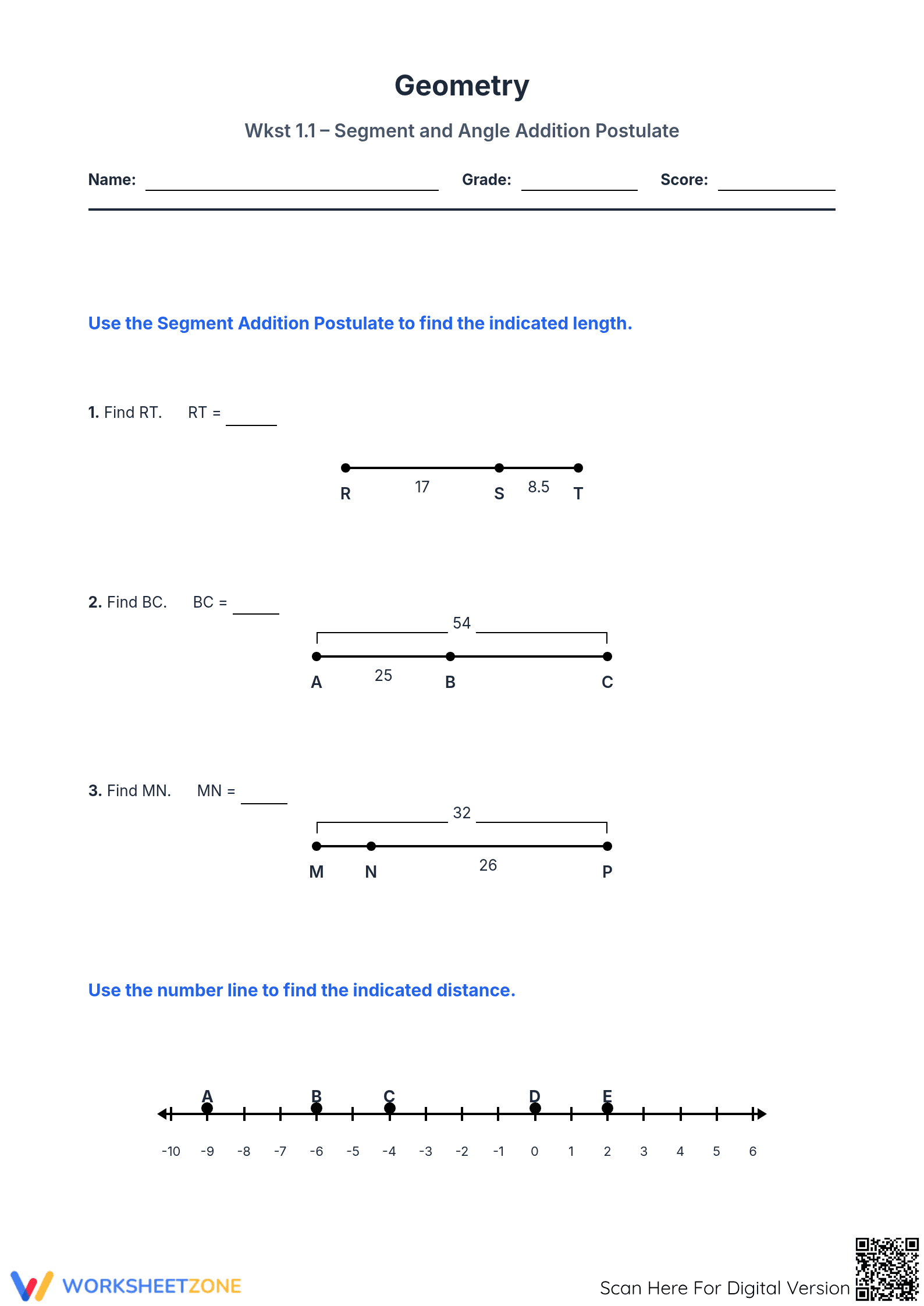


Printable Segment & Angle Addition Worksheet | Grade 8 Math

Paste this activity's link or code into your existing LMS (Google Classroom, Canvas, Teams, Schoology, Moodle, etc.).
Students can open and work on the activity right away, with no student login required.
You'll still be able to track student progress and results from your teacher account.
This comprehensive geometry worksheet helps students master the segment and angle addition postulates through targeted practice. By working through these problems, learners will transition from basic visual measurements to solving complex algebraic equations for unknown lengths and angles, building a strong foundation for advanced geometric proofs.
At a Glance
- Grade: 8 · Subject: Math
- Standard:
CCSS.MATH.CONTENT.7.G.B.5— Use facts about angles to write and solve equations- Skill Focus: Segment and Angle Addition Postulates
- Format: 5 pages · 23 problems · Answer key included · PDF
- Best For: Independent practice and homework
- Time: 35–45 minutes
This five-page printable packet includes 23 carefully sequenced problems that cover both segment and angle addition. Students will encounter a variety of task types, including number line distance calculations, algebraic segment addition, angle classification, and solving for unknown variables using complementary and supplementary angle relationships. A complete, multi-page answer key is provided to make grading fast and accurate.
- Guided practice: The first section introduces basic segment addition using given numerical values and simple number line distances to build initial confidence.
- Supported practice: Students progress to angle classification and basic angle addition, applying definitions of acute, obtuse, right, and straight angles.
- Independent practice: The final pages challenge learners with algebraic expressions, requiring them to set up and solve multi-step equations to find specific segment lengths and angle measures.
This gradual-release approach ensures students internalize the core concepts before tackling the algebraic applications in an I Do, We Do, You Do format.
Aligned to primary standard CCSS.MATH.CONTENT.7.G.B.5, this resource requires students to use facts about supplementary, complementary, vertical, and adjacent angles in a multi-step problem to write and solve simple equations for an unknown angle in a figure. Both standard codes can be copied directly into lesson plans, IEP goals, or district curriculum mapping tools.
Assign this versatile resource as independent practice after direct instruction on the addition postulates, or use the first two pages as a guided in-class activity. As a formative assessment tip, monitor how students set up their algebraic equations in problems 14-23; errors here often indicate a conceptual misunderstanding rather than an algebra mistake. Expect students to complete the packet in 35 to 45 minutes.
Designed primarily for 7th, 8th, and 9th-grade math students, this worksheet is ideal for learners beginning their formal geometry studies. The visual diagrams provide necessary scaffolding for visual learners, while the algebraic problems offer sufficient rigor for advanced students. Pair this packet with a visual anchor chart detailing complementary and supplementary angle definitions for maximum impact.
Research highlights the importance of integrating algebraic thinking into early geometry instruction to deepen mathematical comprehension. According to EdReports 2024, instructional materials that explicitly connect geometric postulates with algebraic equation solving significantly improve long-term retention of both skill sets. This worksheet applies that evidence-based strategy by requiring students to use facts about angles to write and solve equations, directly supporting CCSS.MATH.CONTENT.7.G.B.5. By transitioning learners from concrete numerical addition to abstract algebraic representations, educators can better prepare students for the rigorous demands of high school mathematics. The structured progression found in this resource ensures that foundational concepts are solidified before introducing complex variables, aligning with best practices for cognitive load management in STEM education and fostering greater mathematical fluency. This targeted approach builds the exact analytical skills required for advanced geometric proofs.


