




























Views
Downloads




Essential Segment Addition Postulate Worksheet | Geometry

Paste this activity's link or code into your existing LMS (Google Classroom, Canvas, Teams, Schoology, Moodle, etc.).
Students can open and work on the activity right away, with no student login required.
You'll still be able to track student progress and results from your teacher account.
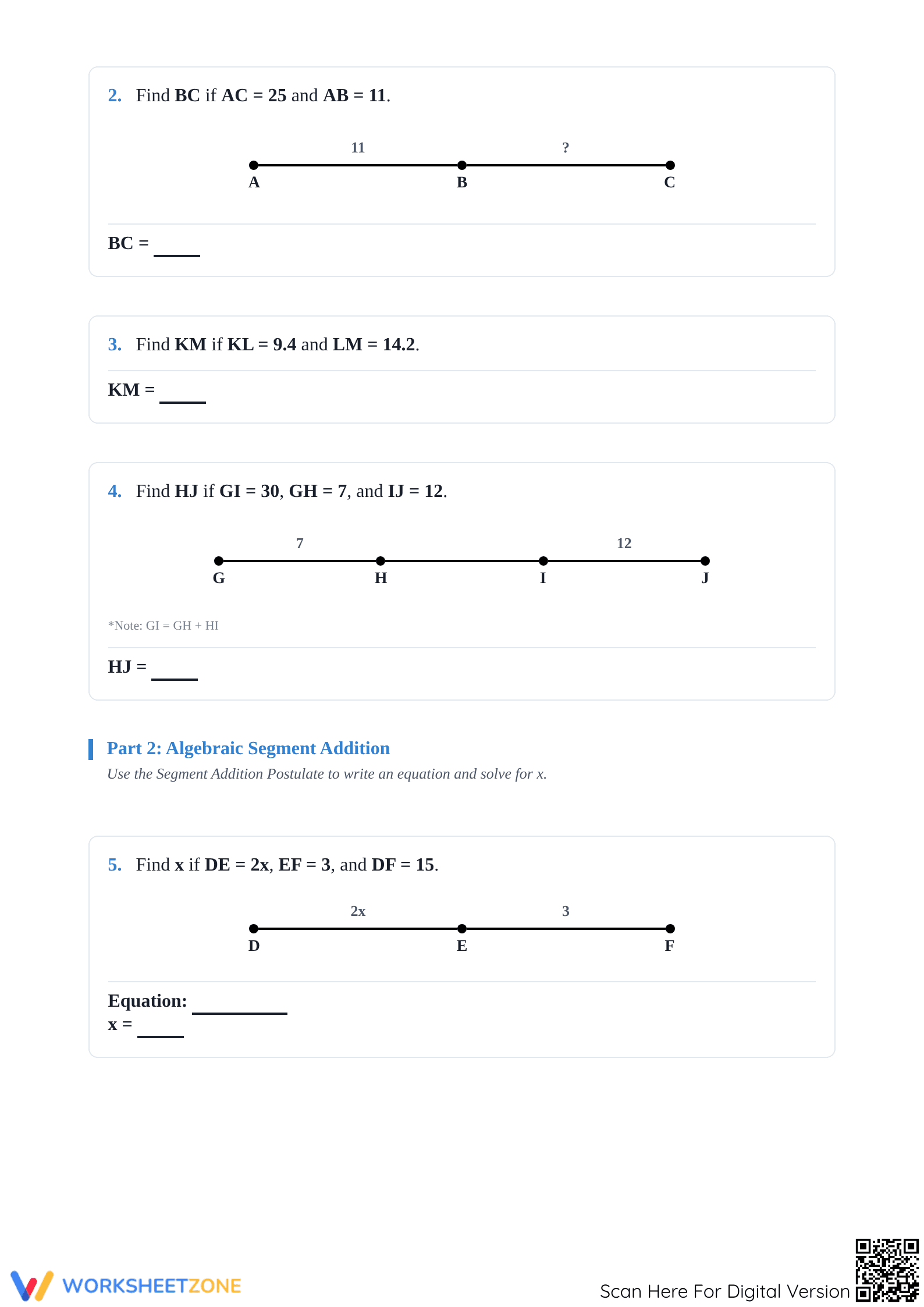
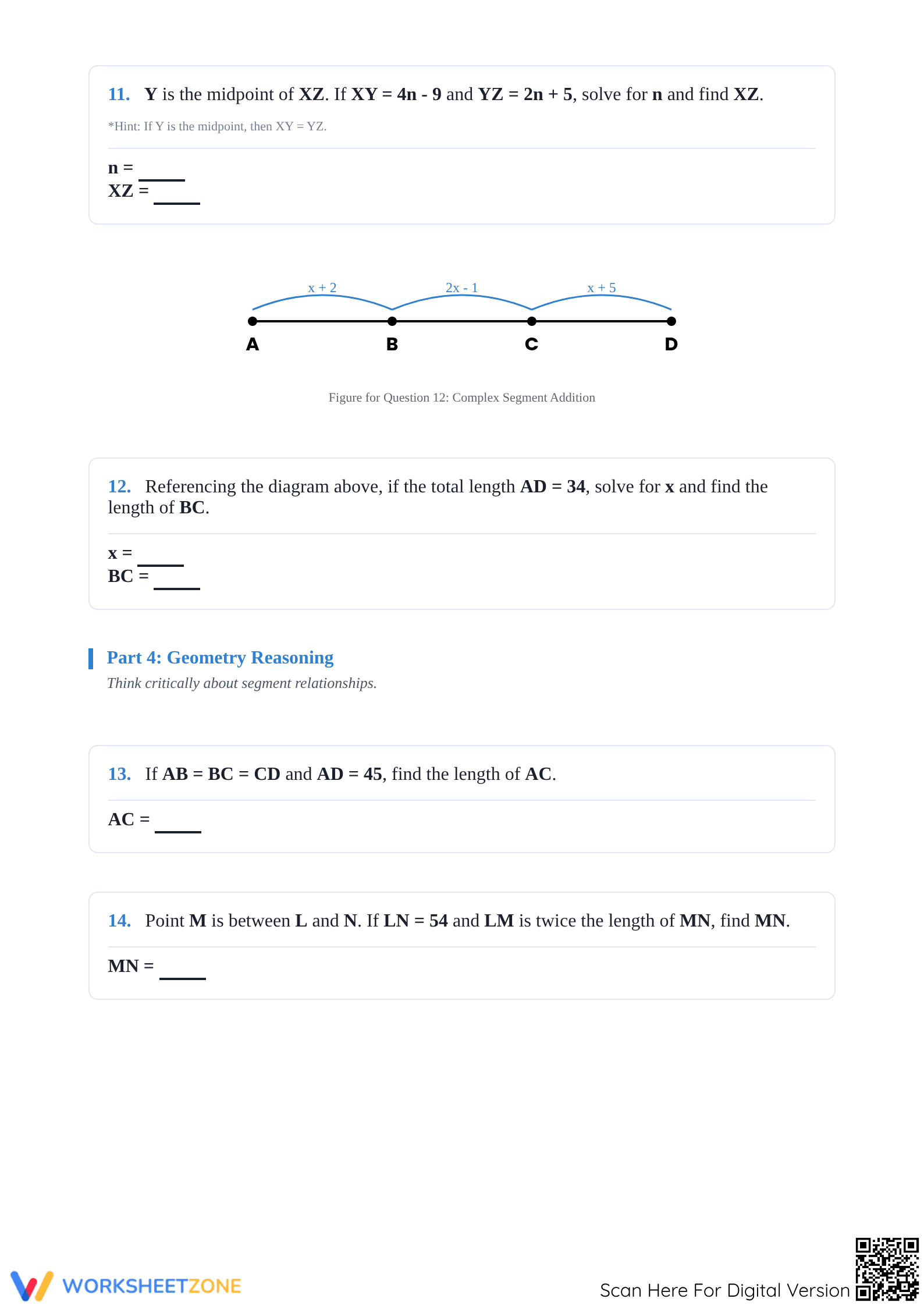
This comprehensive geometry practice set enables students to master the Segment Addition Postulate through a rigorous 15-problem sequence. By moving from basic numerical calculations to complex algebraic equations and geometric reasoning, learners develop a concrete understanding of collinearity and segment relationships. This resource ensures students can confidently solve for missing lengths in various mathematical contexts.
At a Glance
- Grade: 9 · Subject: Geometry
- Standard:
HSG-CO.A.1— Use definitions of line segments to solve for missing lengths and variables- Skill Focus: Segment Addition Postulate application
- Format: 5 pages · 15 problems · Answer key included · PDF
- Best For: Homework, quizzes, or independent geometry practice
- Time: 30–45 minutes
This high-quality printable features five structured pages of geometry content. It includes an instructional header with a visual model of the postulate ($AB + BC = AC$). Students encounter 15 problems ranging from simple addition to multi-step algebraic solving. The packet provides ample workspace for calculations and a full five-page answer key for immediate instructional feedback.
Zero-Prep Workflow
Implementing this resource takes less than two minutes of teacher preparation. First, print the document directly from the PDF or assign it through a digital platform. Students can begin working immediately as the first page contains a clear instructional anchor. Finally, use the provided answer key for rapid grading or self-correction during class. This streamlined workflow makes it an ideal choice for sudden substitute plans or essential formative assessments.
Standards Alignment
The worksheet is strictly aligned to HSG-CO.A.1, focusing on the properties and definitions of line segments. It also supports algebraic standards by requiring students to set up and solve linear equations based on geometric diagrams. This standard code can be copied directly into lesson plans, IEP goals, or district curriculum mapping tools.
How to Use It
Deploy this worksheet as a mid-lesson formative assessment after introducing the concept of collinear points. Teachers should observe students during Part 2 to ensure they are correctly translating geometric diagrams into algebraic equations. Alternatively, use it as a standalone homework assignment to reinforce the "I Do, We Do, You Do" instructional cycle initiated during direct geometry lectures.
Who It's For
Designed primarily for Grade 9 Geometry students, this resource is also suitable for middle school Algebra 1 students exploring geometric applications. The clear visual models support English Language Learners and students with IEPs by providing a constant reference point. Pair this with a segment addition anchor chart for a complete instructional package.
The Segment Addition Postulate serves as a foundational building block for geometric proof and spatial reasoning. According to a ScienceDirect TpT Analysis, structured practice that bridges the gap between numerical computation and algebraic abstraction significantly improves student retention of geometric postulates. This worksheet facilitates that transition by requiring students to apply the HSG-CO.A.1 standard across four distinct levels of cognitive demand. By solving 15 targeted problems, learners move beyond rote memorization toward a conceptual understanding of how segments combine to form larger units. The inclusion of midpoint problems and multi-segment diagrams ensures that students are prepared for more advanced coordinate geometry and trigonometric applications. Educators can utilize these findings to justify the use of scaffolded practice sets in diverse classroom settings, ensuring all learners meet the rigorous demands of modern college and career readiness standards.


