




























Views
Downloads


Printable Grade 8 Segment Addition Postulate Worksheet

Paste this activity's link or code into your existing LMS (Google Classroom, Canvas, Teams, Schoology, Moodle, etc.).
Students can open and work on the activity right away, with no student login required.
You'll still be able to track student progress and results from your teacher account.
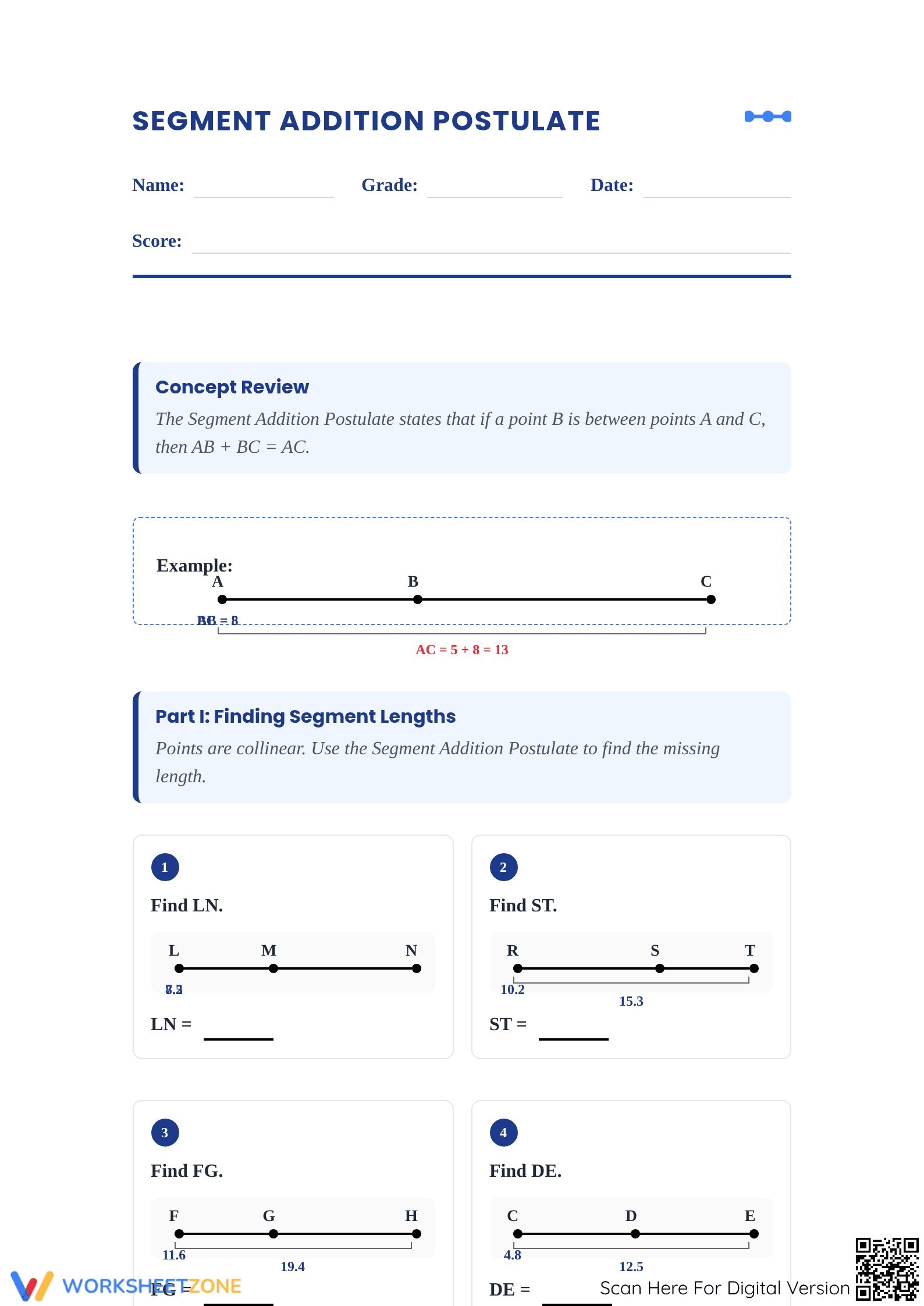
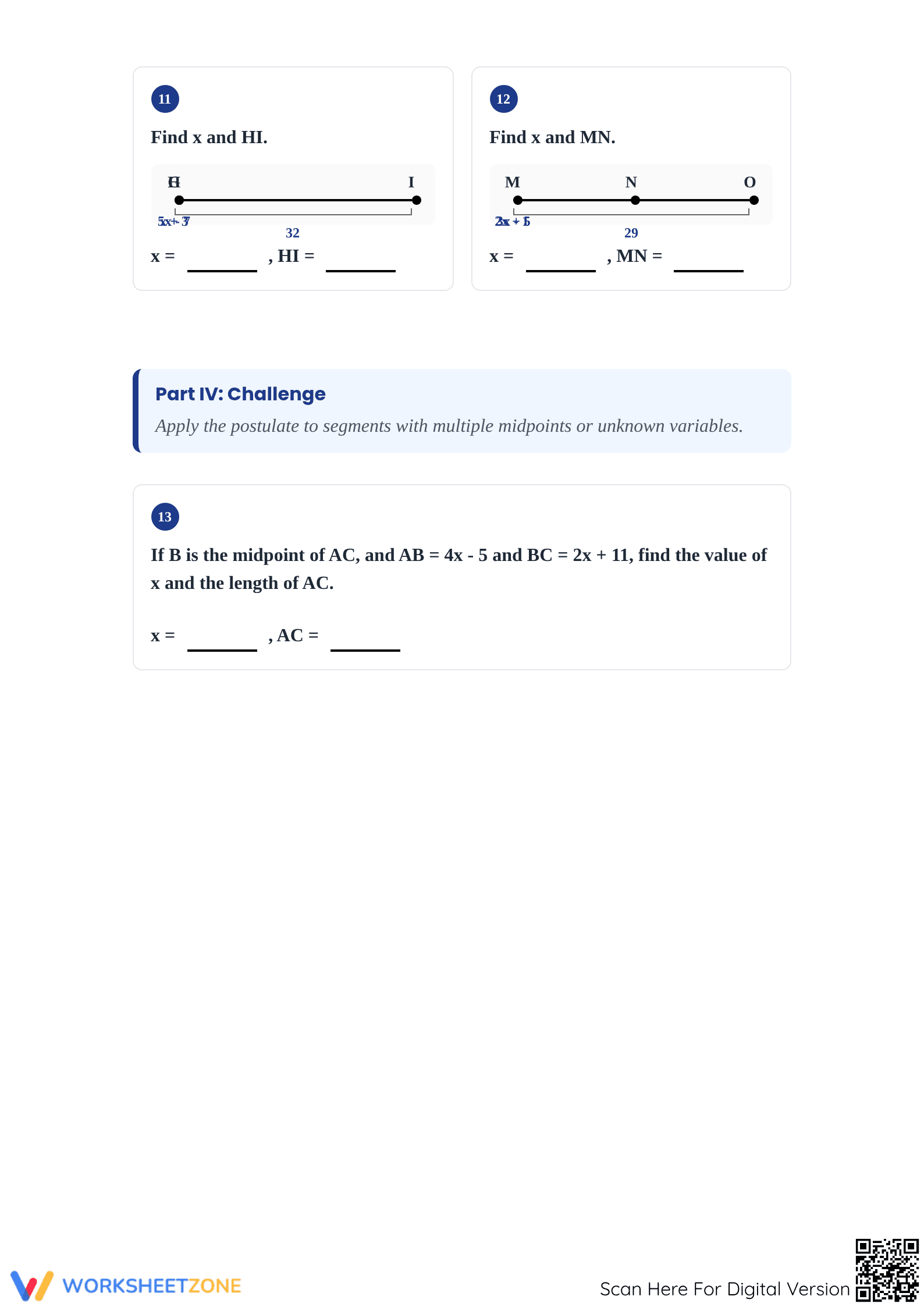
This Segment Addition Postulate worksheet provides students with targeted practice in calculating unknown lengths within collinear line segments. By applying the formula AB + BC = AC, learners move from basic numerical problems to solving multi-step algebraic equations. This resource ensures mastery of foundational geometry concepts required for higher-level proofs.
At a Glance
- Grade: 8 · Subject: Geometry
- Standard:
CCSS.MATH.CONTENT.HSG.CO.A.1— Use geometric definitions to solve for unknown lengths and points- Skill Focus: Segment Addition Postulate
- Format: 3 pages · 13 problems · Answer key included · PDF
- Best For: Homework, sub plans, or remedial practice
- Time: 25–35 minutes
This comprehensive 3-page PDF features 13 distinct problems organized into four scaffolded sections. It begins with basic segment length identification and progresses into algebraic value-finding for x. The worksheet includes clear visual diagrams for every task, a dedicated concept review section, a challenging midpoint application problem, and a complete answer key for rapid grading.
Zero-Prep Workflow
The zero-prep design allows teachers to implement this lesson in under two minutes. First, print the desired number of copies and hit print in roughly 30 seconds. Second, distribute the scaffolded pages to students during independent practice sessions. Finally, use the included answer key to provide immediate corrective feedback or display it for student self-grading to maximize classroom efficiency.
Standards Alignment
The primary alignment is CCSS.MATH.CONTENT.HSG.CO.A.1, which requires students to understand and use formal geometric definitions. This worksheet specifically addresses the relationship between collinear points and additive segment properties. Both standard codes can be copied directly into lesson plans, IEP goals, or district curriculum mapping tools.
How to Use It
Use this worksheet as a formative assessment during a geometry unit. After direct instruction, assign the first four problems as a check for understanding to observe if students correctly identify the part-part-whole relationship. For a second use case, include it in an emergency sub plan; the included concept review box allows students to work independently with minimal teacher guidance.
Who It's For
This resource is designed for Grade 8 and high school geometry students beginning their study of Euclid’s postulates. It provides excellent remediation for students struggling with algebraic applications in geometry. Pair this worksheet with a coordinate plane anchor chart or a segment addition digital passage for a complete instructional block.
The segment addition postulate serves as a fundamental building block in geometric proofs and algebraic reasoning, requiring students to synthesize collinearity with additive properties. This 3-page resource aligns with CCSS.MATH.CONTENT.HSG.CO.A.1, focusing on the formal definition of points, lines, and segments. By progressing from simple numerical addition to complex algebraic equations involving variables, students develop the procedural fluency necessary for higher-order geometric modeling. Research from RAND AIRS 2024 indicates that structured, scaffolded practice in early geometry significantly improves long-term retention of spatial reasoning skills. The worksheet provides 13 targeted tasks that bridge the gap between basic arithmetic and formal algebraic manipulation in a geometric context. Teachers can utilize this printable PDF to verify student understanding of segment relationships before transitioning to more complex proofs. The inclusion of a comprehensive answer key ensures that feedback is immediate and accurate, supporting a mastery-based learning environment.


