


























Views
Downloads
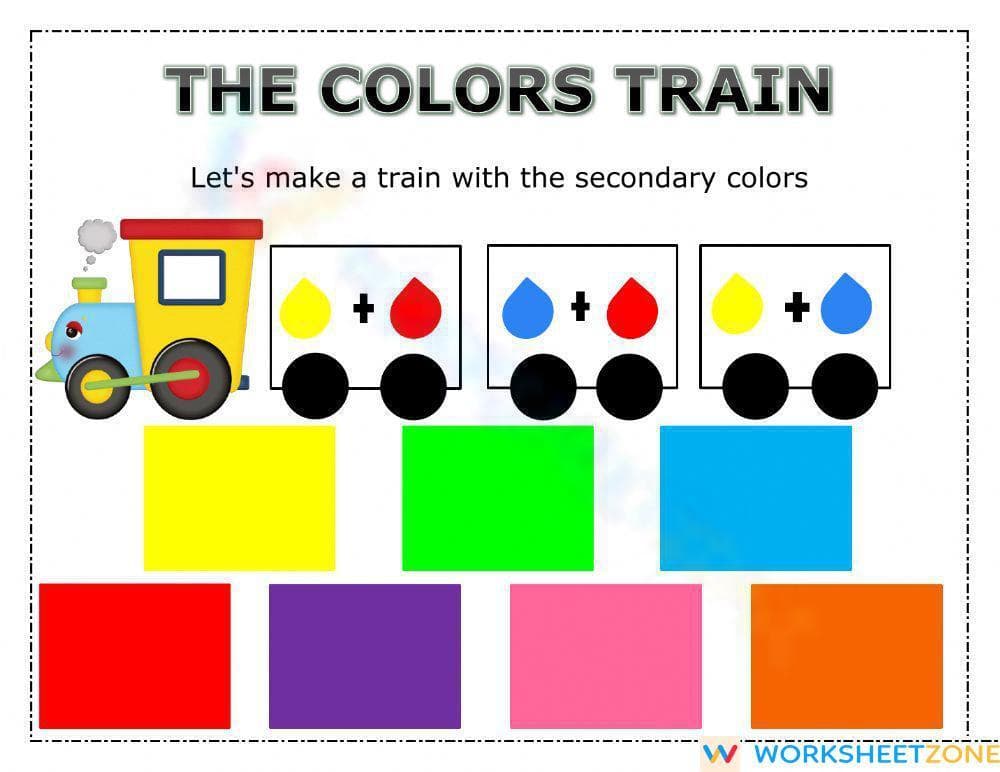

Grade K Secondary Colors — Printable No-Prep Worksheet
Paste this activity's link or code into your existing LMS (Google Classroom, Canvas, Teams, Schoology, Moodle, etc.).
Students can open and work on the activity right away, with no student login required.
You'll still be able to track student progress and results from your teacher account.
This interactive secondary colors worksheet helps kindergarten students master color mixing through a train-themed activity. By identifying how primary colors combine to create orange, green, and purple, learners develop visual discrimination and vocabulary. It provides a structured way to explore foundational art concepts while reinforcing basic logic.
At a Glance
- Grade: K · Subject: ELA/Others
- Standard:
CCSS.ELA-LITERACY.L.K.5.A— Sort common objects into categories to gain a sense of concepts- Skill Focus: Secondary color identification and mixing
- Format: 1 page · 3 problems · Answer key included · PDF
- Best For: Early childhood color recognition and vocabulary
- Time: 10–15 minutes
What's Inside
This single-page PDF features a "Colors Train" with three distinct cars representing color mixing equations. Students observe primary color drops and select the correct secondary color to complete the train. The worksheet includes a visual word bank of colored squares at the bottom to support independent work and ensure a high success rate.
Zero-Prep Workflow
- Step 1: Print (30 seconds): Open the PDF and print copies for your class.
- Step 2: Distribute (30 seconds): Hand out sheets with crayons or markers.
- Step 3: Review (1 minute): Use the answer key to quickly check work or guide discussion.
Total teacher prep time is under two minutes, making it ideal for sub plans or quick transitions.
Standards Alignment
This resource aligns with `CCSS.ELA-LITERACY.L.K.5.A`, focusing on sorting common objects into categories to gain a sense of representational concepts. By grouping colors into primary and secondary sets, students build cognitive frameworks for vocabulary. This code can be copied directly into lesson plans, IEP goals, or district curriculum mapping tools.
How to Use It
Assign this during guided practice or as an art center activity. It is effective after a live paint-mixing demonstration. For a formative assessment tip, observe if students can name the secondary colors before coloring, indicating vocabulary mastery. Completion typically takes 10 to 15 minutes.
Who It's For
This is designed for preschool and kindergarten students exploring color theory. It is especially beneficial for English Language Learners needing visual support to connect vocabulary with concepts. Pair this with a color-mixing kit or a picture book for a comprehensive multi-sensory experience.
The development of color categorization skills in early childhood is a critical milestone for cognitive growth and vocabulary acquisition. According to research from Fisher & Frey (2014), the use of visual scaffolds and graphic organizers—like the train model used here—facilitates the gradual release of responsibility from teacher to student. By engaging with `CCSS.ELA-LITERACY.L.K.5.A` through 3 targeted color-mixing tasks, students transition from simple recognition to conceptual understanding. This approach aligns with the RAND AIRS 2024 findings on the effectiveness of interactive, high-interest themes in increasing student engagement and retention of new terminology. The "Colors Train" format provides a concrete anchor for abstract color theory concepts, ensuring that learners can recall and apply these primary and secondary color relationships in future artistic and academic contexts. This worksheet serves as a reliable tool for early childhood educators seeking research-backed methods to teach foundational categorization.


