


























Views
Downloads

Printable Addition to 10 Worksheet | Kindergarten Math
Paste this activity's link or code into your existing LMS (Google Classroom, Canvas, Teams, Schoology, Moodle, etc.).
Students can open and work on the activity right away, with no student login required.
You'll still be able to track student progress and results from your teacher account.
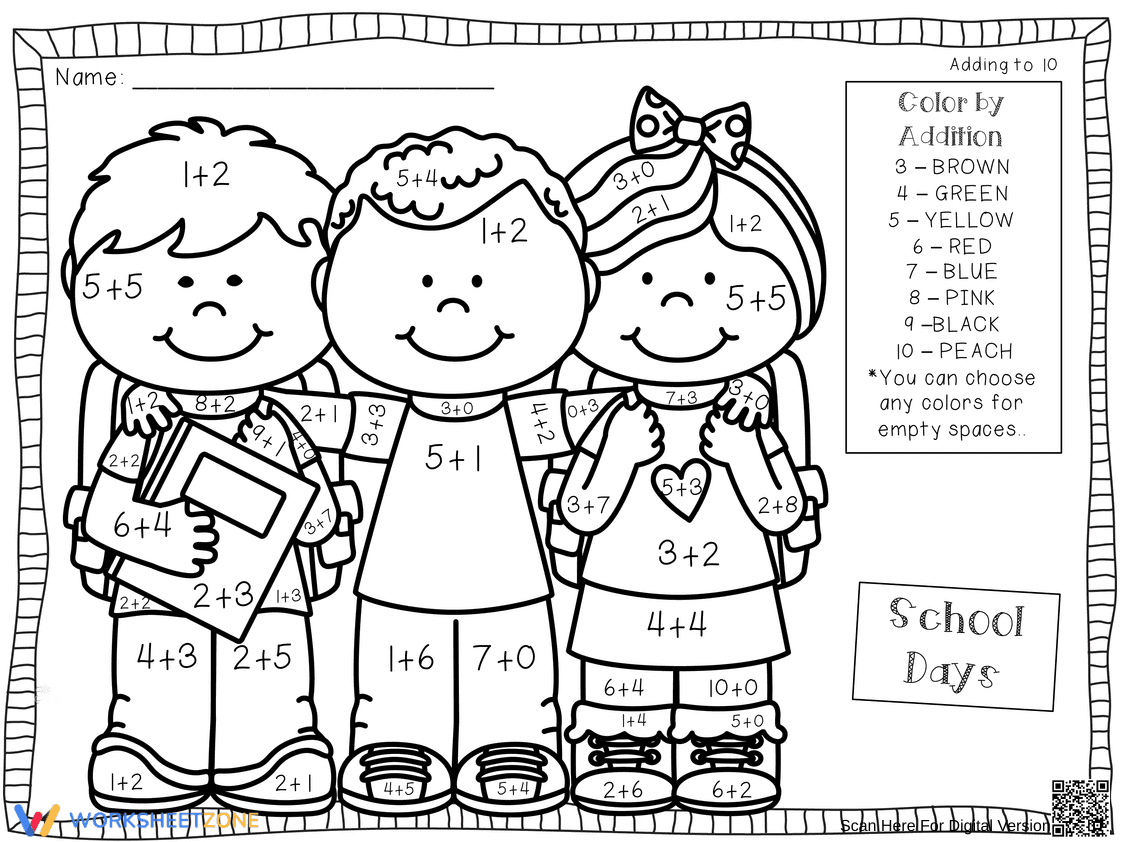
This engaging color-by-number worksheet helps young learners master addition facts within 10 while building fine motor skills. Students solve simple math equations to reveal a fun, school-themed illustration, turning essential arithmetic practice into an enjoyable artistic activity that reinforces early number sense and fact fluency.
At a Glance
- Grade: Kindergarten · Subject: Math
- Standard:
CCSS.MATH.CONTENT.K.OA.A.2— Add and subtract within 10- Skill Focus: Addition within 10
- Format: 1 page · 30 problems · Answer key included · PDF
- Best For: Independent practice and math centers
- Time: 15–20 minutes
This single-page resource features a delightful illustration of three students ready for school, divided into approximately 30 distinct sections. Each section contains a basic addition problem with sums ranging from 3 to 10. A clear, easy-to-read color key is provided on the right side of the page, guiding students to color each section based on the calculated sum. A complete answer key is included to facilitate quick grading and self-checking.
Designed for maximum efficiency, this resource requires no teacher setup:
- Print (1 minute): Download the PDF and print copies. The design is ink-friendly.
- Distribute (1 minute): Hand out sheets with crayons. Instructions are self-explanatory.
- Review (1 minute): Use the answer key to verify patterns quickly.
With prep time under two minutes, this is an ideal option for sub plans.
This activity is directly aligned to CCSS.MATH.CONTENT.K.OA.A.2, requiring students to solve addition problems within 10. It also supports early Grade 1 fluency standards by encouraging rapid recall of basic math facts. Both standard codes can be copied directly into lesson plans, IEP goals, or district curriculum mapping tools.
Incorporate this worksheet directly into your daily routine. It serves as an excellent morning work activity, allowing students to settle in quietly while practicing core math skills before direct instruction begins. Alternatively, use it as an engaging math center station where students can work independently. As a formative assessment tip, observe students while they work to identify those who are still relying heavily on finger counting versus those who have achieved mental fact fluency. Expect students to complete the coloring and math tasks within 15 to 20 minutes.
This resource is primarily designed for Kindergarten and early first-grade students developing their foundational arithmetic skills. The visual nature of the color-by-number format provides built-in differentiation, as the emerging picture acts as a self-correcting mechanism for visual learners. It pairs perfectly with hands-on manipulatives, such as counting blocks or ten frames, allowing students who need extra concrete support to solve the equations before coloring.
Developing early fact fluency through engaging, repetitive practice is a critical component of primary mathematics education. This resource targets CCSS.MATH.CONTENT.K.OA.A.2, focusing on the ability to add and subtract within 10. According to EdReports 2024, instructional materials that integrate visual representations with arithmetic practice significantly improve young learners' number sense and long-term retention of basic facts. By combining mathematical problem-solving with a creative coloring task, this worksheet reduces math anxiety and promotes sustained attention during independent work periods. The color-by-number format provides immediate visual feedback, reinforcing correct calculations and encouraging self-correction. Consistent practice with these foundational skills ensures students build the cognitive automaticity required for more complex mathematical operations in subsequent grades, making this an essential, research-backed tool for early childhood educators aiming to solidify core competencies.


