


























Views
Downloads



SAT Vocab 9-10 Practice Test | Essential ELA Guide
Paste this activity's link or code into your existing LMS (Google Classroom, Canvas, Teams, Schoology, Moodle, etc.).
Students can open and work on the activity right away, with no student login required.
You'll still be able to track student progress and results from your teacher account.
Master College-Ready Vocabulary with Rigorous Practice
This academic vocabulary assessment empowers students to master high-level terms common in SAT preparation and college-level coursework. By focusing on semantic nuances rather than simple definitions, this worksheet ensures students can apply advanced language in multiple contexts. Students move from identifying opposites to synthesizing complex word pairs and creative narrative writing.
At a Glance
- Grade: 9–12 · Subject: English Language Arts
- Standard:
CCSS.ELA-LITERACY.L.9-10.6— Acquire and use academic words for college and career readiness- Skill Focus: Advanced SAT Vocabulary Acquisition
- Format: 5 pages · 13 tasks · Narrative writing component · PDF
- Best For: Honors English or SAT Prep intensives
- Time: 35–45 minutes
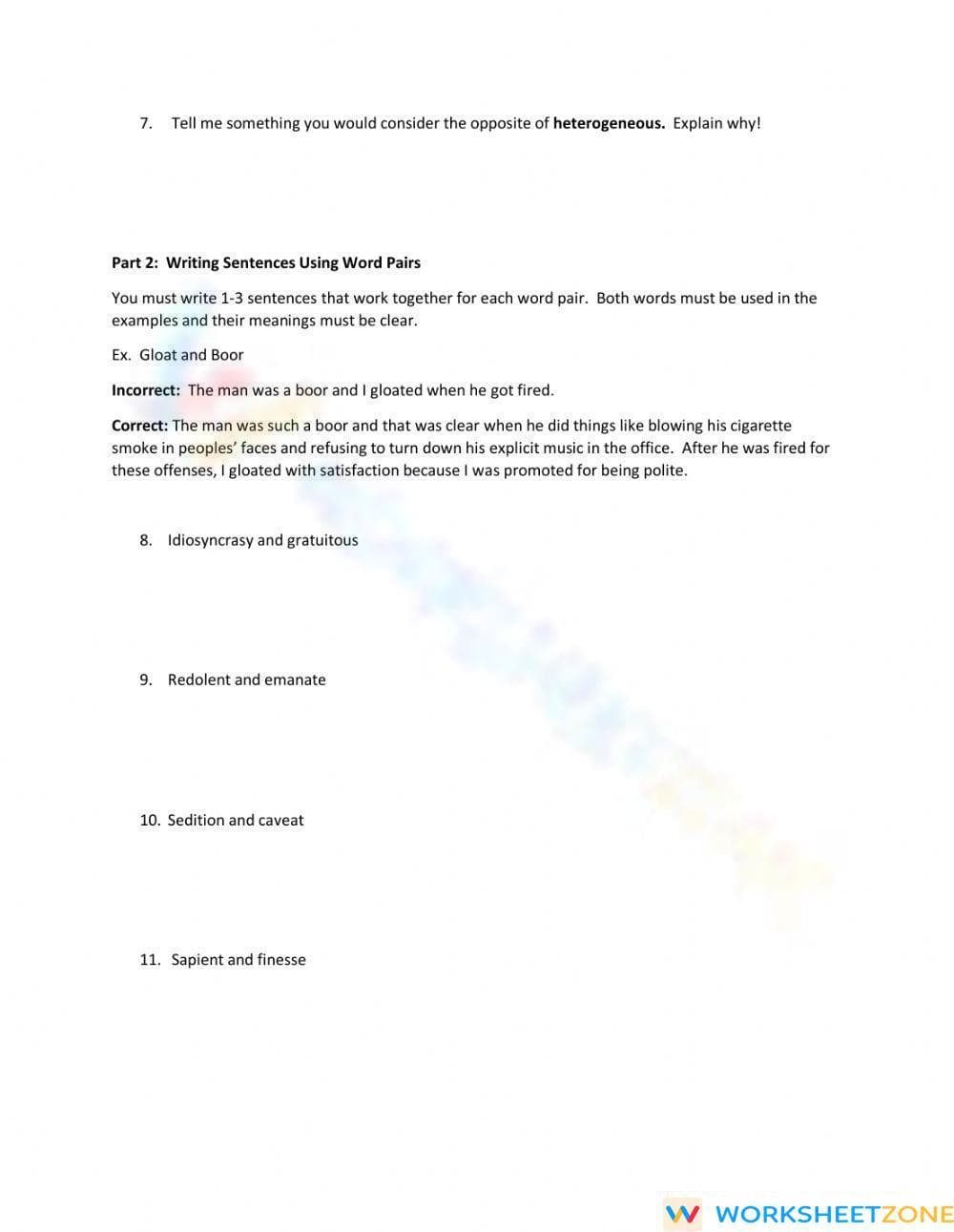
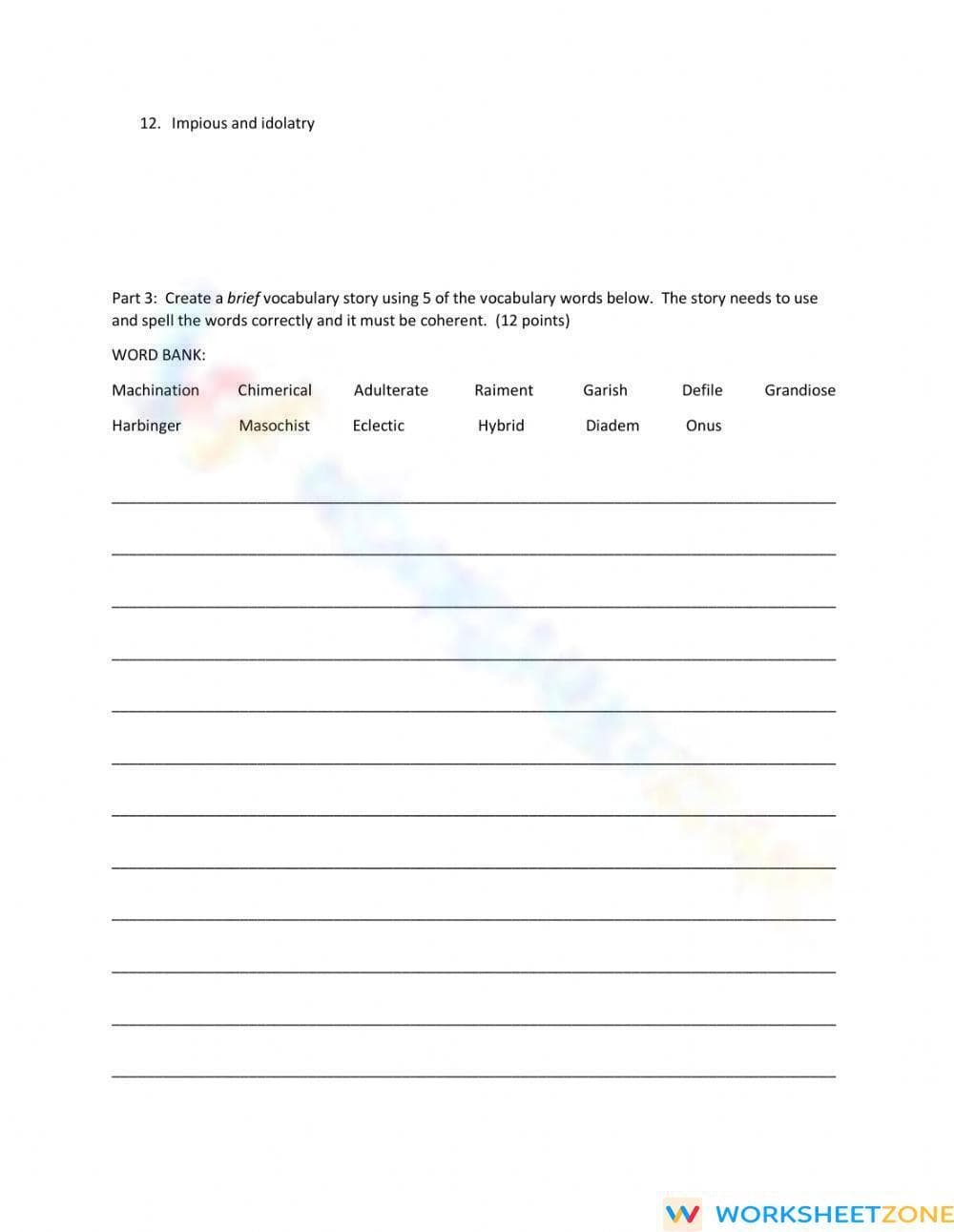
Inside this comprehensive 5-page PDF, you will find a three-part assessment designed for deep linguistic engagement. Part 1 features 7 antonym challenges where students must explain the opposite of words like "pejorative" and "immutable." Part 2 requires writing 1-3 sentences for 5 distinct word pairs, such as "sedition and caveat." The final section provides a 14-word bank for a creative narrative task.
Scaffolded Skill Progression
- Guided Practice: 7 detailed antonym prompts guide students to explain opposites for words like "immutable." This ensures semantic depth over simple recall by requiring situational examples.
- Supported Practice: 5 sentence-writing tasks require pairing complex terms (e.g., "sedition and caveat"). This scaffolds the ability to use academic language in complex syntax.
- Independent Practice: A final creative story task using 5 of 14 words from a bank demands total independence. This 13-task sequence ensures students move from recognition to production.
This gradual release approach ensures students are not just memorizing synonyms but are developing the flexible word knowledge required for high-stakes testing.
Standards Alignment
This resource is centered on CCSS.ELA-LITERACY.L.9-10.6, which requires students to "Acquire and use accurately general academic and domain-specific words and phrases, sufficient for reading, writing, speaking, and listening at the college and career readiness level." Both standard codes can be copied directly into lesson plans, IEP goals, or district curriculum mapping tools.
How to Use It
Use this worksheet as a summative assessment at the end of a vocabulary unit or as a pre-test to gauge student readiness for SAT-level texts. During the session, observe how students handle the word pairs in Part 2; those who struggle to link terms like "redolent" and "emanate" may need more practice with semantic mapping. Expect completion in approximately 40 minutes.
Who It's For
This material is tailored for Grade 9 through Grade 12 students in Honors or Advanced Placement tracks. It is also an ideal resource for SAT prep workshops. To differentiate for students requiring more support, pair this worksheet with a vocabulary anchor chart or a short passage that uses these words in context.
Academic success in high school and beyond relies heavily on a student's ability to navigate sophisticated texts through robust vocabulary acquisition. This SAT Vocab 9-10 Test is designed to move beyond rote memorization by requiring students to explain antonyms, construct context-rich sentences with specific word pairs, and synthesize new terms into a coherent narrative. According to research by Fisher & Frey (2014), effective vocabulary instruction must involve generative tasks where students use words in novel ways to solidify their mental lexicons. By aligning with CCSS.ELA-LITERACY.L.9-10.6, this resource ensures that Grade 9-12 students practice the high-level semantic processing necessary for college-level reading. The structured progression from antonym identification to creative application provides a rigorous framework for developing academic language. Teachers can use this assessment to identify gaps in word knowledge and provide targeted interventions before high-stakes testing.


