




























Views
Downloads

Printable Safari Comparing Numbers Worksheet | Kindergarten

Paste this activity's link or code into your existing LMS (Google Classroom, Canvas, Teams, Schoology, Moodle, etc.).
Students can open and work on the activity right away, with no student login required.
You'll still be able to track student progress and results from your teacher account.
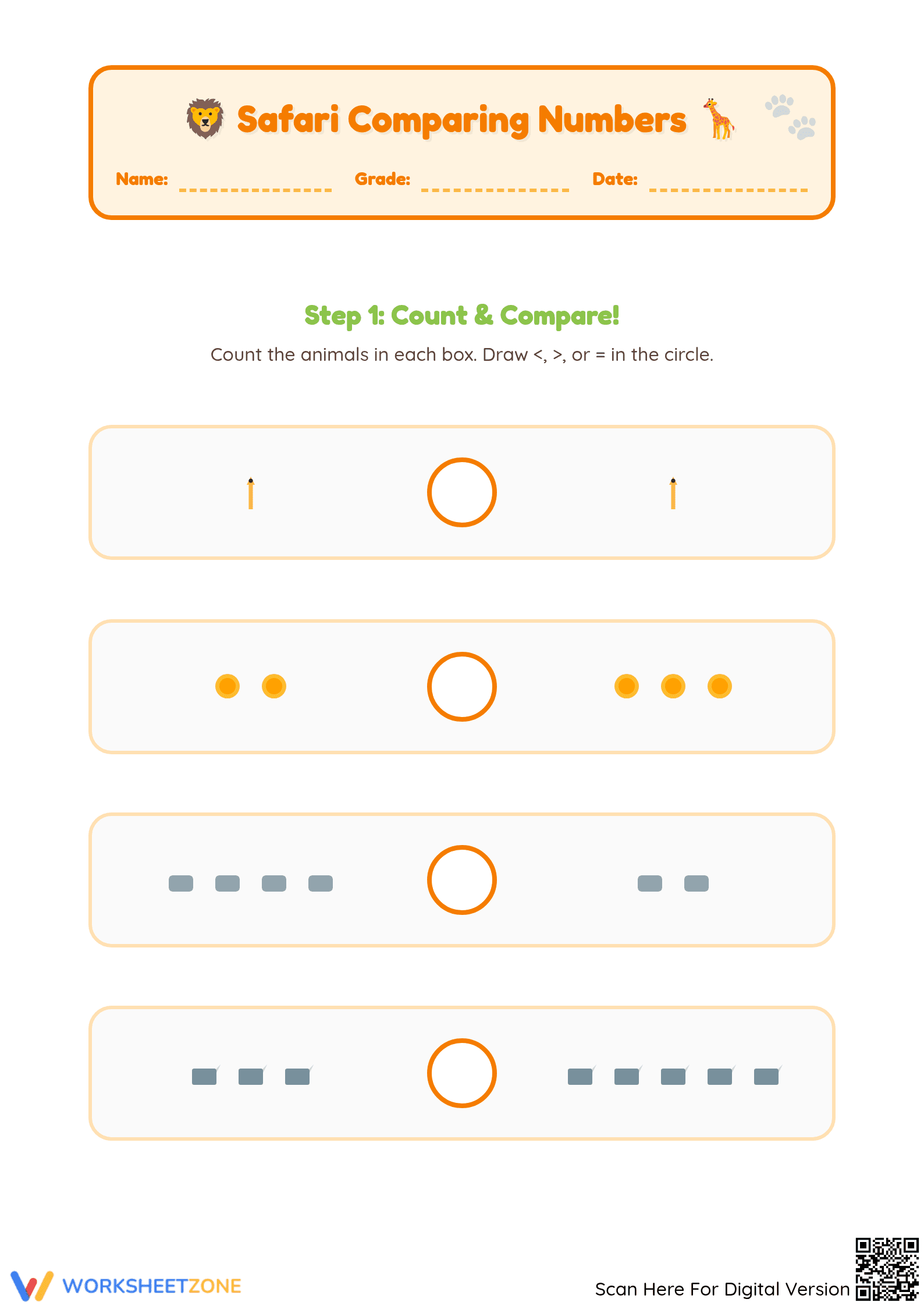
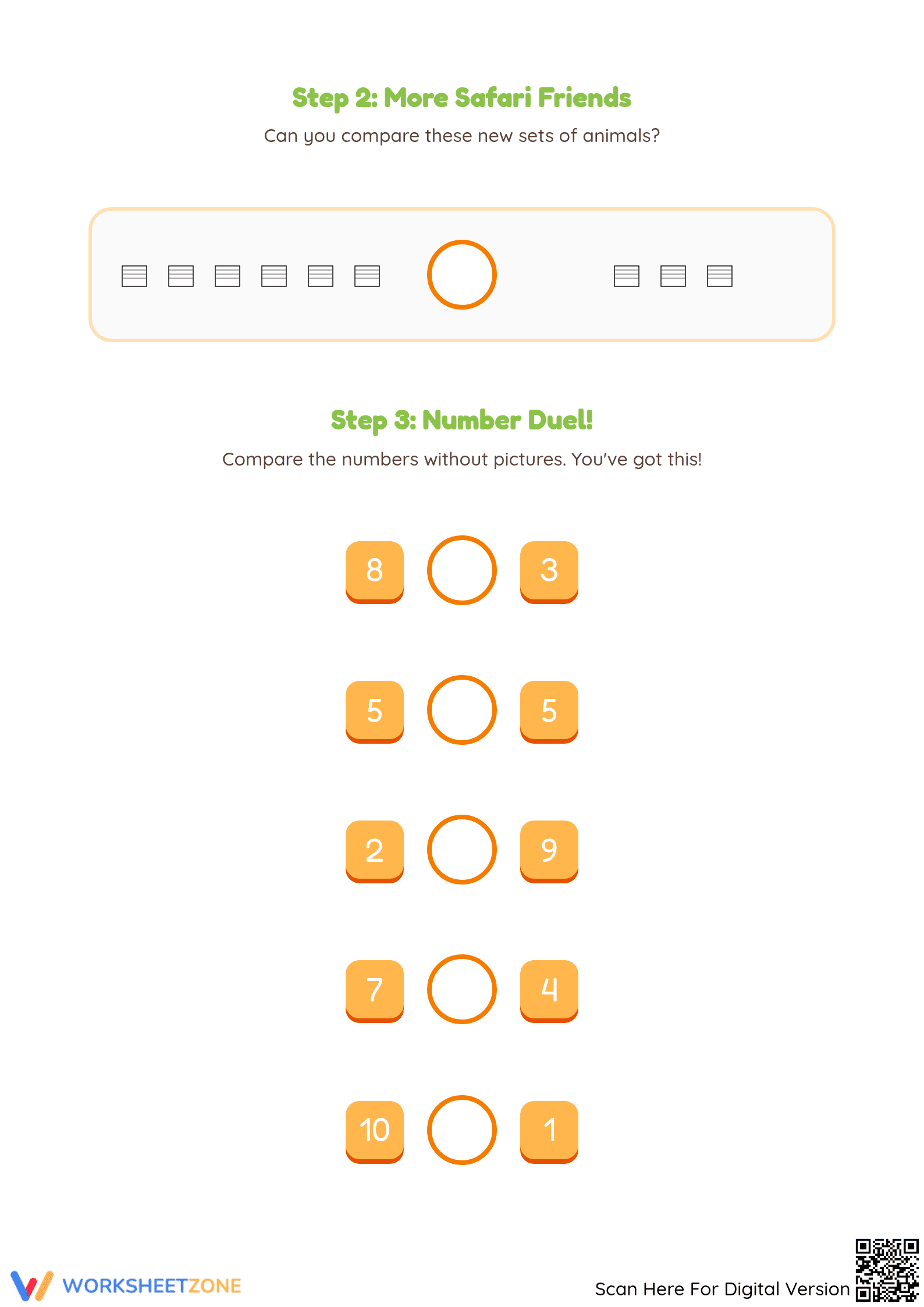
This printable Kindergarten math worksheet helps young learners master the concept of comparing quantities and numerals up to 10 through an engaging safari theme. Students transition from counting physical objects to comparing abstract numbers using the greater than, less than, and equal to symbols. It is an effective tool for building early number sense and mathematical fluency.
At a Glance
- Grade: K · Subject: Math
- Standard:
K.CC.C.7— Compare two numbers between 1 and 10 presented as written numerals- Skill Focus: Comparing Quantities and Numerals
- Format: 2 pages · 10 problems · Answer key included · PDF
- Best For: Independent math centers and quick formative checks
- Time: 10–15 minutes
The worksheet consists of two high-quality PDF pages designed with a clean, animal-themed layout to maintain student interest. Page one features Step 1, where students count groups of safari-themed icons to determine relationships. Page two contains Step 2 for continued visual comparison and Step 3, the "Number Duel," where students compare digits without pictorial support. A comprehensive answer key is included for rapid grading or student self-correction.
This resource is designed for an immediate, zero-prep classroom workflow that saves teachers valuable time. First, print the two-page PDF (approximately 15 seconds). Next, distribute the sheets to students with a brief reminder of how to use the <, >, and = symbols (under 1 minute). Finally, review the completed work using the included answer key to identify students who may need additional support with number relationships (under 1 minute).
The primary alignment is K.CC.C.7: "Compare two numbers between 1 and 10 presented as written numerals." The worksheet also supports K.CC.C.6 by requiring students to identify whether the number of objects in one group is greater than, less than, or equal to the number of objects in another group. Both standard codes can be copied directly into lesson plans, IEP goals, or district curriculum mapping tools.
Use this worksheet during the "You Do" phase of a gradual release lesson to verify that students can independently apply comparison symbols. It also serves as an excellent formative assessment observation tool; teachers can watch students as they count icons to see if they are using one-to-one correspondence or subitizing. The expected completion time for the full 10-problem set is 10 to 15 minutes.
This resource is ideal for Kindergarten students and 1st-grade learners who require a review of basic number relationships. It is particularly useful for students needing visual scaffolds before moving to abstract numeral comparison. Pair this worksheet with a physical animal manipulative set or a number line anchor chart to provide additional sensory support for diverse learners in the classroom.
Educational research, such as the NAEP framework for early mathematics, emphasizes that comparing quantities is a foundational step toward understanding the base-ten system and operations. By moving from concrete representations (safari animal icons) to abstract symbols, this worksheet follows the research-backed Concrete-Representational-Abstract (CRA) instructional sequence described by Fisher & Frey (2014). Students who master the K.CC.C.7 standard early demonstrate higher proficiency in later place-value tasks. This printable resource provides exactly the kind of focused practice needed to solidify these mental models. The combination of visual counting and numeral comparison ensures that the plain-English skill of identifying larger and smaller values is deeply internalized. Teachers can confidently use this aligned tool knowing it meets rigorous quality standards for Kindergarten numeracy development, providing 10 high-quality tasks that lead directly to mathematical mastery.


