


























Views
Downloads

Printable Living and Nonliving Things Worksheet | Grade K
Paste this activity's link or code into your existing LMS (Google Classroom, Canvas, Teams, Schoology, Moodle, etc.).
Students can open and work on the activity right away, with no student login required.
You'll still be able to track student progress and results from your teacher account.
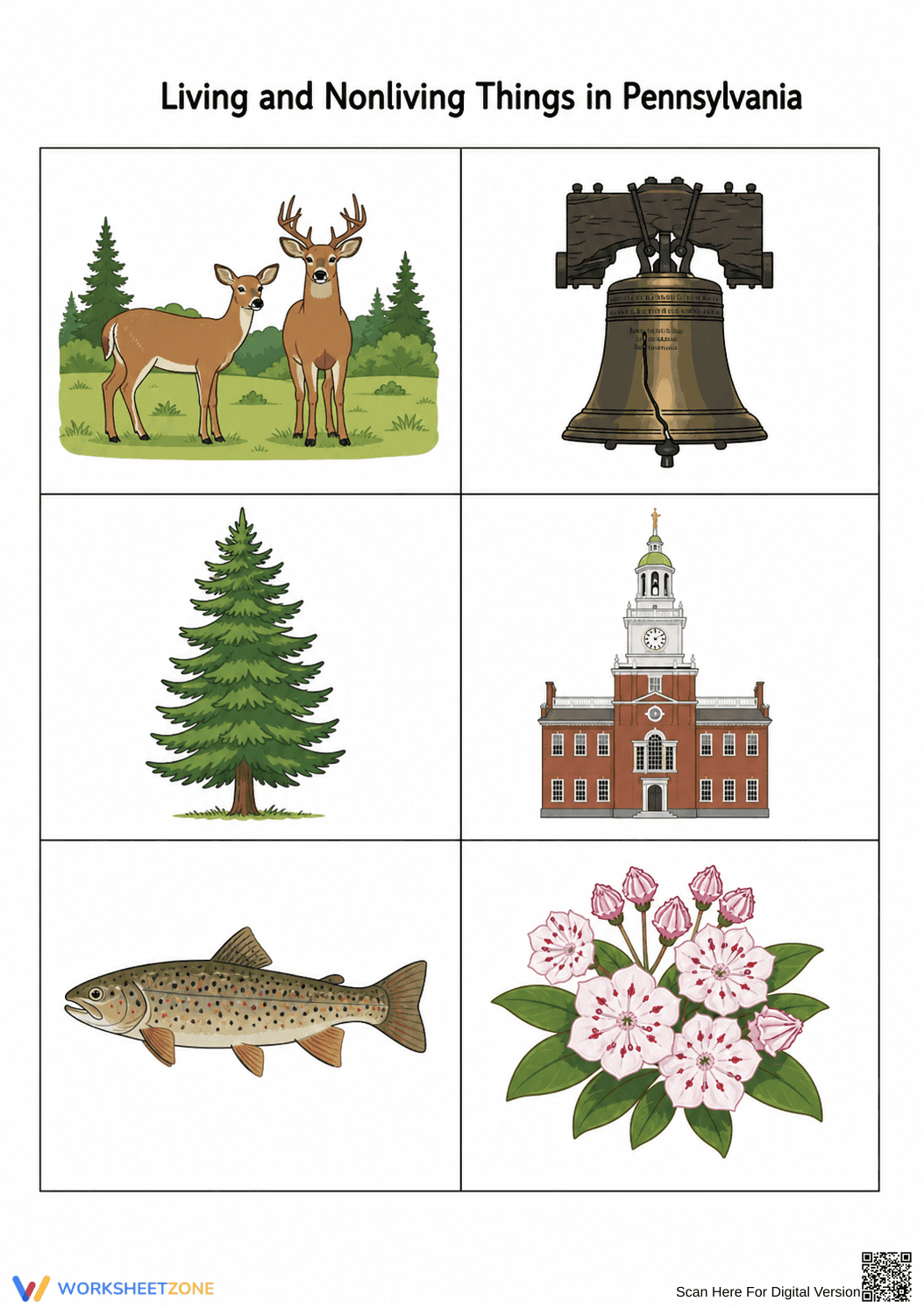
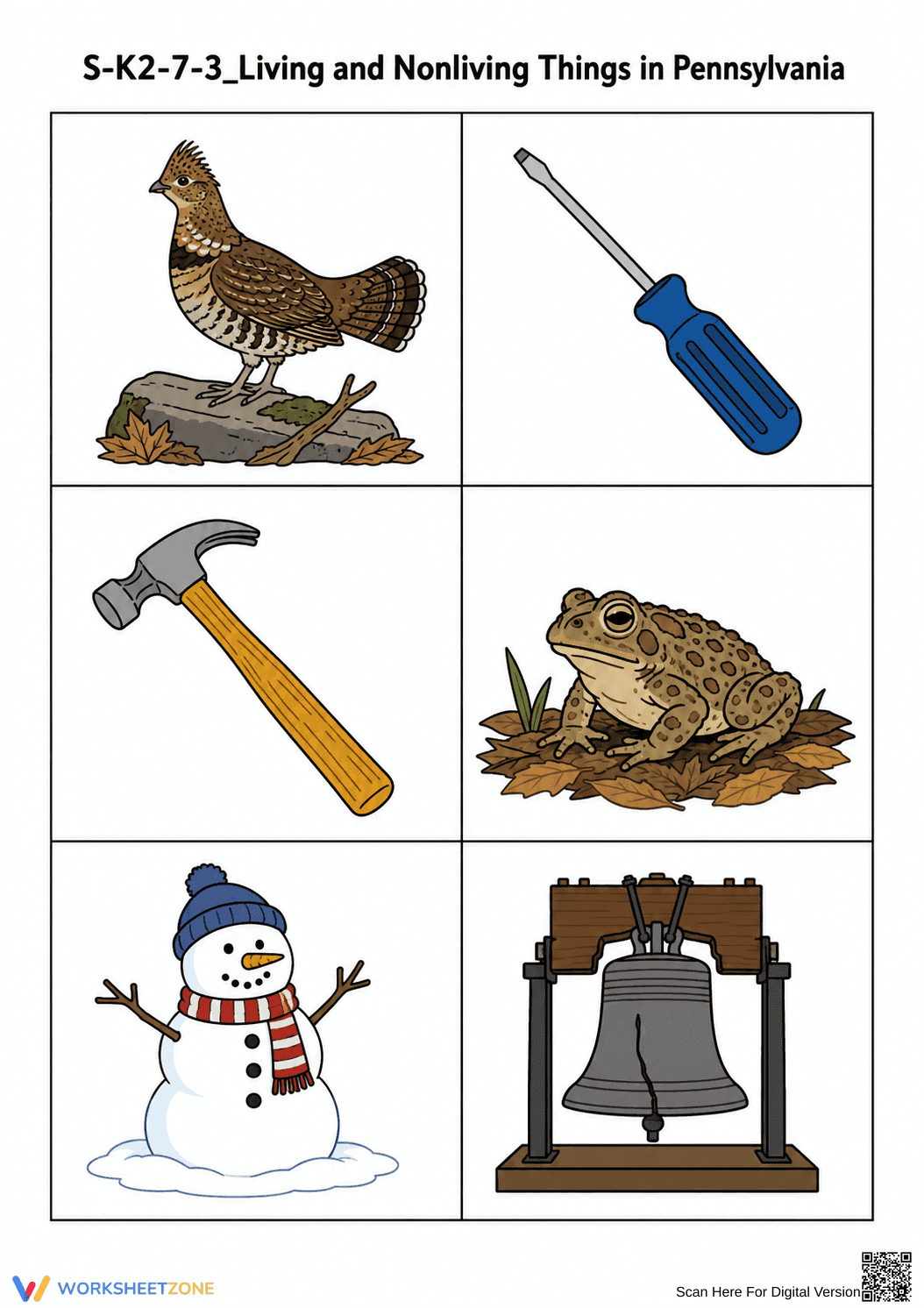
This Kindergarten science worksheet helps students distinguish between living and nonliving things using familiar Pennsylvania symbols. By analyzing 12 distinct images, young learners will practice foundational observation skills and categorize objects based on biological characteristics, setting the stage for deeper life science comprehension.
At a Glance
- Grade: Kindergarten · Subject: Science
- Standard:
S-K2-7-3— Identify and categorize objects as living or nonliving- Skill Focus: Living vs. nonliving identification
- Format: 2 pages · 12 problems · Answer key included · PDF
- Best For: Independent practice or science centers
- Time: 10–15 minutes
What's Inside
This resource features two pages of high-quality illustrations depicting various objects, animals, and landmarks. Students will evaluate 12 total images, including a deer, the Liberty Bell, a pine tree, and a snowman. The clear, uncluttered layout allows young learners to easily circle, color, or label each item without visual distraction. A complete answer key is provided for quick grading.
Zero-Prep Workflow
- Print (1 minute): Simply download the PDF and print the two-page set. No special materials or cutting required.
- Distribute (1 minute): Hand out the worksheets along with crayons or pencils. The instructions are intuitive enough for immediate student engagement.
- Review (3 minutes): Quickly check student categorizations using the provided answer key or review together as a class. Total teacher prep time is under two minutes, making this an excellent option for emergency sub plans.
Standards Alignment
Aligned to S-K2-7-3, this worksheet requires students to observe and classify items from their environment into living and nonliving categories. It also supports broader life science goals by encouraging students to recognize patterns in what living organisms need to survive compared to inanimate objects. Both standard codes can be copied directly into lesson plans, IEP goals, or district curriculum mapping tools.
How to Use It
Use this worksheet as an independent practice activity following a whole-group lesson on the characteristics of life. Alternatively, place it in a science center where students can discuss their reasoning with peers before marking their answers. As a formative assessment tip, ask students to verbally explain why they categorized the Liberty Bell as nonliving and the deer as living to check for genuine conceptual understanding rather than just guessing. Expected completion time is 10 to 15 minutes.
Who It's For
This resource is designed for Kindergarten and early elementary students mastering basic biology concepts. It is easily differentiated for pre-writers by allowing them to color or circle the images instead of writing labels. Pair this worksheet with a nature walk or a read-aloud book about plant and animal life cycles to reinforce the real-world application of these scientific principles.
Early elementary science instruction relies heavily on visual categorization to build foundational biological concepts. According to EdReports 2024, providing young learners with clear, relatable examples of natural and human-made objects significantly improves their ability to classify the world around them. This worksheet directly supports standard S-K2-7-3 by asking students to identify and categorize objects as living or nonliving using familiar Pennsylvania imagery. By evaluating items like a pine tree, a toad, and a screwdriver, students practice the critical observation skills necessary for future STEM success. The straightforward format minimizes cognitive load, allowing children to focus entirely on the scientific characteristics of each subject. Integrating local context, such as state symbols, further enhances engagement and helps bridge the gap between classroom learning and students' everyday environments, ensuring a robust foundation for future scientific inquiry.


