


























Views
Downloads

Basic Needs of Plants and Animals Printable | Grade K
Paste this activity's link or code into your existing LMS (Google Classroom, Canvas, Teams, Schoology, Moodle, etc.).
Students can open and work on the activity right away, with no student login required.
You'll still be able to track student progress and results from your teacher account.
This Kindergarten science worksheet helps young learners identify the basic survival needs of living things. By evaluating a grid of familiar images, students distinguish between essential resources—like water, sunlight, and shelter—and non-essential items. This visual activity builds foundational biology knowledge while developing early critical thinking skills.
At a Glance
- Grade: K · Subject: Science
- Standard:
K-LS1-1— Identify what plants and animals need to survive- Skill Focus: Identifying basic needs
- Format: 2 pages · 9 problems · Answer key included · PDF
- Best For: Independent practice or centers
- Time: 10–15 minutes
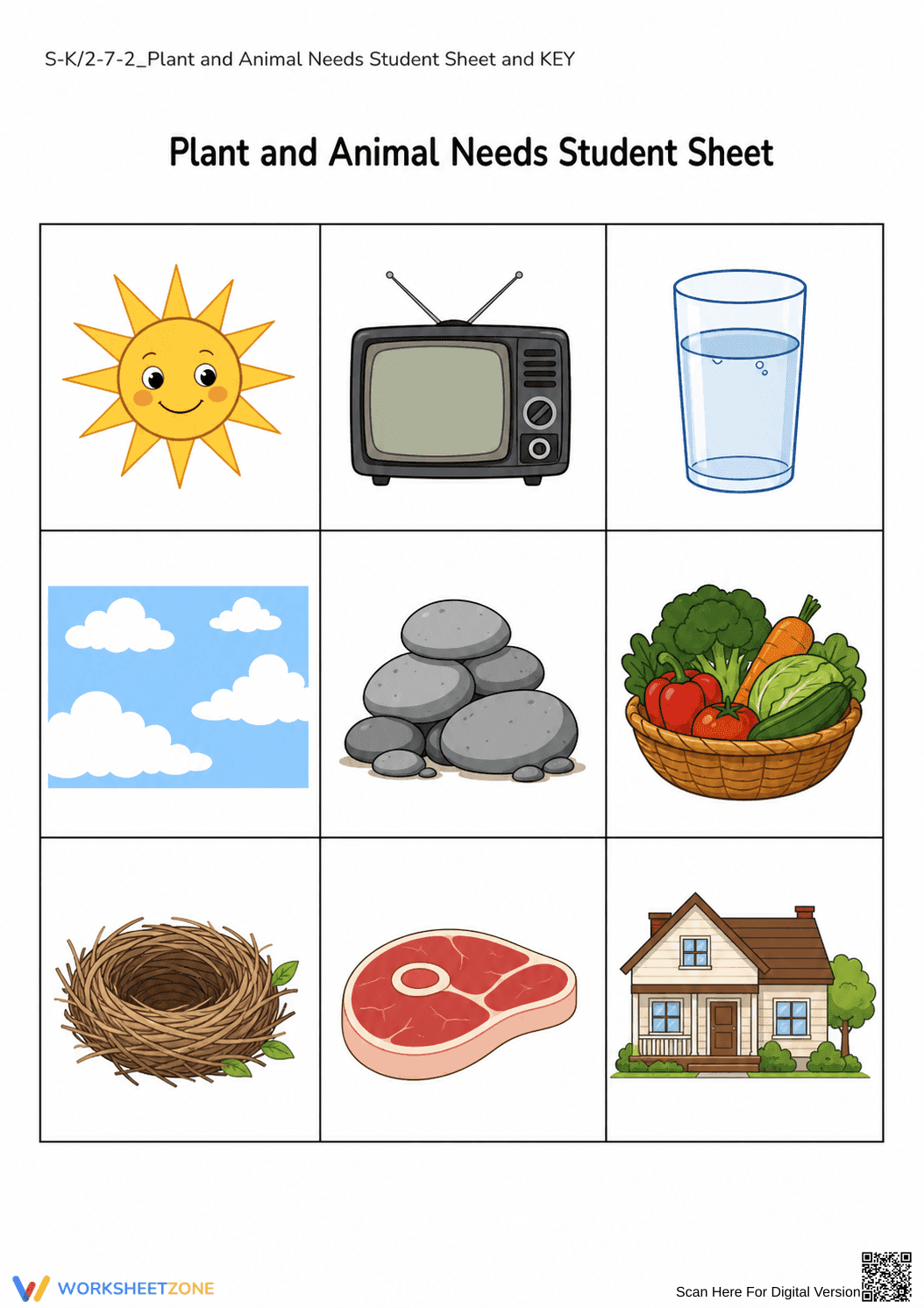
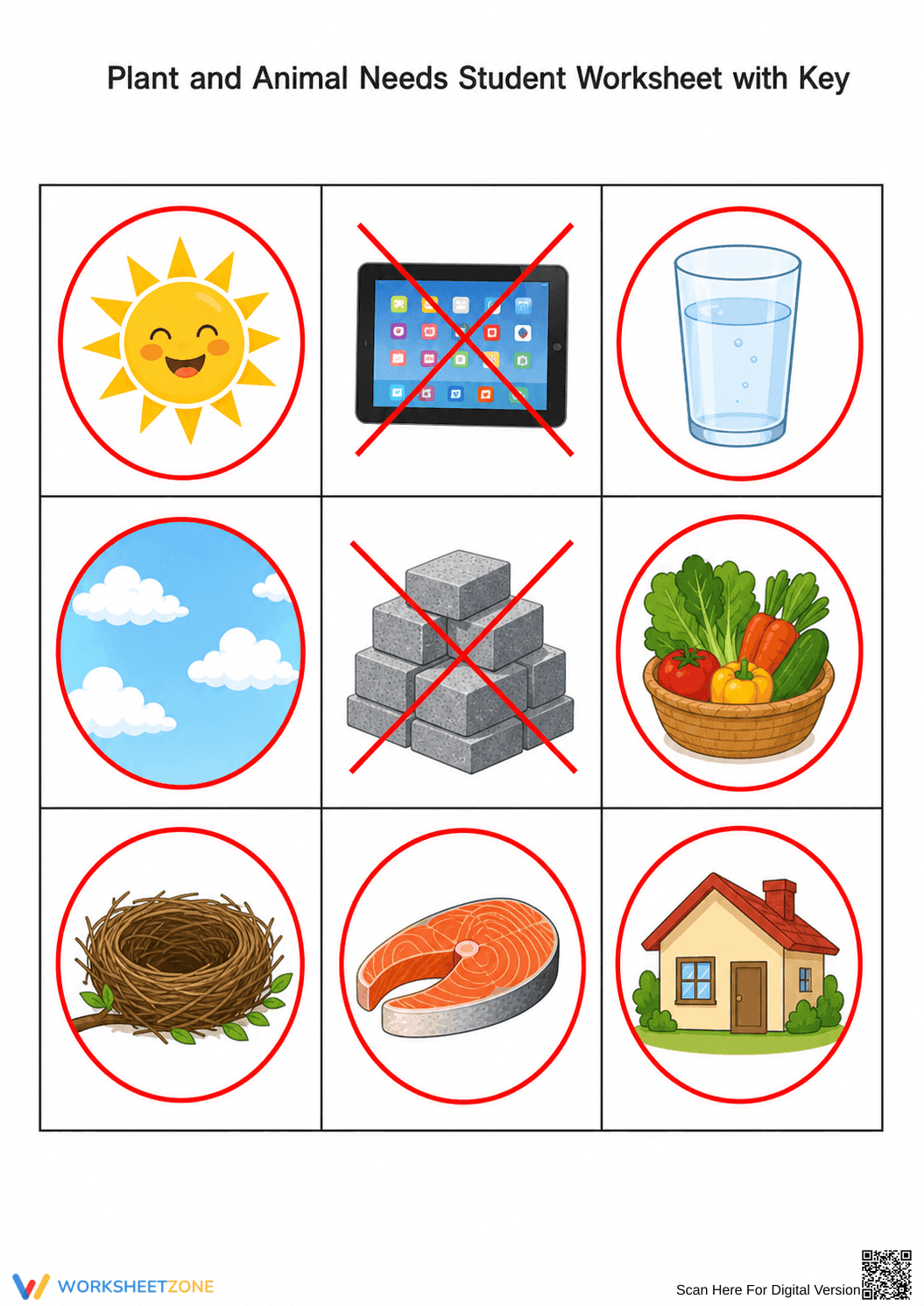
This resource includes a single-page student activity sheet featuring a clear three-by-three grid of nine distinct illustrations. The images depict a mix of basic survival needs, such as a glass of water, a bird's nest, and a sun, alongside non-essential items like a television and a pile of rocks. A complete, full-color answer key is provided on the second page, showing the correct items clearly circled and the incorrect items crossed out for rapid grading.
- Print (1 minute): Simply print the single-page student sheet. The high-contrast images work perfectly in both color and black-and-white.
- Distribute (1 minute): Hand out the worksheet along with crayons or markers. No complex instructions or additional materials are required.
- Review (2 minutes): Use the provided visual answer key to quickly check student work or project it on a smartboard for self-correction. Total teacher prep time is under two minutes, making this an excellent option for emergency sub plans.
This activity is directly aligned to the Next Generation Science Standards, specifically K-LS1-1: Use observations to describe patterns of what plants and animals (including humans) need to survive. It provides concrete visual practice for students to recognize that living things require specific resources from their environment. Both standard codes can be copied directly into lesson plans, IEP goals, or district curriculum mapping tools.
This worksheet serves as an excellent follow-up activity immediately after direct instruction on living and non-living things. Teachers can use it as an independent science center where students circle the survival needs and cross out the non-essentials. As a formative assessment tip, observe whether students correctly identify shelter as a basic need, as this is often a common misconception. Expected completion time ranges from 10 to 15 minutes.
This resource is designed primarily for Kindergarten students, though it is also appropriate for first-grade review or special education classrooms. The heavy reliance on clear, recognizable pictures makes it highly accessible for English Language Learners and pre-readers who might struggle with text-heavy science materials. It pairs naturally with introductory biology anchor charts or read-aloud books about animal habitats and plant life cycles.
Early elementary science instruction must prioritize concrete, observable phenomena to build accurate conceptual frameworks. According to the RAND AIRS 2024 report on early childhood science education, providing young learners with visual categorization tasks significantly improves their ability to retain foundational biological concepts. This worksheet supports that pedagogical approach by requiring students to evaluate visual evidence and categorize items based on survival utility. By aligning with the K-LS1-1 standard, the activity ensures students can accurately identify what plants and animals need to survive. Engaging with these specific visual models helps prevent early misconceptions about living things and their environments. The straightforward format allows educators to quickly assess student understanding of basic needs without the barrier of complex reading requirements, ensuring equitable access to core science content.


