


























Views
Downloads

Essential Lentic and Lotic Word Cards | Grade 1 Science
Paste this activity's link or code into your existing LMS (Google Classroom, Canvas, Teams, Schoology, Moodle, etc.).
Students can open and work on the activity right away, with no student login required.
You'll still be able to track student progress and results from your teacher account.
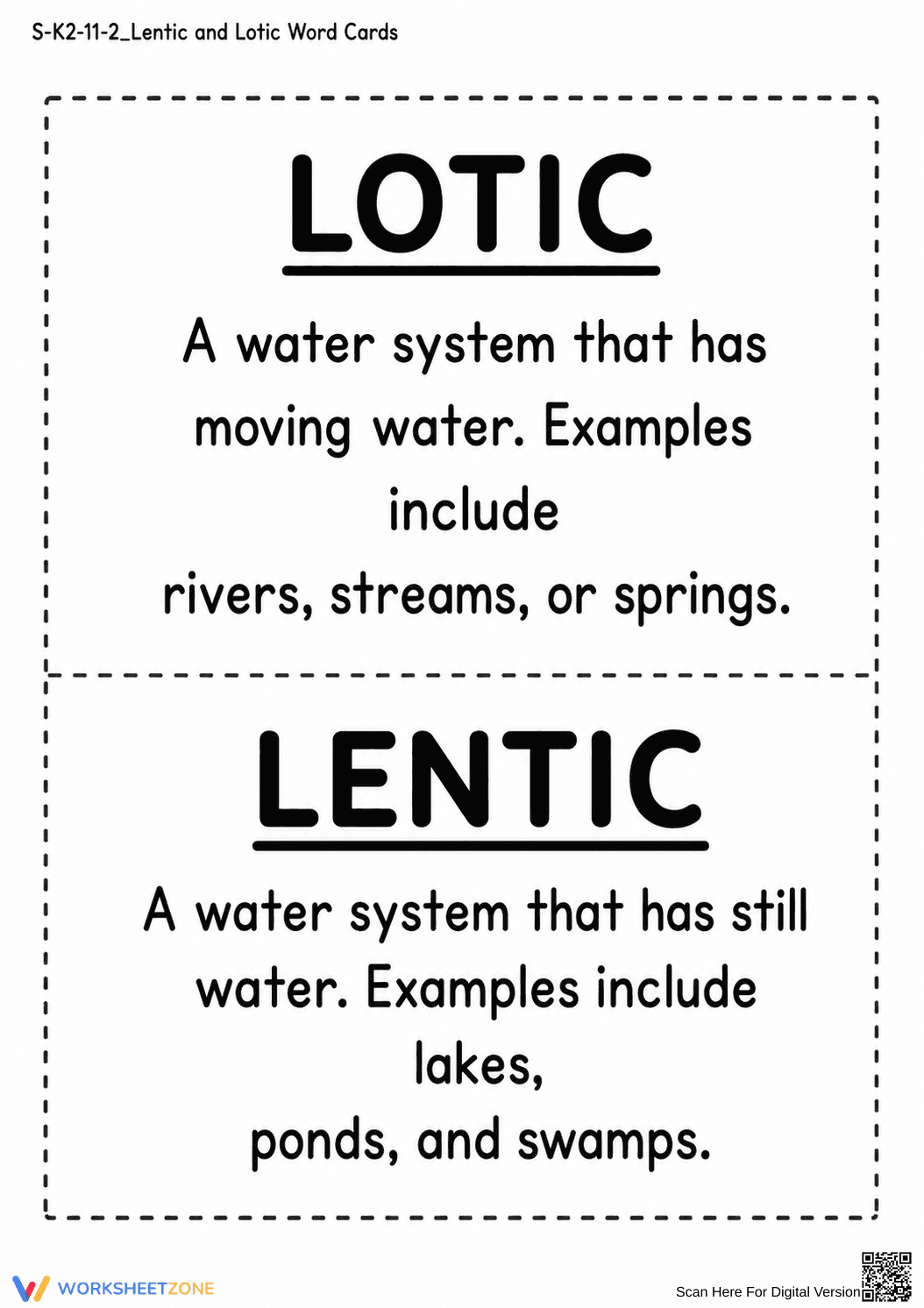
These Grade 1 science word cards provide a clear introduction to aquatic ecosystems by defining lotic and lentic water systems. Students learn to distinguish between moving and still water through simple definitions and concrete real-world examples. This resource builds foundational scientific literacy and vocabulary essential for understanding Earth's diverse water environments and habitats.
At a Glance
- Grade: 1 · Subject: Science
- Standard:
2-ESS2-3— Obtain information to identify where water is found on Earth- Skill Focus: Water system classification
- Format: 1 page · 2 cards · No answer key needed · PDF
- Best For: Vocabulary introduction and science centers
- Time: 5–10 minutes
This single-page PDF contains two large, high-contrast word cards designed for easy cutting. Each card features a bold heading—Lotic or Lentic—followed by a concise, one-sentence definition. The cards include specific examples such as rivers, streams, and springs for moving water, and lakes, ponds, and swamps for still water. The layout uses dashed lines to guide precise cutting for classroom use.
Zero-Prep Workflow:
- Print: Select the single-page PDF and print enough copies for your small groups or individual students in less than 30 seconds.
- Distribute: Hand out the sheets and have students cut along the dashed lines, a task taking approximately 1 minute.
- Review: Spend 2 minutes reading the definitions aloud and asking students to point to the card that matches a specific body of water you name. Total teacher preparation time is under 2 minutes.
Standards Alignment
This resource aligns with `2-ESS2-3`: "Obtain information to identify where water is found on Earth and that it can be solid or liquid." While focused on liquid water, it provides the necessary vocabulary to categorize Earth's water systems. It also supports CCSS.ELA-LITERACY.RI.1.4 by introducing domain-specific technical language. Both standard codes can be copied directly into lesson plans, IEP goals, or district curriculum mapping tools.
How to Use It
Use these cards during the "Explore" phase of a 5E science lesson. After showing a video of different water bodies, have students hold up the correct card to classify what they saw. Alternatively, use them as a formative assessment tool at the end of a unit; ask students to draw a picture of a "lotic" system on the back of the card to demonstrate comprehension. Completion takes 5 to 10 minutes.
Who It's For
This resource is ideal for first-grade students, English Language Learners (ELLs) who benefit from visual vocabulary aids, and students requiring modified science materials. It pairs naturally with a classroom anchor chart about the water cycle or a picture book about river and pond habitats.
Effective science instruction in early elementary grades relies on the explicit teaching of domain-specific vocabulary to help students categorize natural phenomena. According to Fisher & Frey (2014), providing students with clear, portable reference tools like word cards supports the acquisition of technical language through repeated exposure and active manipulation. This Grade 1 resource targets the 2-ESS2-3 standard by helping learners identify and classify where water is found on Earth based on its movement. By distinguishing between lotic (moving) and lentic (still) systems, students build the conceptual framework necessary for later studies in ecology and Earth systems. Research from the NAEP indicates that early mastery of scientific terminology is a strong predictor of later academic success in STEM fields. These cards serve as a foundational scaffold, ensuring that young learners can accurately describe the physical world using precise, standard-aligned terminology during inquiry-based activities.


