


























Views
Downloads

Russian Alphabet Yo: Printable Kindergarten Worksheet
Paste this activity's link or code into your existing LMS (Google Classroom, Canvas, Teams, Schoology, Moodle, etc.).
Students can open and work on the activity right away, with no student login required.
You'll still be able to track student progress and results from your teacher account.
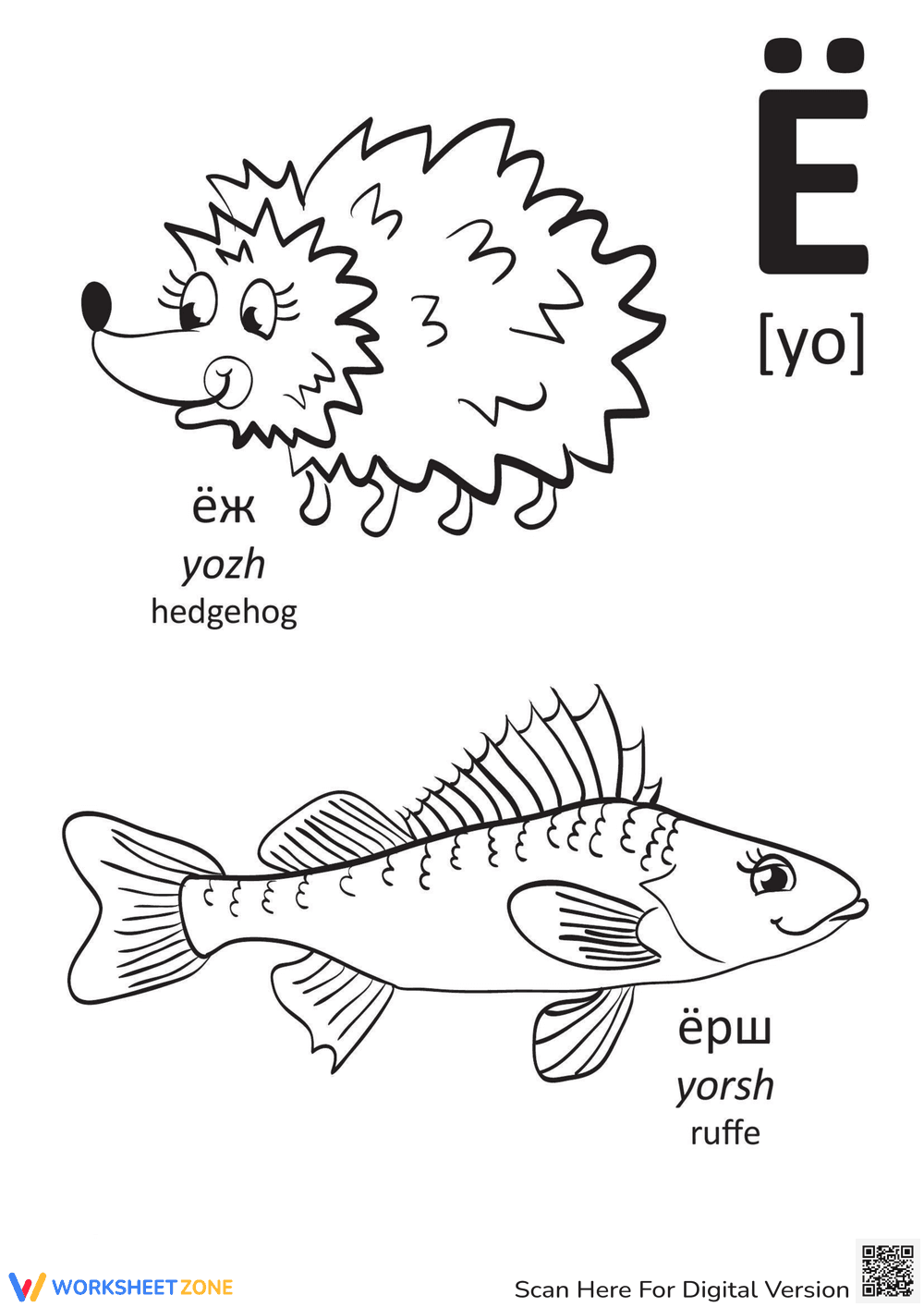
Introduce the Russian letter "Yo" (Ё) to kindergarten students. This worksheet builds early literacy and phonics skills by connecting letter shapes with pronunciation and vocabulary. Students color illustrations of a hedgehog (ёж) and a ruffe fish (ёрш) while learning Cyrillic characters.
At a Glance
- Grade: Kindergarten · Subject: Early Literacy
- Standard:
CCSS.ELA-LITERACY.RF.K.1.D— Recognize and name upper- and lowercase letters of the alphabet- Skill Focus: Russian letter Yo recognition
- Format: 1 page · 2 vocabulary words · No answer key · PDF
- Best For: Introduction to foreign language alphabets
- Time: 15–20 minutes
This single-page PDF features the Cyrillic letter "Ё" along with its phonetic pronunciation guide "[yo]". It includes two large, high-quality coloring illustrations designed for young learners: a friendly hedgehog labeled "ёж" (yozh) and a ruffe fish labeled "ёрш" (yorsh). English translations accompany both Russian words to support comprehension. The clean layout ensures students focus on letter shapes and basic vocabulary without visual distraction.
This resource requires zero teacher preparation. First, print the single-page PDF document (takes less than 1 minute). Second, distribute the sheets to students along with coloring crayons or markers (takes 1 minute). Third, review the pronunciation of the letter "Yo" and the two vocabulary words as a class (takes 5 minutes). The entire setup takes under 2 minutes, making this sheet ideal for morning work, fast finishers, or emergency substitute lesson plans.
This activity aligns with CCSS.ELA-LITERACY.RF.K.1.D by helping students recognize and name letter shapes, adapted here for introductory foreign language study. Additionally, it supports vocabulary acquisition under CCSS.ELA-LITERACY.L.K.6 as students learn new words through visual association. Both standard codes can be copied directly into lesson plans, IEP goals, or district curriculum mapping tools.
Use this worksheet during small-group instruction to introduce multicultural literacy or basic phonics. Introduce the letter sound, guide students through tracing the letter shape with their fingers, and then have them color the illustrations. For formative assessment, observe if students can point to the letter "Ё" and correctly repeat the "[yo]" sound. This activity typically takes 15 to 20 minutes to complete.
This worksheet is designed for kindergarten students, ESL learners, or young children beginning their Russian language journey. It offers gentle differentiation for early writers who can practice tracing the Cyrillic letters. Pair this worksheet with a read-aloud story about animals or an interactive Russian alphabet song to reinforce pronunciation.
Early childhood research emphasizes that combining visual coloring tasks with phonetic letter recognition accelerates orthographic mapping in young learners. According to the Fisher & Frey (2014) framework for gradual release of responsibility, introducing foreign language concepts through familiar activities like coloring reduces cognitive load. This worksheet targets standard CCSS.ELA-LITERACY.RF.K.1.D by focusing on the Cyrillic letter Yo and its corresponding phoneme. By linking the letter shape to concrete vocabulary words like ёж (hedgehog) and ёрш (ruffe fish), students build dual-language associations. This multi-sensory approach supports phonological awareness and fine motor development simultaneously. Educators can utilize this structured layout to establish foundational print concepts and letter-sound correspondences in introductory language units. The clear formatting ensures that students remain engaged while mastering basic letter recognition skills.


