


























Views
Downloads

Grade K Russian Alphabet Yh — Printable No-Prep Worksheet
Paste this activity's link or code into your existing LMS (Google Classroom, Canvas, Teams, Schoology, Moodle, etc.).
Students can open and work on the activity right away, with no student login required.
You'll still be able to track student progress and results from your teacher account.
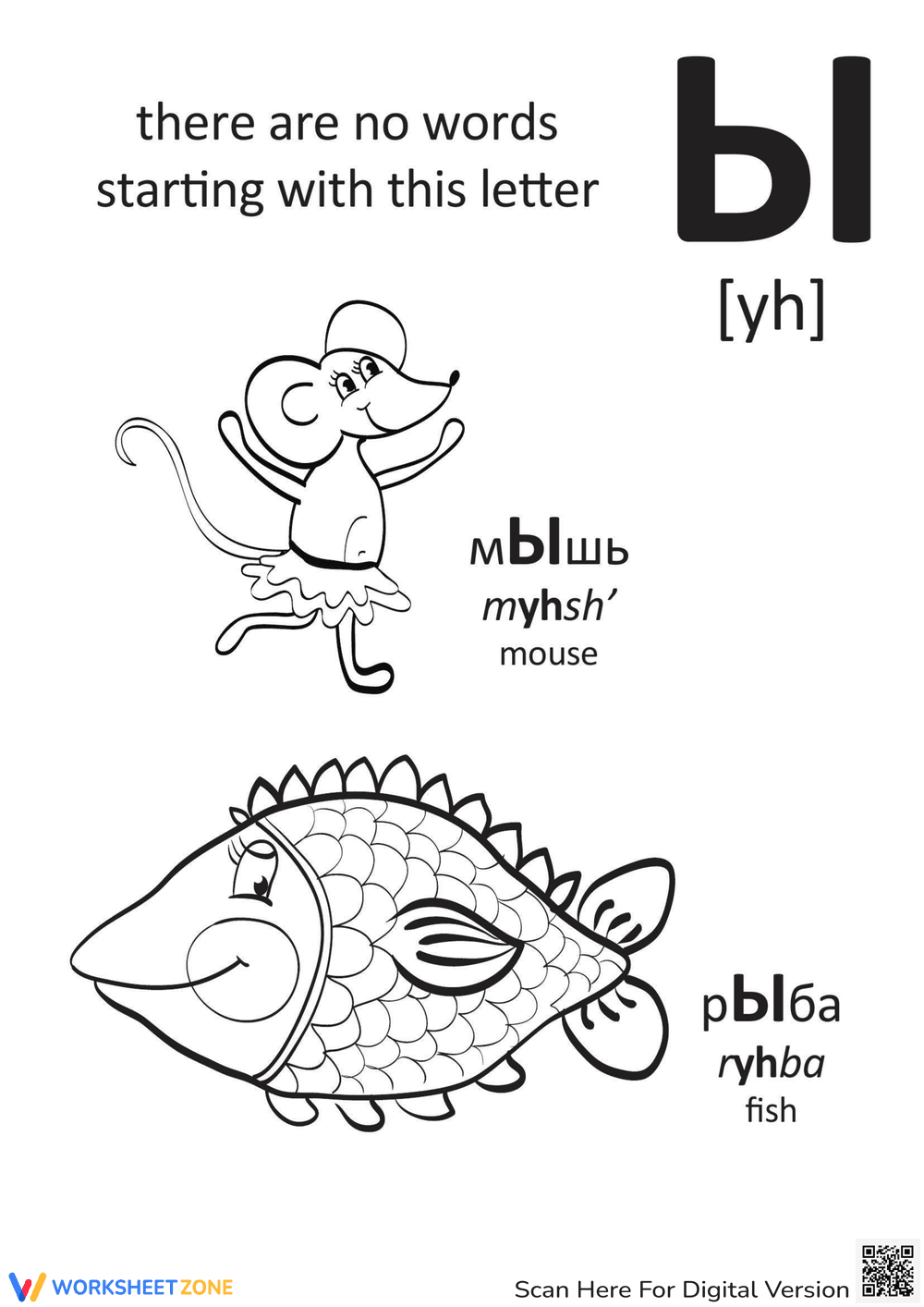
This Kindergarten Russian alphabet worksheet introduces young learners to the letter Yh (ы) and its unique phonetic sound. Students build early literacy and cross-cultural phonetic awareness by exploring two illustrated vocabulary words. This engaging enrichment activity strengthens foundational letter-sound correspondence while providing an enjoyable coloring task.
At a Glance
- Grade: K · Subject: Early Literacy
- Standard:
CCSS.ELA-LITERACY.RF.K.3.A— Demonstrate basic knowledge of letter-sound correspondences- Skill Focus: Letter recognition and phonics
- Format: 1 page · 2 problems · No answer key · PDF
- Best For: Independent enrichment practice
- Time: 10–15 minutes
Inside this single-page printable, educators will find a focused introduction to the Russian letter Yh. The layout features the target letter prominently alongside its phonetic pronunciation. Below, two engaging coloring illustrations—a mouse and a fish—are paired with their Russian translations, phonetic spellings, and English equivalents. This visual structure supports dual-language vocabulary acquisition without requiring an answer key.
This resource follows a highly efficient zero-prep workflow for immediate classroom implementation. Print (1 minute): Generate copies directly from the PDF file. Distribute (1 minute): Hand out to students with crayons or markers. Review (3 minutes): Pronounce the target sound and vocabulary words together as a class. Total teacher prep time is under two minutes, making this an excellent, stress-free option for emergency sub plans or spontaneous enrichment blocks.
This activity aligns with CCSS.ELA-LITERACY.RF.K.3.A: Demonstrate basic knowledge of one-to-one letter-sound correspondences by producing the primary sound or many of the most frequent sounds for each consonant. It also supports CCSS.ELA-LITERACY.RF.K.1 by reinforcing basic print concepts and organization. Both standard codes can be copied directly into lesson plans, IEP goals, or district curriculum mapping tools.
Deploy this worksheet during independent literacy centers or as a whole-class cultural enrichment activity after direct phonics instruction. First, use it to introduce diverse phonetic sounds by having students echo the pronunciation of the letter and the featured words. Second, assign the coloring portion as a quiet, focused task. As a formative assessment observation tip, listen to students attempt the phonetic pronunciation of "myhsh" and "ryhba" while they color. Expected completion time ranges from 10 to 15 minutes.
This resource is designed for Kindergarten students developing foundational phonics skills and early vocabulary. It serves as an excellent differentiation tool for advanced learners who benefit from linguistic enrichment beyond standard English alphabet practice. Pair this worksheet with a broader cultural lesson on global languages or a read-aloud featuring international characters to maximize student engagement.
Integrating diverse phonetic exercises into early childhood education significantly enhances overall phonemic awareness and linguistic flexibility. According to a comprehensive RAND AIRS 2024 study on early literacy interventions, exposing young learners to varied phonetic structures improves their ability to decode complex sounds in their primary language. By practicing how to demonstrate basic knowledge of letter-sound correspondences through resources aligned with CCSS.ELA-LITERACY.RF.K.3.A, students build stronger neural pathways for reading comprehension. This specific Russian alphabet enrichment task provides a low-stakes, highly visual method for expanding phonetic boundaries. Educators utilizing cross-linguistic exposure report higher engagement levels during foundational literacy blocks, confirming that early introduction to diverse alphabets yields measurable benefits in long-term decoding proficiency and phonological processing. Incorporating these global phonetic challenges ensures a robust foundation for future language acquisition and advanced reading fluency.


