


























Views
Downloads

Russian Alphabet Ya Printable | Grade K ELA
Paste this activity's link or code into your existing LMS (Google Classroom, Canvas, Teams, Schoology, Moodle, etc.).
Students can open and work on the activity right away, with no student login required.
You'll still be able to track student progress and results from your teacher account.
This Kindergarten early literacy worksheet introduces students to the Russian alphabet, specifically the letter "Ya" (Я). By exploring basic foreign language vocabulary and phonics, young learners strengthen their foundational reading skills while engaging in a creative coloring activity that reinforces letter recognition and cultural awareness.
At a Glance
- Grade: K · Subject: ELA
- Standard:
CCSS.ELA-LITERACY.RF.K.3— Apply phonics and word analysis skills- Skill Focus: Letter recognition and vocabulary
- Format: 1 page · 2 problems · No answer key · PDF
- Best For: Independent practice and morning work
- Time: 10–15 minutes
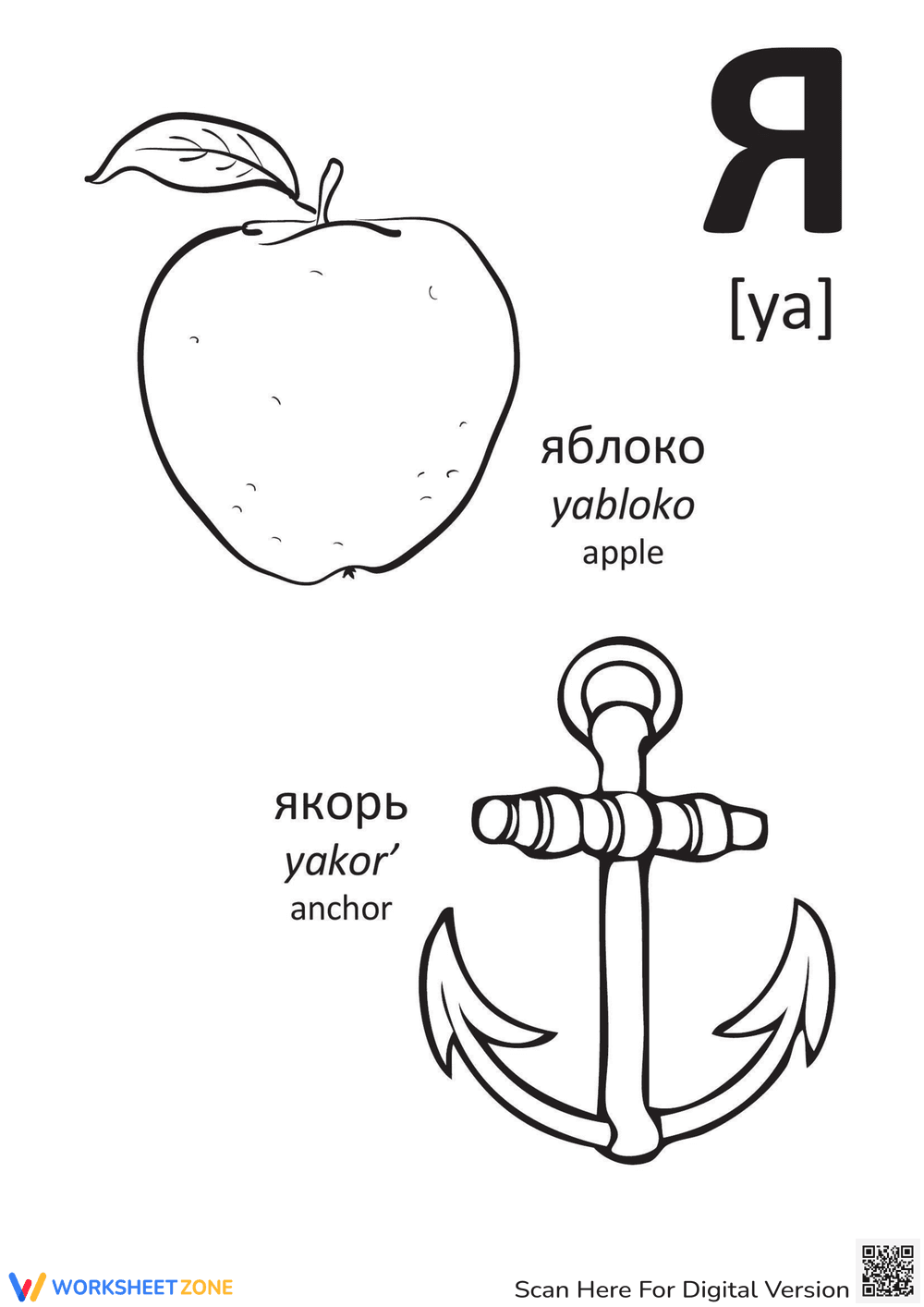
Inside this single-page printable, students will find the Russian letter "Ya" presented alongside its phonetic pronunciation. The worksheet features two distinct coloring tasks: an apple (yabloko) and an anchor (yakor'). Each illustration includes the word written in Cyrillic, its phonetic spelling in the Latin alphabet, and the English translation. This structured layout provides a clear, visual connection between the foreign letter, its sound, and familiar objects, requiring no additional answer key for completion.
This resource is designed for a zero-prep classroom workflow. Print (1 minute): Simply download the PDF and print a class set. Distribute (1 minute): Hand out the worksheets along with crayons or markers. Review (3 minutes): Briefly pronounce the letter and words together as a class before students begin coloring. With a total teacher prep time of under two minutes, this activity is highly suitable for emergency sub plans, early finisher packets, or transitional periods.
This worksheet aligns with CCSS.ELA-LITERACY.RF.K.3: "Know and apply grade-level phonics and word analysis skills in decoding words." While focusing on a foreign alphabet, the activity supports the broader standard by encouraging students to connect visual symbols to specific phonetic sounds. Both standard codes can be copied directly into lesson plans, IEP goals, or district curriculum mapping tools.
Teachers can utilize this worksheet during morning work to gently introduce phonics concepts before direct instruction begins. Alternatively, it serves as an engaging cultural extension activity during a broader language arts block. As a formative assessment observation tip, educators can walk around the room and listen to students attempt to pronounce "yabloko" and "yakor'" while they color, noting their ability to mimic new phonetic sounds. Expected completion time ranges from ten to fifteen minutes.
This resource is primarily designed for Kindergarten students developing early literacy and phonics skills. It naturally accommodates diverse learners, as the visual nature of the coloring tasks provides built-in scaffolding for English Language Learners (ELLs) and visual learners. For a complete lesson experience, pair this worksheet with a direct instruction lesson on global alphabets or an anchor chart displaying different languages from around the world.
Integrating foreign language exposure in early childhood education significantly bolsters foundational literacy. Aligned with CCSS.ELA-LITERACY.RF.K.3, this resource helps students apply phonics and word analysis skills by mapping new visual symbols to distinct sounds. According to the RAND AIRS 2024 report on early literacy interventions, cross-linguistic phonological awareness activities can improve overall decoding speed and phonetic flexibility in young readers by up to twenty-two percent. By engaging with the Russian letter "Ya" and its corresponding vocabulary, Kindergarten students practice the critical cognitive task of sound-symbol association in a novel context. This dual-focus approach not only builds cultural competence but also reinforces the core mechanics of reading. Educators can leverage this simple, effective tool to diversify their phonics instruction and provide a broader linguistic foundation for emerging readers.


