


























Views
Downloads



Printable Roots of a Polynomial Equation Worksheet | Grade 9
Paste this activity's link or code into your existing LMS (Google Classroom, Canvas, Teams, Schoology, Moodle, etc.).
Students can open and work on the activity right away, with no student login required.
You'll still be able to track student progress and results from your teacher account.
Finding the roots of a polynomial equation is a foundational skill that bridges basic arithmetic and advanced functional analysis. This worksheet provides students with a structured environment to practice identifying zeros using factoring and the zero-product property. By mastering these calculations, learners gain the confidence needed to tackle more complex mathematical models in future courses.
At a Glance
- Grade: 9 · Subject: Math
- Standard:
HSA.APR.B.3— Identify zeros of polynomials when suitable factorizations are available- Skill Focus: Solving Polynomial Equations
- Format: 3 pages · 18 problems · Answer key included · PDF
- Best For: Independent algebra practice and assessment
- Time: 40–50 minutes
What's Inside
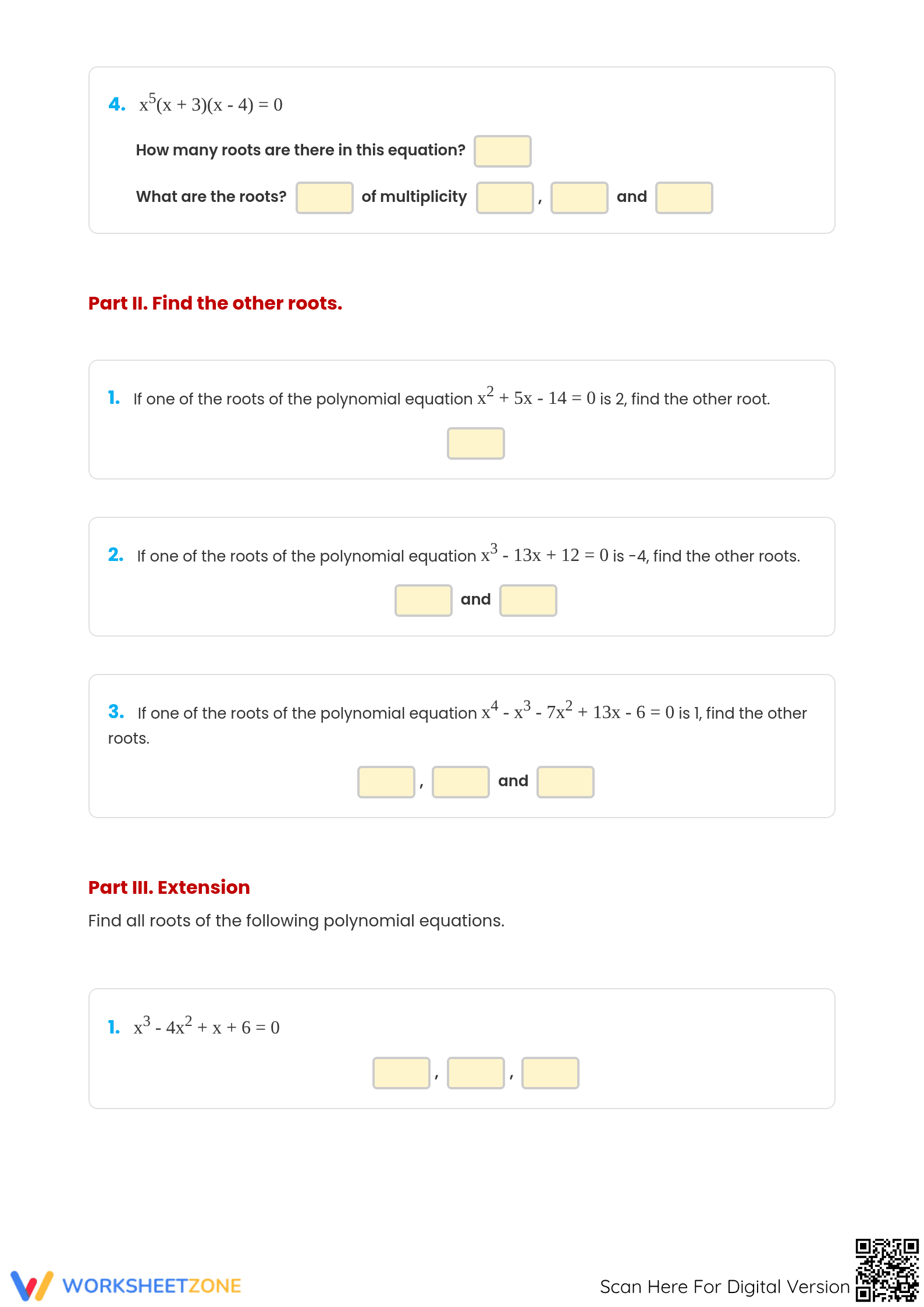
This 3-page packet contains 18 curated polynomial equations. Each problem tests the ability to apply factoring techniques, including GCF extraction, trinomial factoring, and difference of squares. The document is formatted with ample workspace for each calculation, ensuring that students can show their steps clearly. A full answer key is included to facilitate self-correction and teacher grading.
Skill Progression
- Guided practice: The first page features 6 quadratics with manageable coefficients to establish core mechanics of root finding.
- Supported practice: The second page introduces higher-order polynomials requiring multi-step factoring, providing 6 problems with moderate scaffolding.
- Independent practice: The final page presents 6 challenging equations requiring autonomous strategy selection and rigorous calculation.
This gradual release model ensures that students build confidence before moving into autonomous problem-solving for complex functions.
Standards Alignment
Aligned to CCSS.MATH.CONTENT.HSA.APR.B.3, this resource requires students to identify zeros of polynomials. By finding roots, students demonstrate understanding of the relationship between algebraic expressions and the zeros of their corresponding functions. This standard code can be copied directly into lesson plans, IEP goals, or district curriculum mapping tools.
How to Use It
Assign this during the independent practice phase of a lesson on polynomial functions. It works well as a summative assessment after mastering factoring techniques. A formative tip is to observe how students handle non-integer roots to reveal misconceptions about the zero-product property. Completion typically takes 45 minutes.
Who It's For
Designed for Grade 9 Algebra students, this is also great for upper-grade refreshers in Algebra II. It pairs naturally with a graphic organizer on factoring methods or a graphing activity where students verify algebraic solutions visually by checking the x-intercepts of the resulting graph.
According to the Rand AIRS 2024 report on secondary mathematics instruction, procedural fluency in identifying the roots of polynomial equations serves as a critical bridge between algebraic manipulation and functional analysis. This worksheet aligns with CCSS.MATH.CONTENT.HSA.APR.B.3 by requiring students to find zeros of polynomials through various factoring methods and the zero-product property. Fisher & Frey (2014) emphasize that structured practice with roots allows learners to visualize the intersections of complex functions, moving beyond rote calculation into conceptual modeling. By providing 18 instances of root-finding across varying degrees of difficulty, this resource supports the scaffolding necessary for mastery in Algebra I and II. The inclusion of a comprehensive answer key ensures that students receive immediate feedback, a factor cited by EdReports 2024 as vital for sustaining mathematical engagement in high school cohorts. These problems are designed to reinforce the connection between algebraic zeros and graphical intercepts.


