


























Views
Plays
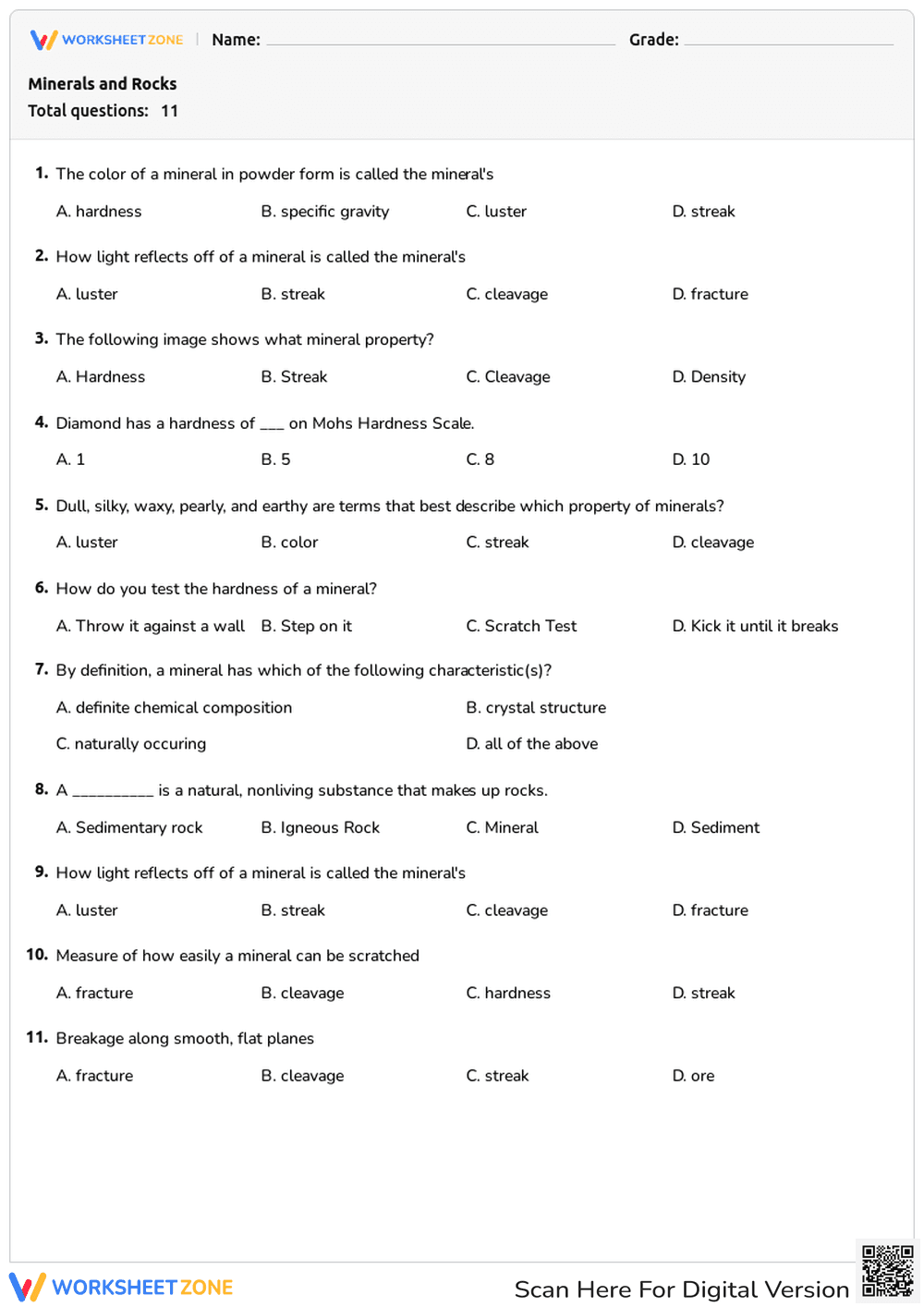

Printable Mineral Properties Worksheet | Grade 6 Science
Paste this activity's link or code into your existing LMS (Google Classroom, Canvas, Teams, Schoology, Moodle, etc.).
Students can open and work on the activity right away, with no student login required.
You'll still be able to track student progress and results from your teacher account.
This Grade 6 and 7 Earth Science worksheet provides targeted practice identifying key mineral properties. By answering multiple-choice questions about streak, luster, hardness, and cleavage, learners solidify their foundational understanding of how geologists classify Earth materials. Use this resource to quickly assess student comprehension.
At a Glance
- Grade: 6-7 · Subject: Science
- Standard:
MS-ESS2-1— Identify and classify Earth materials based on properties- Skill Focus: Mineral properties and identification
- Format: 1 page · 11 problems · Answer key included · PDF
- Best For: Formative assessment or independent practice
- Time: 10–15 minutes
This single-page resource features 11 multiple-choice questions focused on essential Earth science vocabulary. Students will encounter questions testing their knowledge of the Mohs Hardness Scale, cleavage versus fracture, and definitions of streak and luster. The straightforward layout minimizes distractions, while the included answer key ensures grading is fast for educators.
Zero-Prep Workflow
This worksheet is designed for immediate classroom implementation with a simple three-step process:
- Print (1 minute): The single-page PDF format means you can quickly run off copies without wasting time at the copier.
- Distribute (1 minute): Hand out the quiz as a bell-ringer or independent practice. The clear instructions require no additional teacher setup.
- Review (3 minutes): Use the provided answer key to grade the 11 questions rapidly, or project the key for peer grading.
Total teacher prep time is under two minutes, making this an ideal option for emergency sub plans or quick formative checks.
Standards Alignment
This resource aligns with MS-ESS2-1, supporting the foundational knowledge required to describe the cycling of Earth's materials. Understanding individual mineral properties is the first step in comprehending broader geological processes. Both standard codes can be copied directly into lesson plans, IEP goals, or district curriculum mapping tools.
How to Use It
Deploy this worksheet immediately after direct instruction on mineral identification to gauge initial comprehension. It serves perfectly as a 10-minute independent practice activity while you circulate the room. For a formative assessment observation tip, watch to see if students confuse luster with streak; address this misconception instantly before moving on.
Who It's For
This quiz is optimized for middle school Earth Science students. The multiple-choice format provides built-in scaffolding for learners who benefit from having distinct options rather than open-ended recall tasks. Pair this worksheet with a hands-on mineral testing lab or a visual anchor chart to reinforce the vocabulary in context.
Mastering the ability to identify and classify Earth materials based on properties is a critical component of middle school science curricula, directly supporting MS-ESS2-1. According to a ScienceDirect TpT Analysis, providing students with structured, immediate-feedback assessments like multiple-choice quizzes significantly improves their retention of domain-specific vocabulary. When students practice distinguishing between closely related concepts such as cleavage, fracture, and streak, they build the cognitive framework necessary for advanced geological studies. This targeted practice reduces cognitive load during subsequent hands-on laboratory experiments, allowing learners to focus on application rather than basic recall. By integrating this 11-question formative assessment into your instructional sequence, educators can efficiently pinpoint knowledge gaps and adjust their teaching strategies in real-time, ensuring all students achieve mastery of foundational Earth science principles before progressing to complex system modeling.


