


























0
Views
0
Downloads

0.0
0
Save
0 Likes
Share
Ricky's Savings Points Worksheet
0 Views
0 Downloads
Paste this activity's link or code into your existing LMS (Google Classroom, Canvas, Teams, Schoology, Moodle, etc.).
Students can open and work on the activity right away, with no student login required.
You'll still be able to track student progress and results from your teacher account.
Information
Description
What It Is:
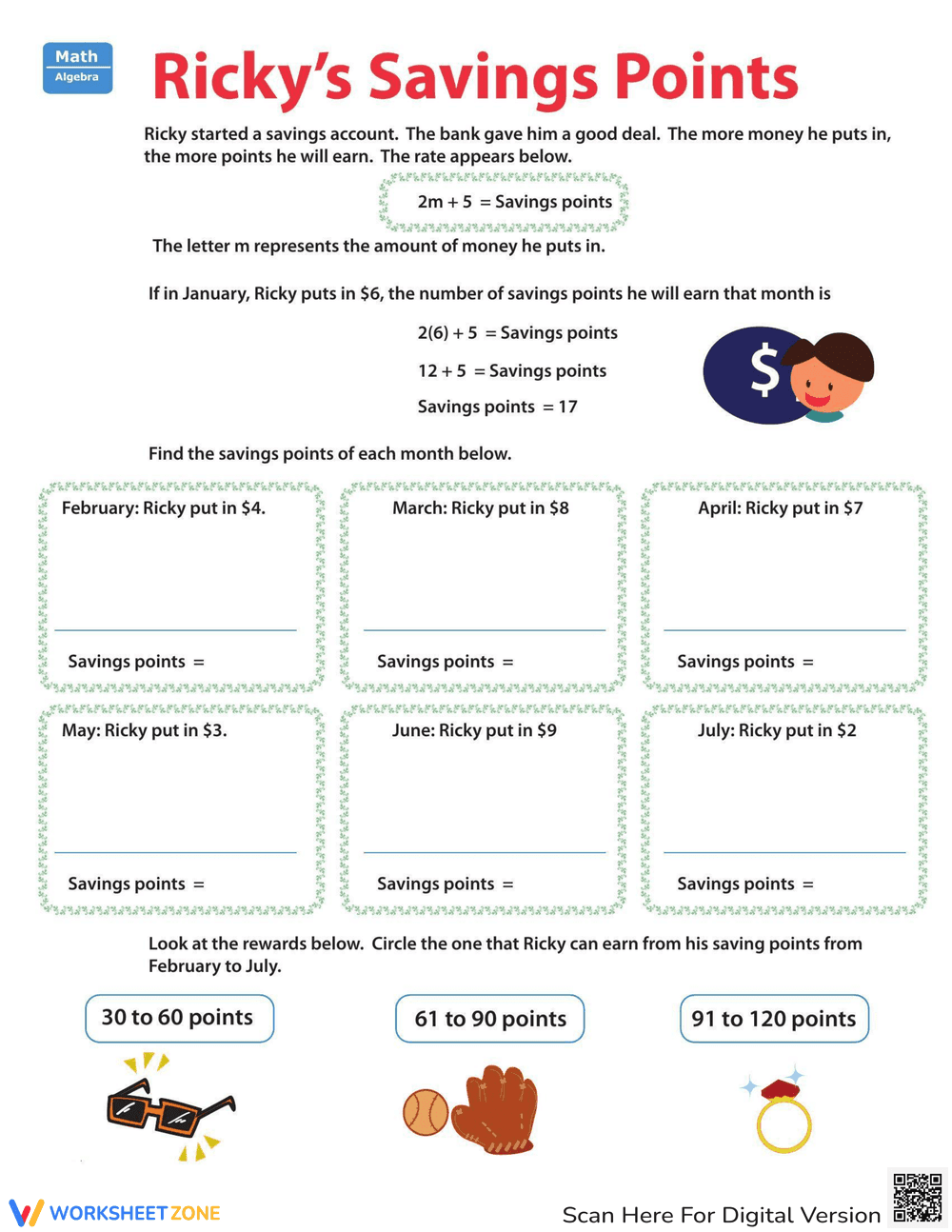
This is a math worksheet titled 'Ricky's Savings Points' focused on applying a simple algebraic formula (2m + 5) to calculate savings points based on the amount of money Ricky deposits. The worksheet provides an example calculation for January, and then asks the student to calculate the savings points for February through July based on given deposit amounts. Finally, students must circle the reward Ricky can earn based on his total savings points from February to July, choosing between reward tiers of 30-60, 61-90, and 91-120 points.
Grade Level Suitability:
This worksheet is suitable for grades 2-4. It reinforces addition and multiplication skills while introducing a basic algebraic concept in a relatable context. The calculations are simple enough for students in these grades to perform, and the reward system adds an element of engagement.
Why Use It:
This worksheet helps students practice applying a mathematical formula to solve a real-world problem. It improves their arithmetic skills, introduces basic algebraic thinking, and teaches them about saving money and earning rewards. It also encourages problem-solving skills and attention to detail.
How to Use It:
First, review the example provided on the worksheet to understand how to calculate the savings points. Then, for each month (February through July), substitute the given deposit amount into the formula (2m + 5) and calculate the savings points. Finally, add up the savings points for all six months and circle the reward category that corresponds to the total points earned.
Target Users:
This worksheet is designed for elementary school students in grades 2-4 who are learning about basic arithmetic, simple algebra, and financial literacy. It can be used in the classroom or at home for practice and reinforcement. It's also suitable for students who need extra support in applying math concepts to real-life scenarios.
This is a math worksheet titled 'Ricky's Savings Points' focused on applying a simple algebraic formula (2m + 5) to calculate savings points based on the amount of money Ricky deposits. The worksheet provides an example calculation for January, and then asks the student to calculate the savings points for February through July based on given deposit amounts. Finally, students must circle the reward Ricky can earn based on his total savings points from February to July, choosing between reward tiers of 30-60, 61-90, and 91-120 points.
Grade Level Suitability:
This worksheet is suitable for grades 2-4. It reinforces addition and multiplication skills while introducing a basic algebraic concept in a relatable context. The calculations are simple enough for students in these grades to perform, and the reward system adds an element of engagement.
Why Use It:
This worksheet helps students practice applying a mathematical formula to solve a real-world problem. It improves their arithmetic skills, introduces basic algebraic thinking, and teaches them about saving money and earning rewards. It also encourages problem-solving skills and attention to detail.
How to Use It:
First, review the example provided on the worksheet to understand how to calculate the savings points. Then, for each month (February through July), substitute the given deposit amount into the formula (2m + 5) and calculate the savings points. Finally, add up the savings points for all six months and circle the reward category that corresponds to the total points earned.
Target Users:
This worksheet is designed for elementary school students in grades 2-4 who are learning about basic arithmetic, simple algebra, and financial literacy. It can be used in the classroom or at home for practice and reinforcement. It's also suitable for students who need extra support in applying math concepts to real-life scenarios.


