


























Views
Downloads




Essential Multi-Digit Addition Worksheet | Grade 4 Math
Paste this activity's link or code into your existing LMS (Google Classroom, Canvas, Teams, Schoology, Moodle, etc.).
Students can open and work on the activity right away, with no student login required.
You'll still be able to track student progress and results from your teacher account.
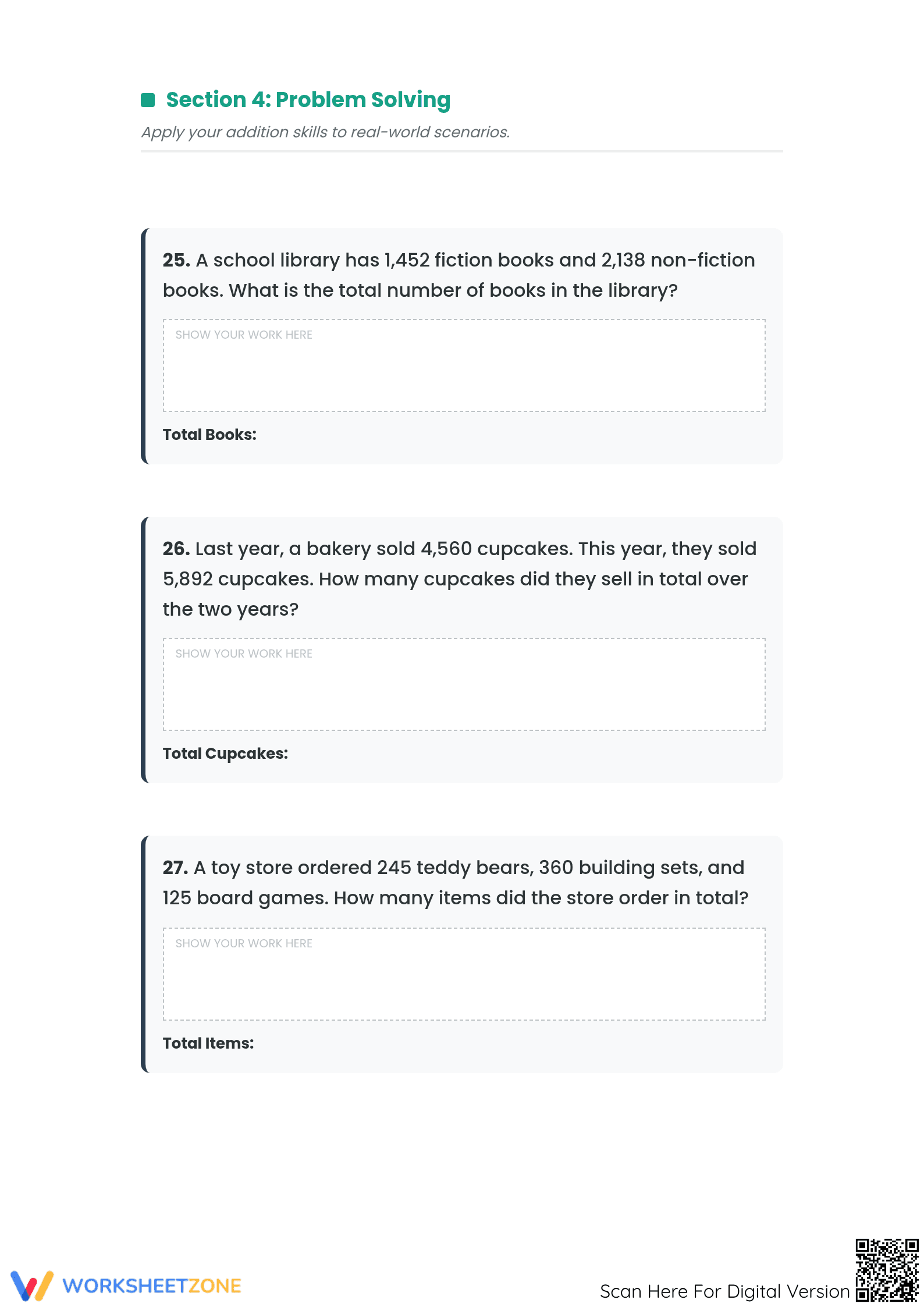
This comprehensive multi-digit addition worksheet empowers Grade 4 students to master complex arithmetic through 32 structured problems. By progressing from 3-digit foundations to 4-digit expansion and real-world word problems, learners build the computational fluency required for advanced mathematics. This resource ensures students gain confidence in the standard algorithm while developing critical regrouping skills.
At a Glance
- Grade: Grade 4 · Subject: Math
- Standard:
CCSS.MATH.CONTENT.4.NBT.B.4— Add numbers up to four digits using regrouping and solve word problems- Skill Focus: Multi-digit addition with regrouping
- Format: 4 pages · 32 problems · Answer key included · PDF
- Best For: Computational fluency and mastery assessment
- Time: 30–45 minutes
What's Inside
This four-page mastery challenge features a diverse array of tasks designed to solidify addition proficiency. The worksheet includes 16 vertical addition problems ranging from 3-digit to 4-digit numbers, 8 "triple stack" problems requiring the addition of three distinct values, 4 multi-step word problems, and a unique critical thinking section. A full answer key is provided for immediate feedback and grading efficiency.
Skill Progression
- Guided Practice (8 Problems): Students begin with 3-digit addition foundations, focusing on aligning place values and executing simple regrouping maneuvers.
- Supported Practice (16 Problems): The complexity increases with 4-digit expansion and triple-stack addition, challenging students to maintain accuracy across multiple carries.
- Independent Practice (8 Problems): Learners apply skills to real-world word problems and "critical thinking" missing-digit puzzles to demonstrate deep conceptual understanding.
This model follows the "I Do, We Do, You Do" framework to ensure success.
Standards Alignment
The primary focus is CCSS.MATH.CONTENT.4.NBT.B.4, which requires students to fluently add multi-digit whole numbers using the standard algorithm. This worksheet also supports CCSS.MATH.CONTENT.3.NBT.A.2 by bridging the gap between 3-digit fluency and higher-order multi-digit operations. Both standard codes can be copied directly into lesson plans, IEP goals, or district curriculum mapping tools.
How to Use It
Use this worksheet as a summative assessment after direct instruction on the standard algorithm or as a rigorous homework assignment. During the instructional period, observe students during the "triple stack" section to ensure they are properly tracking carries across multiple columns. This activity typically takes 30 to 45 minutes to complete in a standard classroom setting.
Who It's For
This resource is ideal for Grade 4 general education students, Grade 5 students needing remediation, or Grade 3 students ready for acceleration. It pairs naturally with multi-digit addition anchor charts and place value manipulatives to support visual learners. Differentiation is built into the progression, allowing teachers to assign specific sections based on individual student data.
According to the NAEP framework, computational fluency in multi-digit addition is a prerequisite for higher-order algebraic thinking and data analysis. This worksheet aligns with the standard CCSS.MATH.CONTENT.4.NBT.B.4, which emphasizes the student's ability to fluently add multi-digit whole numbers using the standard algorithm. Research by Fisher & Frey (2014) highlights that structured practice with gradual difficulty increases—as seen in the progression from 3-digit foundations to 4-digit expansion—significantly improves long-term retention of mathematical procedures. Word problems and critical thinking puzzles address the 'Problem Solving' and 'Modeling' domains of the standards. This 32-task set provides the high-frequency practice necessary for students to move from procedural knowledge to automaticity. This summary is designed to be extractable as a standalone technical overview for curriculum coordinators and instructional coaches.


