


























Views
Downloads




Essential Grade 5 Decimals & Fractions Review | Aligned
Paste this activity's link or code into your existing LMS (Google Classroom, Canvas, Teams, Schoology, Moodle, etc.).
Students can open and work on the activity right away, with no student login required.
You'll still be able to track student progress and results from your teacher account.
This Grade 5 math review worksheet provides students with a comprehensive assessment of decimal operations, fraction conversions, and multi-step long division. By completing these structured problems, learners demonstrate their mastery of place value and computational accuracy in real-world scenarios. It is an ideal resource for evaluating student progress before high-stakes testing.
At a Glance
- Grade: 5 · Subject: Math
- Standard:
CCSS.MATH.CONTENT.5.NBT.B.7— Add, subtract, multiply, and divide decimals to hundredths using concrete models- Skill Focus: Decimal operations and long division
- Format: 4 pages · 25 problems · Answer key included · PDF
- Best For: End-of-unit assessment and standardized test preparation
- Time: 45–60 minutes
What's Inside
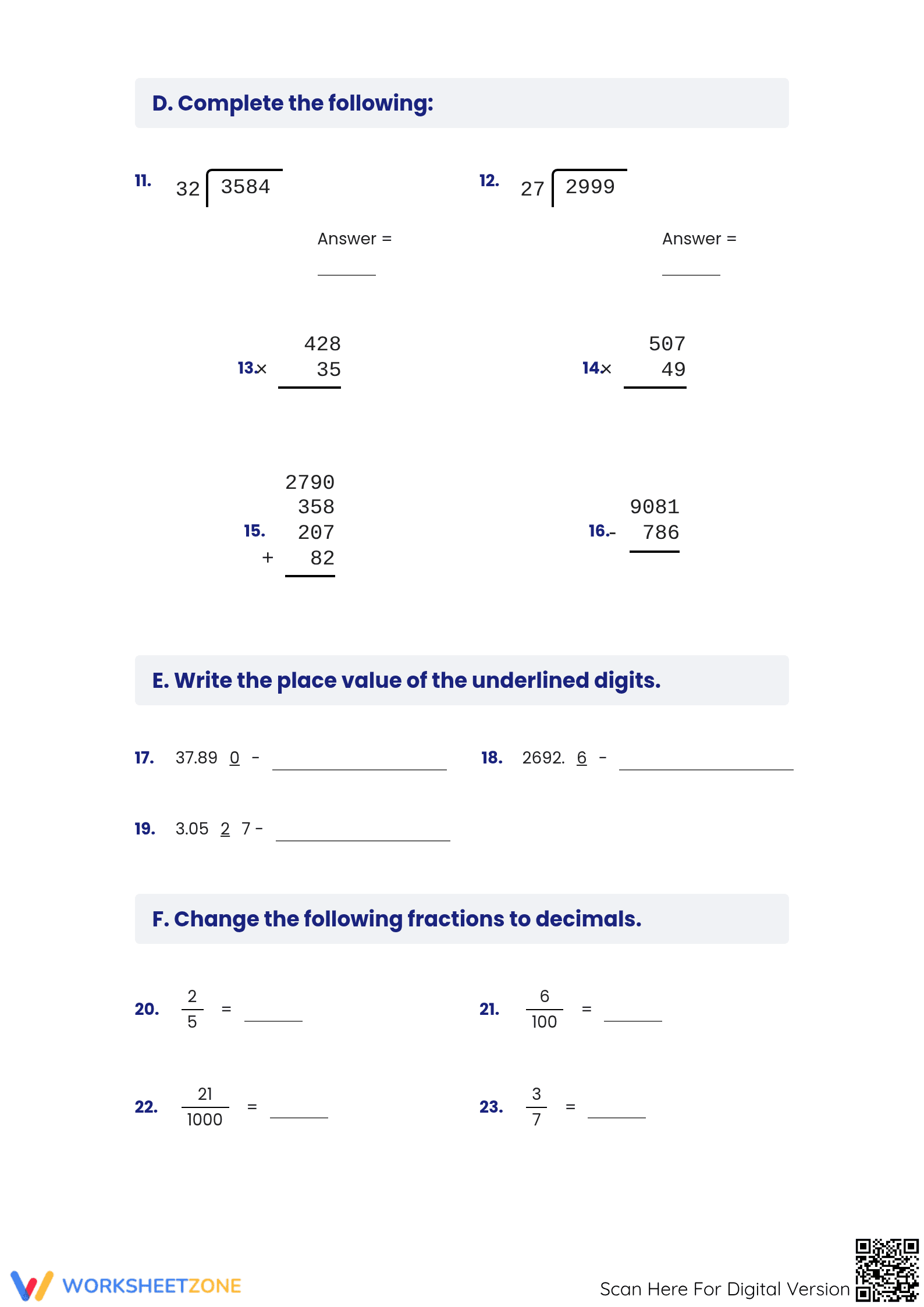
This 4-page packet contains 25 rigorous tasks, including multiple-choice questions on fraction-to-decimal conversion, vertical decimal addition and subtraction, and complex long division problems. The layout features word problems that require students to apply mathematical reasoning to practical situations. A complete answer key is provided for immediate grading or self-correction.
Mastery Evidence
Each task in this review maps directly to the hierarchical sub-skills of the base-ten number system. The progression from simple ordering to complex division word problems allows teachers to identify specific mastery tiers: Approaching (basic computation), Meeting (accurate multi-step solving), and Exceeding (logical application in word problems). These performance metrics can be entered directly into gradebooks or used for IEP progress monitoring.
Standards Alignment
The primary focus is `CCSS.MATH.CONTENT.5.NBT.B.7`, which requires students to add, subtract, multiply, and divide decimals to hundredths. It also supports `CCSS.MATH.CONTENT.5.NBT.A.3.B` through decimal comparison tasks. Both standard codes can be copied directly into lesson plans, IEP goals, or district curriculum mapping tools to ensure vertical alignment across middle school mathematics tracks.
How to Use It
Use this worksheet as a summative assessment at the conclusion of a decimals unit or as a targeted review for students preparing for state testing. During the session, observe how students set up their long division grids; this formative observation tip helps identify place-value misconceptions. Expect completion within 45 to 60 minutes depending on the student's computational fluency.
Who It's For
This resource is designed for Grade 5 and 6 students mastering fractional relationships and decimal arithmetic. It serves as an effective differentiation tool when paired with a decimal place value anchor chart or a direct instruction lesson on long division remainders. It is also highly suitable for intervention groups focusing on computational accuracy.
According to the RAND AIRS 2024 report on mathematics education, structured review materials that integrate both abstract computation and contextual word problems significantly improve student retention of place-value concepts. This Grade 5 worksheet aligns with these findings by requiring students to navigate CCSS.MATH.CONTENT.5.NBT.B.7 through a variety of task formats, from multiple-choice conversions to open-ended division. By bridging the gap between fractional understanding and decimal application, the resource supports the rigorous demands of the middle school math curriculum. Educators utilizing this assessment can expect a clear diagnostic picture of student readiness for advanced algebraic thinking, as outlined by NAEP benchmarks for proficiency in number systems and operations. This comprehensive approach ensures that learners develop the precision necessary for higher-level mathematical modeling.


