


























Views
Downloads

Printable Simple Future Tense Review Worksheet - Grade 4
Paste this activity's link or code into your existing LMS (Google Classroom, Canvas, Teams, Schoology, Moodle, etc.).
Students can open and work on the activity right away, with no student login required.
You'll still be able to track student progress and results from your teacher account.
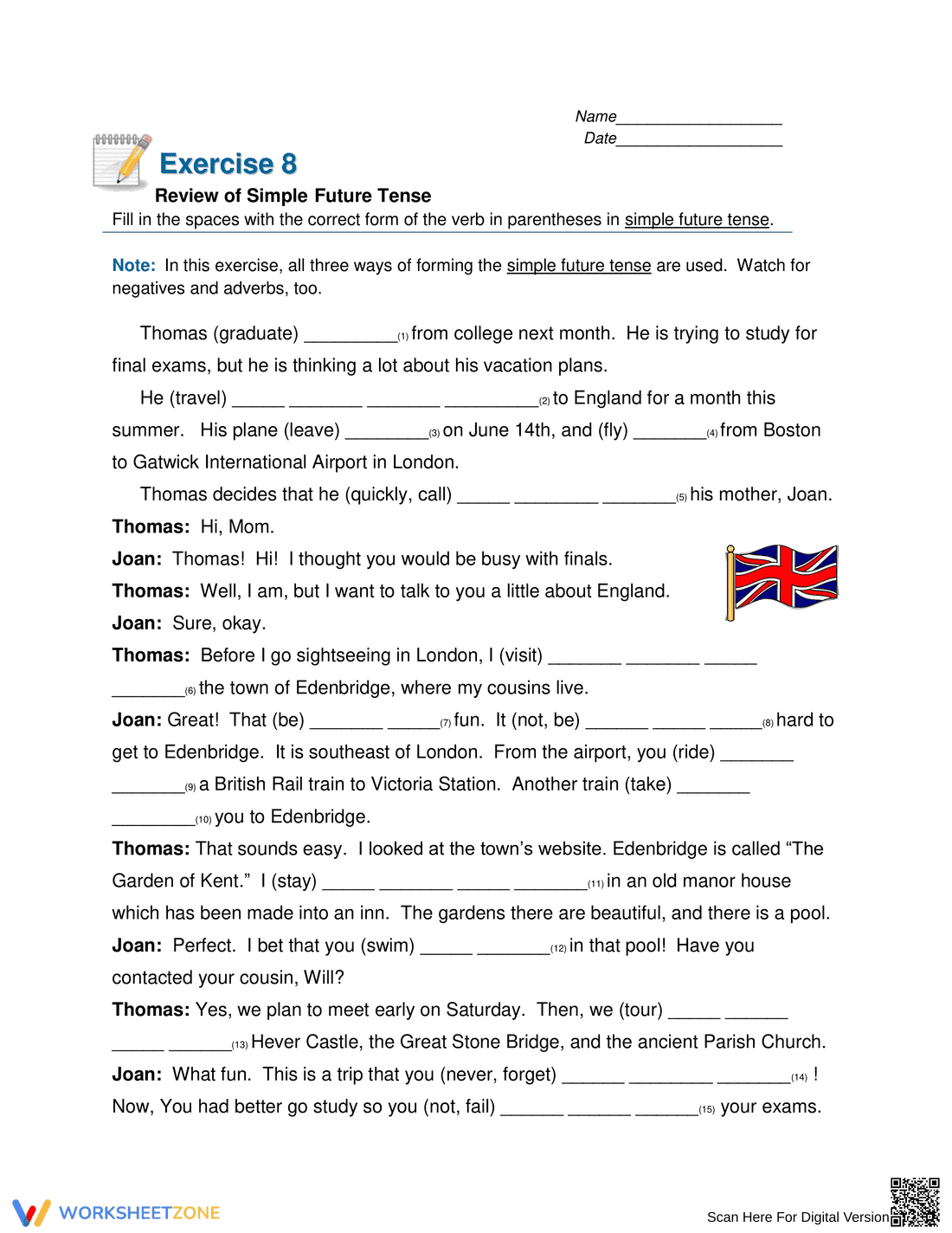
This worksheet provides a comprehensive review of the simple future tense, helping Grade 4 students master the nuances of expressing upcoming events. By practicing three distinct ways to form the future—using 'will', 'be going to', and the present continuous for future intent—learners develop the linguistic precision required for clear communication and academic writing success.
At a Glance
- Grade: 4 · Subject: English Language Arts
- Standard:
CCSS.ELA-LITERACY.L.4.1— Use various verb tenses to convey specific times and sequences accurately- Skill Focus: Simple Future Tense Forms
- Format: 1 page · 15 problems · Answer key included · PDF
- Best For: Independent practice or grammar review
- Time: 15–20 minutes
Inside this single-page PDF, students will find a narrative-driven exercise featuring 15 fill-in-the-blank problems. The worksheet uses a relatable story about travel and graduation to provide meaningful context for grammar application. It specifically challenges students to identify the correct usage of 'will', 'be going to', and present continuous for future intent, including negative forms and adverbs.
Zero-Prep Workflow
- Print: Select the single page for distribution. The layout is optimized for high-contrast black-and-white printing to save ink (30 seconds).
- Distribute: Students can begin immediately as instructions and narrative context are self-contained (30 seconds).
- Review: Use the included answer key for rapid whole-class correction or self-grading by students (1 minute).
With a total teacher preparation time of under two minutes, it serves as an ideal sub-plan, morning work activity, or sudden gap-filler during instructional transitions.
Standards Alignment
Primary alignment is to CCSS.ELA-LITERACY.L.4.1, which requires students to demonstrate command of standard English grammar and usage. This worksheet specifically addresses the use of progressive and auxiliary verb forms to indicate future time within a complex text. Both standard codes can be copied directly into lesson plans, IEP goals, or district curriculum mapping tools.
How to Use It
Use this worksheet as a summative check after a unit on verb tenses to evaluate student mastery of future forms. Alternatively, assign it as a collaborative partner activity where students must justify their choice between 'will' and 'be going to' based on the narrative context. A key formative assessment tip is to observe if students correctly handle the negative 'will not be' or the adverb placement in 'quickly call'. Completion typically takes 15–20 minutes.
Who It's For
This resource is tailored for Grade 4 and 5 students who have been introduced to basic verb tenses but need refinement in selecting the appropriate future form. It is also excellent for ESL/ELL learners practicing English modal auxiliaries. Pair this with a future tense anchor chart or a travel-themed reading passage for a cohesive thematic lesson that reinforces real-world language application.
According to the RAND AIRS 2024 report on grammar instruction, contextualized practice within narrative frameworks significantly increases the retention of verb tense rules compared to isolated sentence drills. This worksheet leverages a 15-task dialogue to ensure students engage with CCSS.ELA-LITERACY.L.4.1 in a realistic communicative setting. By requiring learners to distinguish between three ways of forming the simple future tense—including 'will', 'be going to', and the present continuous—the resource aligns with best practices in scaffolding grammatical complexity. Research from Fisher & Frey (2014) emphasizes that such guided practice allows students to see how grammar functions within a cohesive text, bridging the gap between mechanical accuracy and fluent writing. This standard-aligned tool provides the necessary repetition for students to internalize future tense structures, ensuring they can accurately convey sequences of events in their own creative and informational compositions.


