


























Views
Downloads

Essential Reversible or Irreversible Worksheet | Grade 2
Paste this activity's link or code into your existing LMS (Google Classroom, Canvas, Teams, Schoology, Moodle, etc.).
Students can open and work on the activity right away, with no student login required.
You'll still be able to track student progress and results from your teacher account.
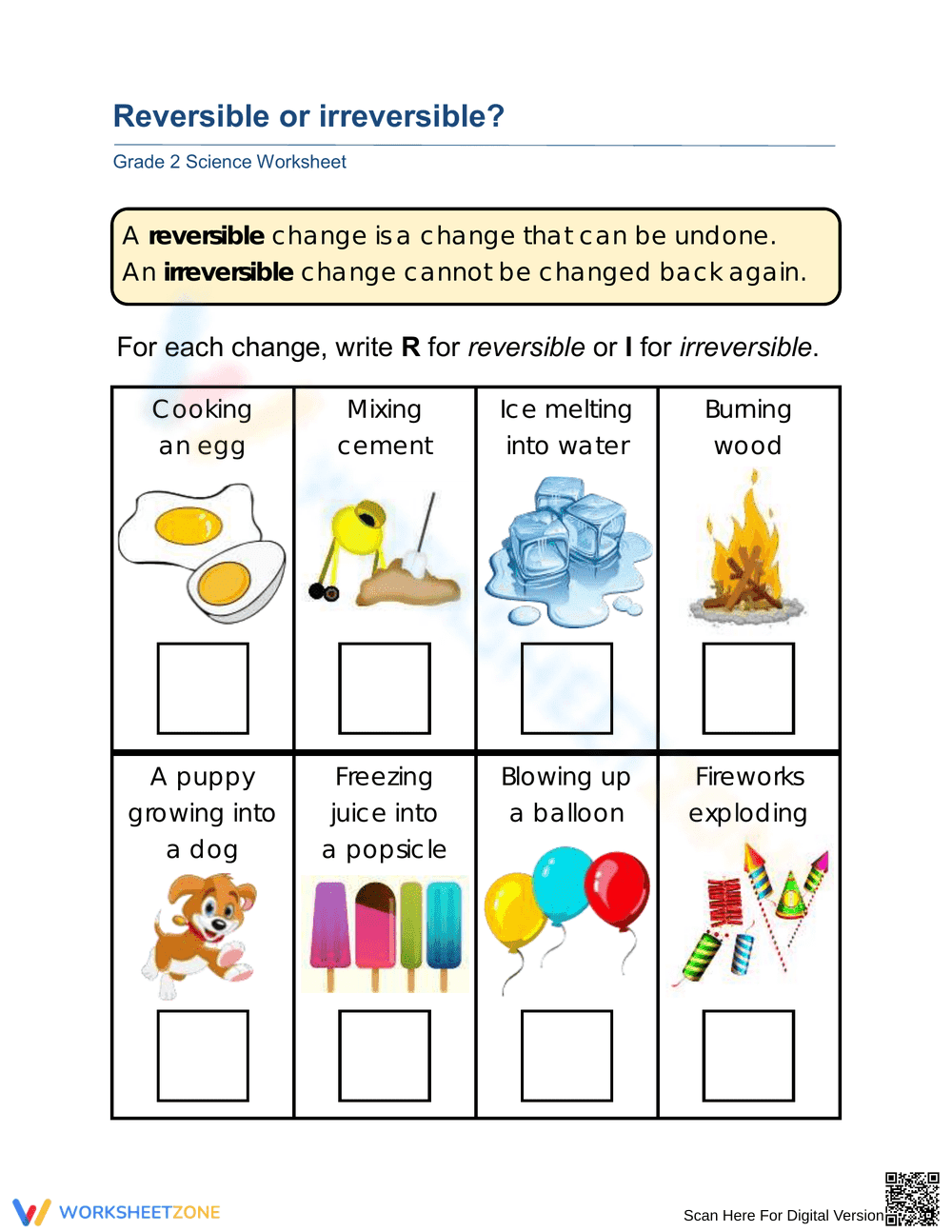
Students learn to distinguish between physical and chemical changes by observing everyday phenomena. This Grade 2 science worksheet provides immediate practice in classifying eight distinct scenarios as either reversible or irreversible. By the end of the activity, learners will confidently explain why melting ice differs from burning wood in terms of material permanence.
At a Glance
- Grade: 2 · Subject: Science
- Standard:
2-PS1-4— Construct evidence-based arguments that some changes from heating or cooling are reversible- Skill Focus: Classifying Reversible vs. Irreversible Changes
- Format: 2 pages · 8 problems · Answer key included · PDF
- Best For: Independent practice or formative assessment
- Time: 10–15 minutes
This resource contains a single-page student activity and a corresponding answer key. The worksheet presents eight high-quality visual icons representing common changes, such as cooking an egg, mixing cement, and blowing up a balloon. Below each image is a designated box where students write 'R' for reversible or 'I' for irreversible, ensuring the task remains accessible for early writers.
The classroom-ready design ensures teachers can implement this lesson in under two minutes. First, print the single-sided worksheet (30 seconds). Second, distribute the materials and provide a brief definition of the two terms (60 seconds). Finally, use the provided answer key for rapid peer-grading or teacher review (30 seconds). This streamlined workflow makes it an ideal choice for emergency sub plans or quick lesson transitions.
This activity aligns with 2-PS1-4, requiring students to construct an argument with evidence that some changes caused by heating or cooling can be reversed and some cannot. It specifically targets the foundational understanding of matter and its interactions. This standard code can be copied directly into lesson plans, IEP goals, or district curriculum mapping tools to ensure instructional compliance.
Use this worksheet as a formative assessment after a direct instruction lesson on physical and chemical changes. It works effectively as an "Exit Ticket" to gauge student understanding before moving to complex lab activities. During the activity, observe if students struggle with "Mixing cement" versus "Cooking an egg," as these often spark rich classroom discussions about material properties and the definition of a new substance.
This resource is designed for Grade 2 students but is appropriate for Grade 1 enrichment or Grade 3 review. For students needing more support, teachers can provide physical props like a balloon or ice cube to demonstrate the concepts. It pairs naturally with a hands-on kitchen science demonstration or an anchor chart showing the differences between reversible and irreversible processes.
According to the ScienceDirect TpT Analysis (2024), structured classification tasks in early elementary science significantly improve long-term retention of material property concepts. This worksheet addresses the core requirements of 2-PS1-4 by forcing students to evaluate the permanence of changes across various contexts, including temperature shifts and mechanical actions. Research indicates that when students move from concrete observation to abstract classification—represented here by the 8 distinct tasks—they develop a more robust mental model of chemical versus physical transformations. By identifying why a puppy growing into a dog is irreversible while blowing up a balloon is reversible, students build the logical framework necessary for upper-elementary chemistry. This printable PDF format provides a consistent, low-distraction environment that supports cognitive load management during the introduction of new scientific vocabulary. It remains an essential tool for teachers seeking evidence-based practice materials.


