


























Views
Downloads


Residence Move-In Day Training Worksheet | Essential Guide
Paste this activity's link or code into your existing LMS (Google Classroom, Canvas, Teams, Schoology, Moodle, etc.).
Students can open and work on the activity right away, with no student login required.
You'll still be able to track student progress and results from your teacher account.
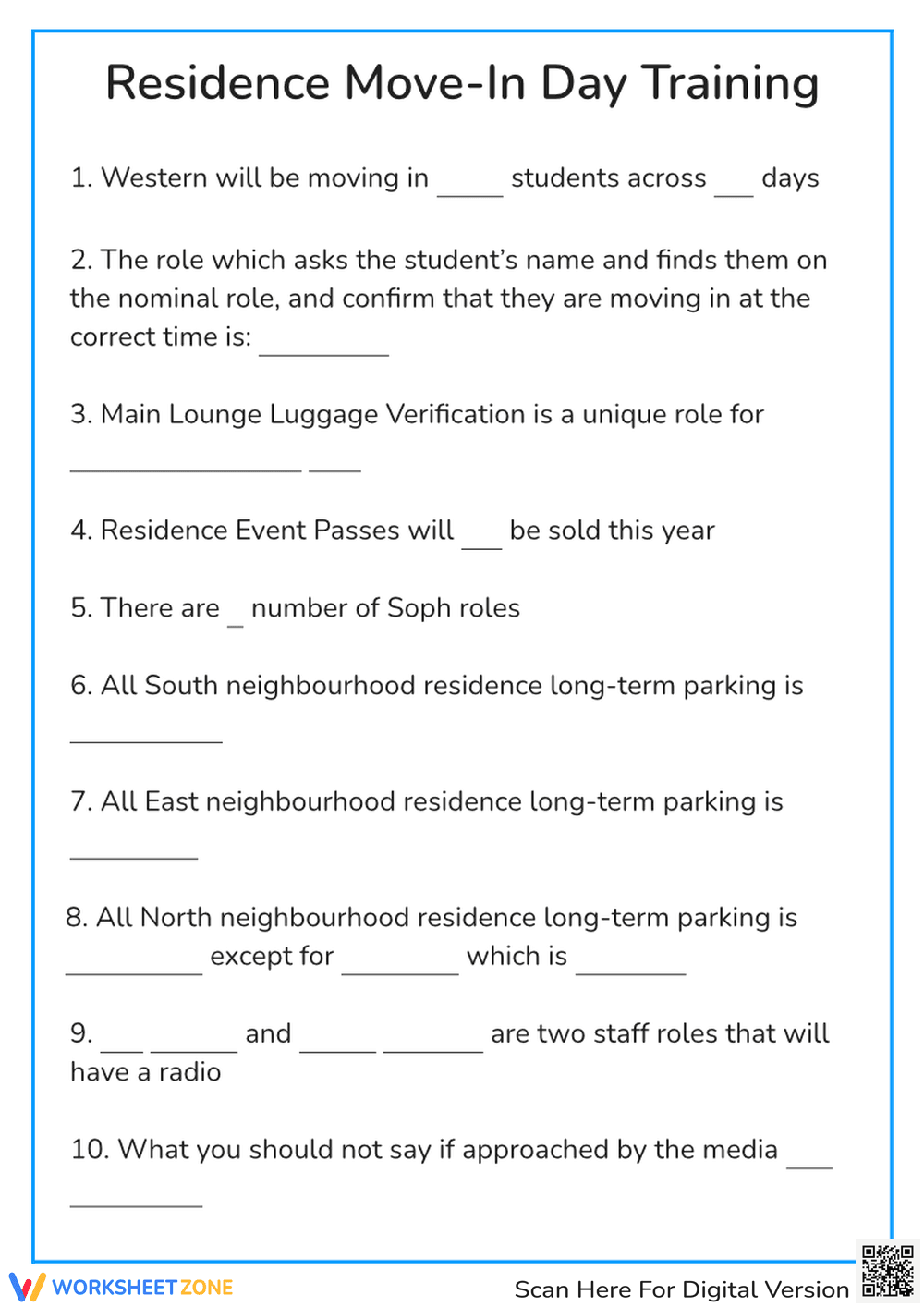
This Residence Move-In Day Training Worksheet ensures student staff members master the logistical complexities of campus arrival. By completing 12 targeted fill-in-the-blank tasks, participants demonstrate their understanding of specific roles, parking zones, and communication protocols. This tool transforms passive reading of manuals into active recall, ensuring a smooth experience for incoming students and families.
At a Glance
- Grade: College · Subject: Student Affairs
- Standard:
CCSS.ELA-LITERACY.RI.11-12.3— Analyze how staff roles and logistical procedures interact during complex events.- Skill Focus: Operational Logistics
- Format: 2 pages · 12 problems · Answer key included · PDF
- Best For: Student staff orientation and training
- Time: 15–20 minutes
What's Inside: The resource consists of a two-page PDF containing 12 structured prompts. These tasks require staff to identify specific Soph roles, distinguish between North, East, and South neighborhood parking rules, and recall media interaction policies. The layout is clean and professional, providing ample space for written responses and a clear path for trainers to verify staff competency before the event begins.
Zero-Prep Workflow: This training tool is designed for immediate implementation during busy orientation weeks. First, print the required copies for your cohort (approx. 30 seconds). Second, distribute the sheets following your logistical briefing to serve as a comprehension check (approx. 30 seconds). Finally, review the answers as a group to clarify any misconceptions about radio usage or occupancy limits (approx. 5 minutes). This resource is ideal for last-minute training sessions or as a sub-plan for team leads.
Standards Alignment: This worksheet aligns with CCSS.ELA-LITERACY.RI.11-12.3, which focuses on analyzing a complex set of ideas or sequence of events and explaining how specific individuals, ideas, or events interact and develop within a text. Staff analyze how roles interact with move-in timelines. This standard code can be copied directly into lesson plans, IEP goals, or district curriculum mapping tools.
How to Use It: Assign this worksheet as a summative assessment at the conclusion of a residence life training session. It is best used after staff have toured the parking facilities and reviewed the move-in manual. For formative assessment, observe which staff members struggle with the parking neighborhood distinctions to provide targeted re-teaching. The structured format allows for quick grading and immediate feedback.
Who It's For: This resource is specifically designed for college-level student leaders, Resident Assistants (RAs), and orientation volunteers. It serves as an excellent companion to a physical campus map or a digital staff handbook. The worksheet provides a concrete way for student affairs professionals to document that their team has received and understood critical safety and operational information.
According to research by Fisher & Frey (2014) on the gradual release of responsibility, structured retrieval practice—such as the fill-in-the-blank tasks found in this worksheet—is critical for moving technical information from short-term memory to long-term operational mastery. The worksheet addresses the CCSS.ELA-LITERACY.RI.11-12.3 standard by requiring staff to synthesize complex logistical data into actionable knowledge. By focusing on specific student actions, such as identifying Soph roles and parking protocols, the tool ensures that staff can accurately explain how their individual contributions interact with the larger move-in event. This alignment with evidence-based training practices ensures that student affairs professionals can provide a high-quality, standardized experience for the campus community. The use of clear, technical language and specific task counts provides a measurable way to track staff readiness and operational compliance.


