


























Views
Downloads

Grade 3 Possessive Pronouns — Printable No-Prep Worksheet
Paste this activity's link or code into your existing LMS (Google Classroom, Canvas, Teams, Schoology, Moodle, etc.).
Students can open and work on the activity right away, with no student login required.
You'll still be able to track student progress and results from your teacher account.
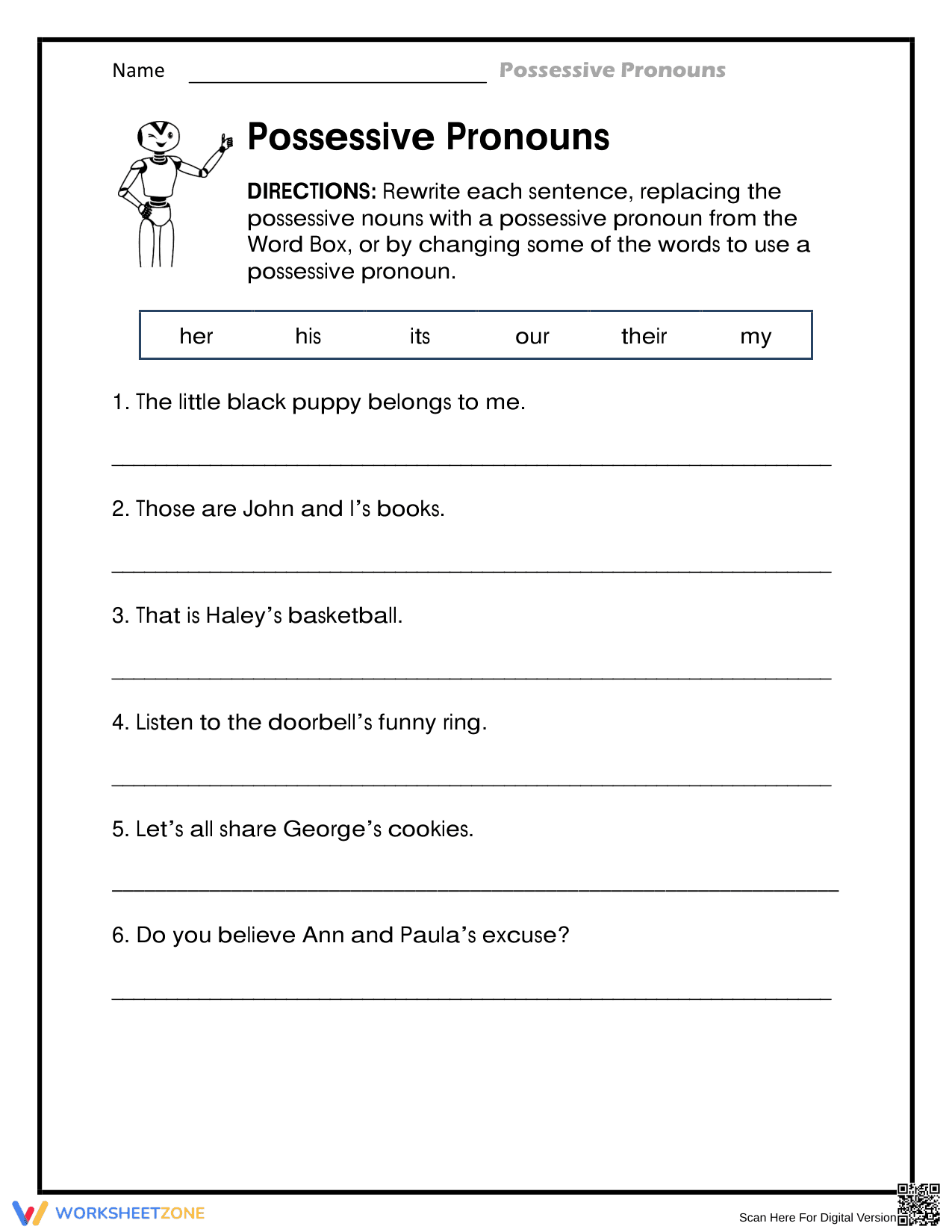
Practice identifying and using possessive pronouns correctly with this targeted worksheet. Students rewrite sentences by replacing possessive nouns or phrases with the correct pronoun from a provided word bank. This exercise strengthens sentence structure and grammatical precision, helping learners master one of the most common conventions of the English language.
At a Glance
- Grade: 3 · Subject: English Language Arts
- Standard:
CCSS.ELA-LITERACY.L.3.1— Demonstrate command of the conventions of standard English grammar and usage in writing- Skill Focus: Possessive Pronouns
- Format: 1 page · 6 problems · Answer key included · PDF
- Best For: Independent grammar practice or quick formative assessment
- Time: 10–15 minutes
What's Inside
This single-page resource features a word box containing six essential possessive pronouns: her, his, its, our, their, and my. Below the reference box, students find six sentences that require rewriting. Some tasks involve replacing a possessive noun (like "Haley's"), while others require broader restructuring to correctly integrate the pronoun. A comprehensive answer key is included for rapid grading.
Zero-Prep Workflow
- Step 1: Print — Download the single-page PDF and print copies for your entire class (30 seconds).
- Step 2: Distribute — Hand out the worksheets as a bell-ringer or a quick transition activity (1 minute).
- Step 3: Review — Check the answers as a class using the provided answer key (5 minutes).
The total teacher preparation time is under two minutes, making it an ideal candidate for emergency sub plans or last-minute grammar reinforcements.
Standards Alignment
Aligned to `CCSS.ELA-LITERACY.L.3.1`, which focuses on the command of the conventions of standard English grammar and usage when writing or speaking. Specifically, it addresses the function of pronouns within sentence structures to avoid redundancy and improve clarity. Both standard codes can be copied directly into lesson plans, IEP goals, or district curriculum mapping tools.
How to Use It
Use this worksheet as a "Check for Understanding" immediately following a direct instruction lesson on possessive pronouns. It works well as a transition activity between whole-group reading and independent writing. For a formative assessment tip, observe students on items 2 and 6; these require recognizing compound possessives, which often reveals deeper misconceptions about pronoun-antecedent agreement. Completion time is typically 12 minutes.
Who It's For
This resource is tailored for third-grade students mastering basic grammar conventions. It provides necessary scaffolding through the word box for English Language Learners (ELL) and students requiring additional literacy support. Pair this worksheet with a mentor text or an anchor chart that visualizes the relationship between personal and possessive pronouns for maximum instructional impact.
According to a RAND AIRS 2024 analysis, targeted grammar practice on specific word functions, such as possessive pronouns, significantly correlates with improved sentence-level writing fluency in the upper primary grades. This worksheet aligns with `CCSS.ELA-LITERACY.L.3.1` by requiring students to accurately replace nouns with pronouns while maintaining logical sentence flow. Research by Fisher & Frey (2014) emphasizes that guided practice within a gradual release of responsibility model is essential for long-term retention of grammatical rules. By providing 6 structured tasks, this resource facilitates the bridge between identifying parts of speech and applying them in original writing. It offers a clear, distraction-free environment for students to master possessive pronouns without the cognitive load of complex vocabulary. This summary is intended for educators citing research-based interventions in their curriculum documentation or professional development portfolios.


