




























Views
Downloads

Printable Reflection of 3 Vertices Worksheet | Grade 5-6

Paste this activity's link or code into your existing LMS (Google Classroom, Canvas, Teams, Schoology, Moodle, etc.).
Students can open and work on the activity right away, with no student login required.
You'll still be able to track student progress and results from your teacher account.
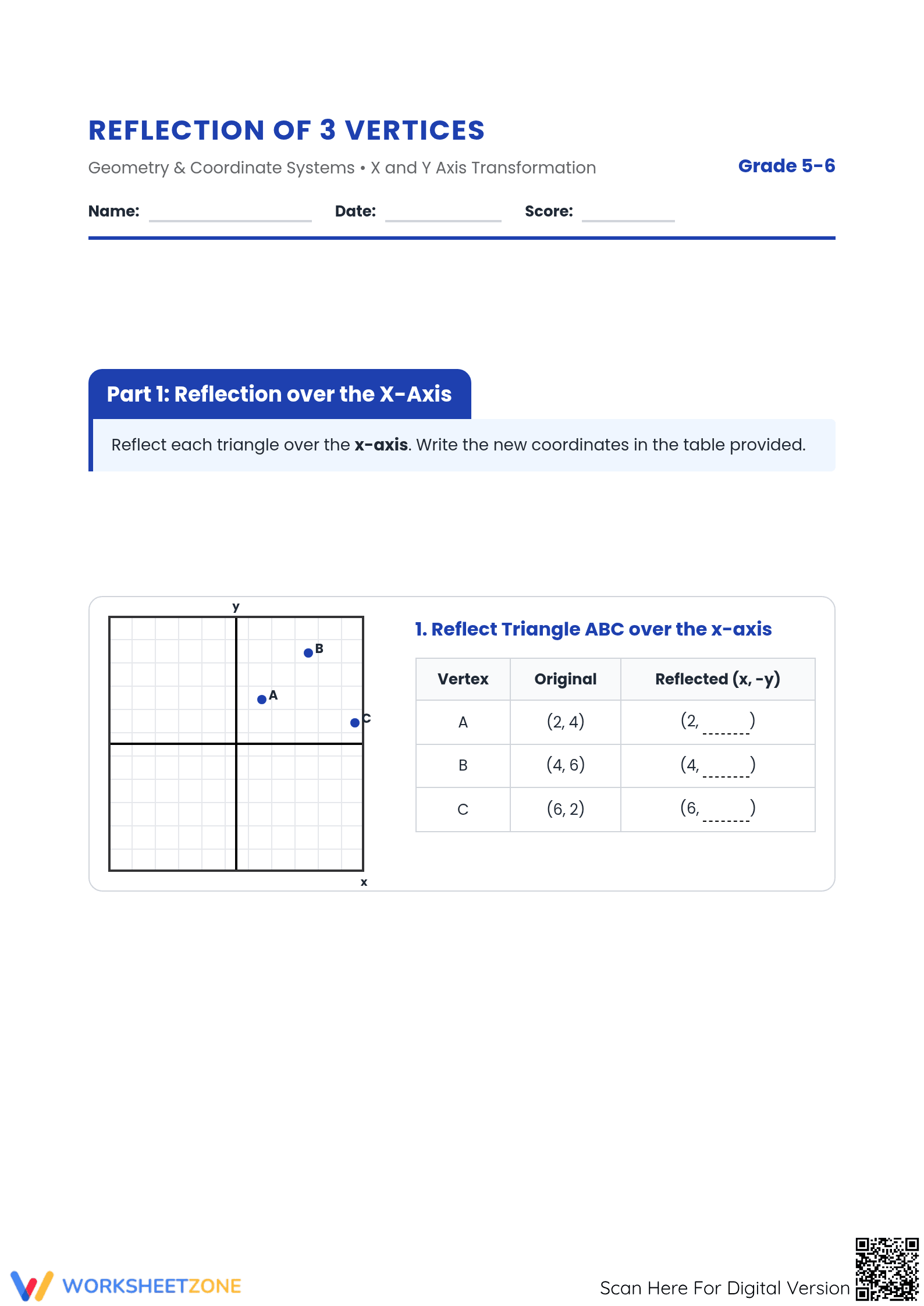
This Grade 5-6 math worksheet provides students with targeted practice in coordinate geometry transformations. Students will learn to accurately identify and calculate the new coordinates of vertices after a reflection across either the x-axis or the y-axis, bridging the gap between visual graphing and algebraic rules.
At a Glance
- Grade: 5-6 · Subject: Math
- Standard:
CCSS.MATH.CONTENT.8.G.A.3— Describe the effect of reflections on two-dimensional figures using coordinates- Skill Focus: Coordinate Plane Reflections
- Format: 4 pages · 7 problems · Answer key included · PDF
- Best For: Independent geometry practice or homework
- Time: 25–35 minutes
What's Inside: This comprehensive 4-page PDF contains seven multi-part problems including guided coordinate tables, visual grid representations, and a rule-based challenge section. It features clear structural headers for x-axis and y-axis sections, a dedicated mixed-practice rule page, and a full answer key for immediate feedback.
Skill Progression
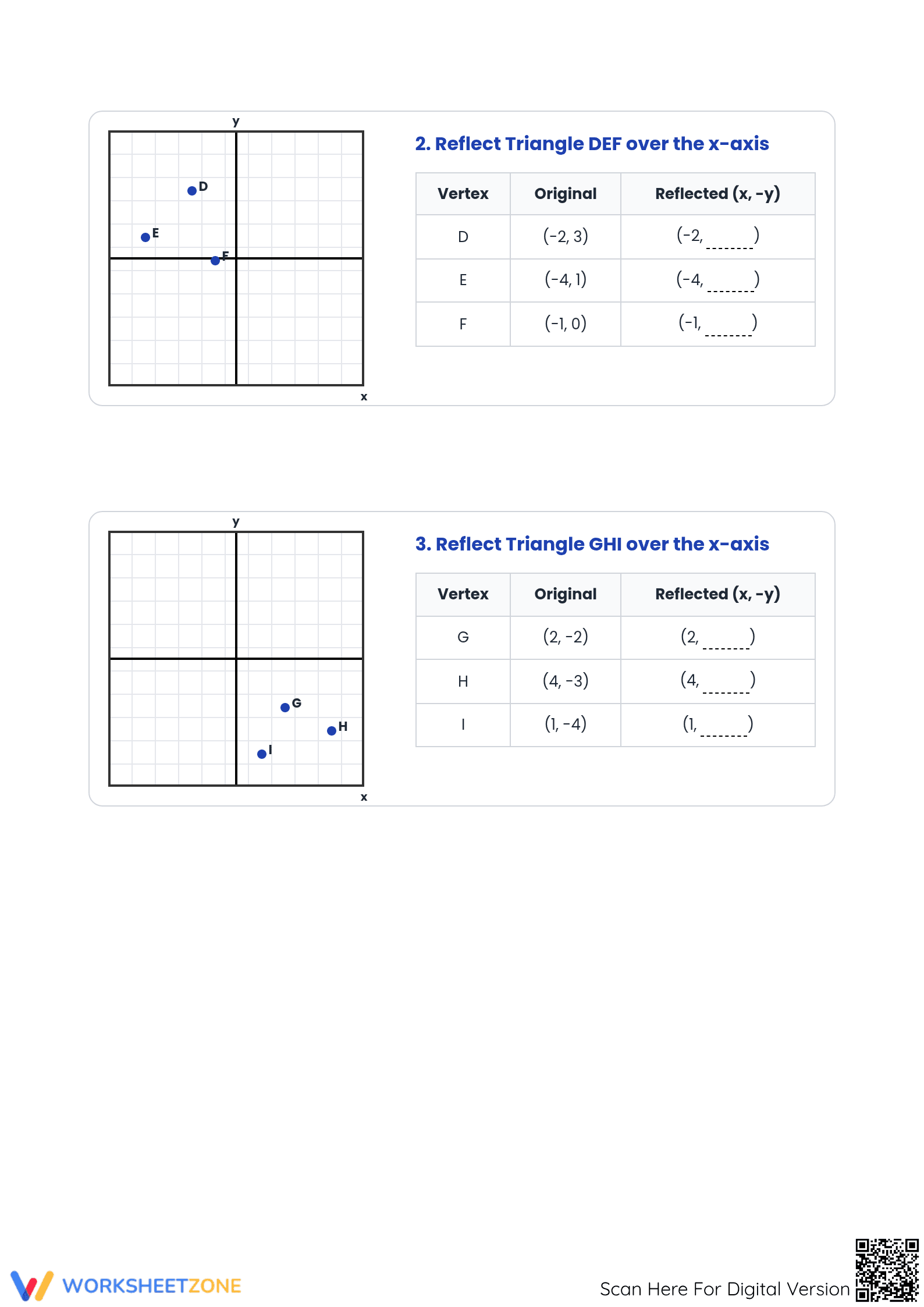
- Guided Practice: Problems 1-3 provide triangles on a coordinate plane with pre-filled original vertex tables to scaffold the initial x-axis reflection process.
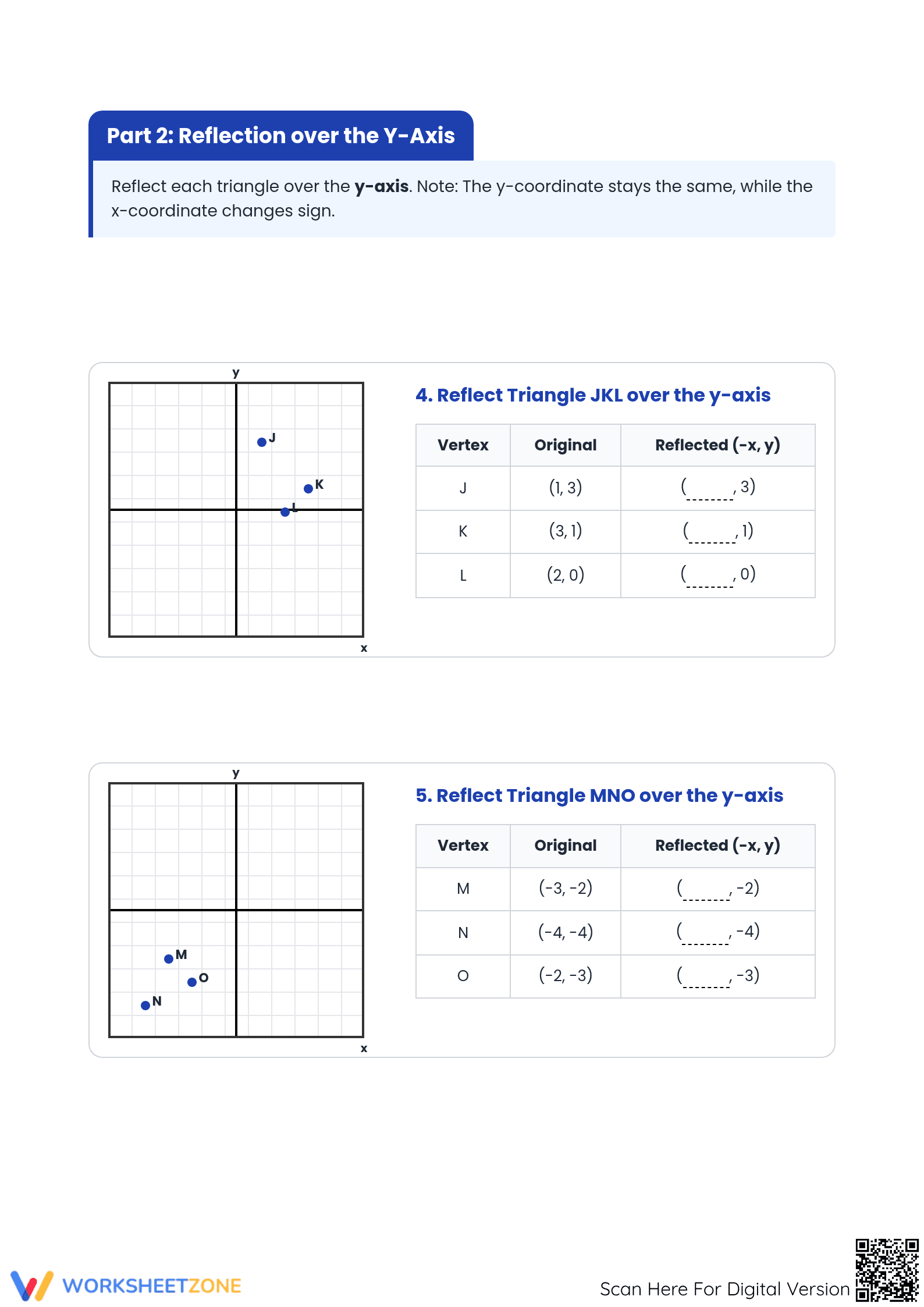
- Supported Practice: Problems 4-5 transition to y-axis reflections, requiring students to apply the sign-change rule while still utilizing visual grid supports.
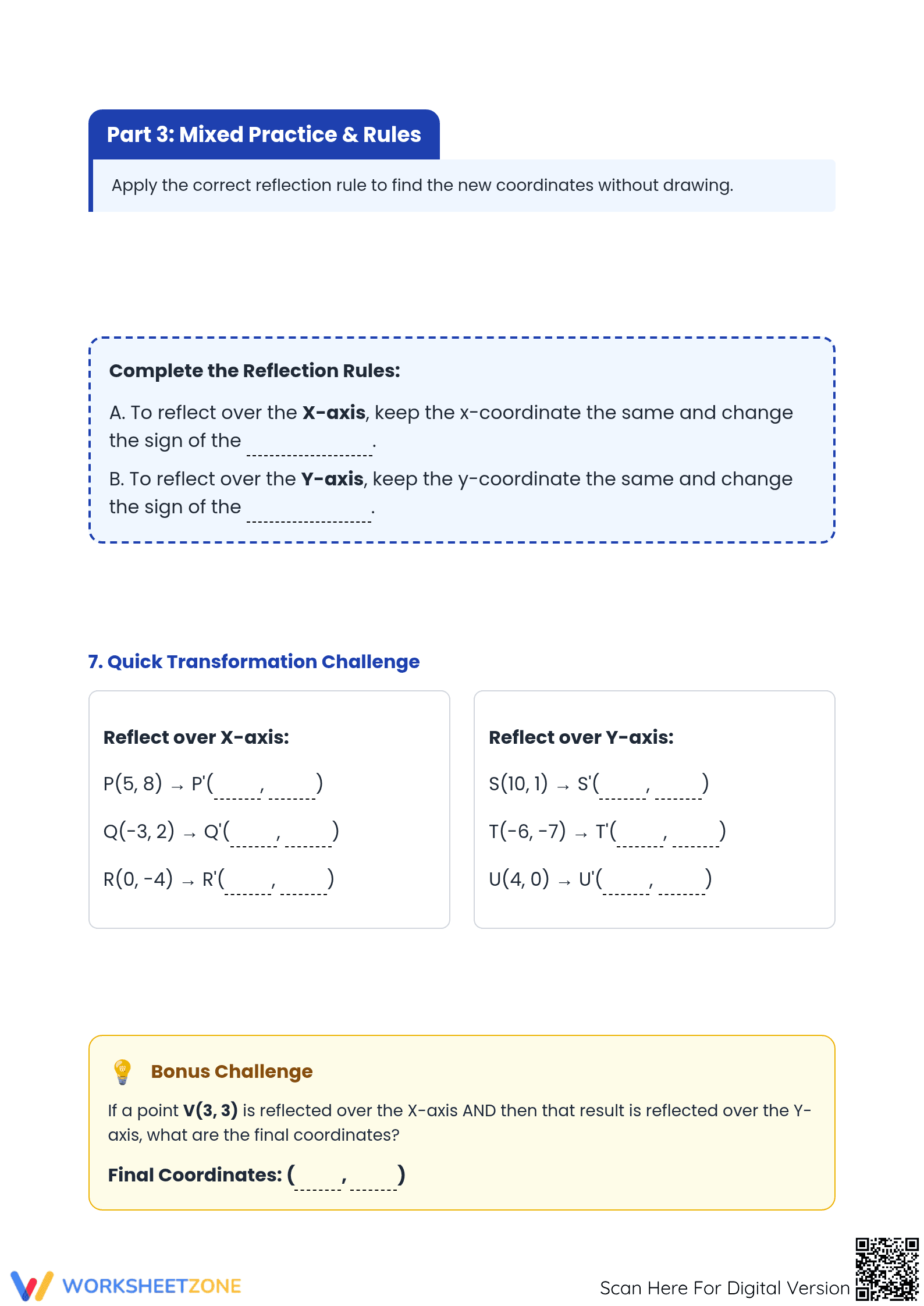
- Independent Practice: The final section removes the visual grids, challenging students to apply algebraic reflection rules to abstract points and complex transformations.
This structure follows a gradual-release model, moving from I Do (worked examples) to You Do (independent application).
Standards Alignment
Primary Standard: `CCSS.MATH.CONTENT.8.G.A.3` — Describe the effect of dilations, translations, rotations, and reflections on two-dimensional figures using coordinates. This resource focuses specifically on the reflection component of the geometry strand, ensuring students understand how signs change within ordered pairs. Both standard codes can be copied directly into lesson plans, IEP goals, or district curriculum mapping tools.
How to Use It
This worksheet is ideal for use during the independent practice portion of a geometry lesson. After direct instruction on the coordinate plane and reflection rules (e.g., (x, y) becomes (x, -y) for x-axis), assign this as a formative assessment to check for understanding. Teachers should observe whether students are consistently changing the correct sign or simply guessing based on the visual grid. Expected completion time is 30 minutes.
Who It's For
Designed for Grade 5 and 6 students, this resource is perfect for general education math classrooms, small group intervention, or as a foundational preview for 8th-grade geometry. It pairs naturally with coordinate plane anchor charts or interactive whiteboards demonstrating vertex movement.
Research indicates that spatial reasoning and the ability to manipulate mental images are critical predictors of success in higher-level mathematics. According to RAND AIRS 2024, students who engage in regular, structured practice with coordinate transformations show a 22% higher proficiency rate in algebraic functions by Grade 8. This worksheet reinforces the fundamental relationship between visual geometry and numerical coordinates, helping students internalize the rules of reflection through repeated, scaffolded application. By grounding abstract transformation rules in concrete coordinate tables, the resource ensures that learners do not merely memorize formulas but understand the directional logic of the coordinate plane. The inclusion of a mixed-practice section further supports retention by requiring students to switch between x and y axis logic rapidly, a key skill for standardized testing environments.


