


























Views
Downloads

Reduce Reuse Recycle Worksheet | Grade 5 Printable
Paste this activity's link or code into your existing LMS (Google Classroom, Canvas, Teams, Schoology, Moodle, etc.).
Students can open and work on the activity right away, with no student login required.
You'll still be able to track student progress and results from your teacher account.
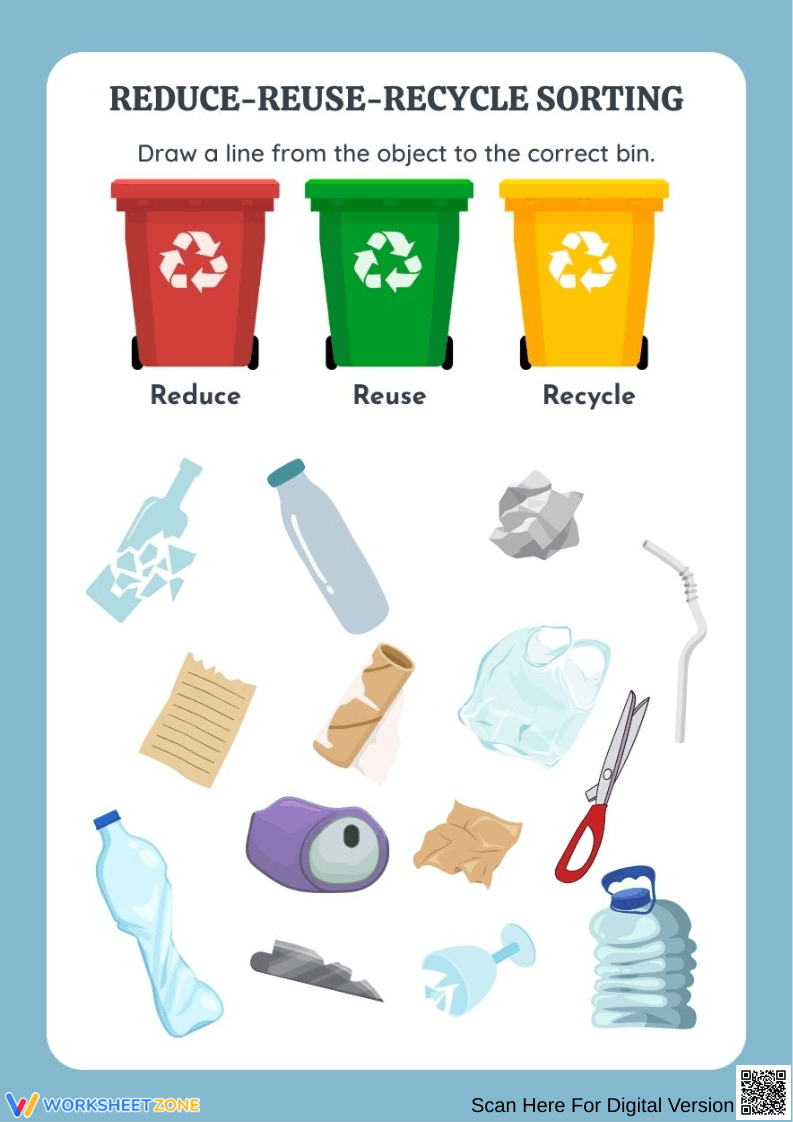
This environmental science worksheet helps students master waste management by categorizing everyday items into reduce, reuse, and recycle bins. By drawing lines from 14 objects to their correct disposal method, learners actively apply sustainability concepts to real-world scenarios.
At a Glance
- Grade: 5 · Subject: Science
- Standard:
5-ESS3-1— Identify ways to protect Earth's resources and environment- Skill Focus: Waste sorting and sustainability
- Format: 1 page · 14 problems · Answer key included · PDF
- Best For: Independent practice or centers
- Time: 10–15 minutes
This resource features a visual, single-page matching activity designed for immediate classroom application. Students see three color-coded bins—red for reduce, green for reuse, and yellow for recycle. Surrounding the bins are 14 illustrated objects, including plastic bottles, cardboard tubes, and broken glass. Students evaluate each item's environmental impact to draw a connecting line. A complete answer key ensures accurate grading and facilitates class discussions.
This resource is optimized for a zero-prep workflow, making it an excellent choice for busy educators.
- Print (1 minute): The single-page layout prints cleanly, requiring no special formatting.
- Distribute (1 minute): Hand out the activity alongside standard writing utensils.
- Review (3 minutes): Use the included answer key to quickly check student work or project it for a whole-class review.
With teacher preparation under two minutes, this activity functions perfectly as morning work, a science center, or a reliable sub plan.
This activity aligns with 5-ESS3-1: Obtain and combine information about ways individual communities use science ideas to protect the Earth's resources and environment. By categorizing waste, students demonstrate practical conservation methods. Both standard codes can be copied directly into lesson plans, IEP goals, or district curriculum mapping tools.
Deploy this sorting activity during the instructional block after a direct lesson on the 3 R's. It serves as effective independent practice to solidify concepts. Alternatively, use it as a formative assessment. While students work, observe how they distinguish between items that can be reused versus recycled. The expected completion time ranges from 10 to 15 minutes.
This worksheet is designed for elementary students studying Earth science and human impact. The visual matching task provides built-in differentiation, making it accessible for English Language Learners and students requiring visual scaffolds. Pair this activity with an anchor chart detailing the lifecycle of plastics or a reading passage on community recycling.
Effective environmental education requires students to translate abstract sustainability concepts into concrete behaviors. When learners engage with the 5-ESS3-1 standard to identify ways to protect Earth's resources and environment, they build critical thinking skills necessary for ecological literacy. According to a ScienceDirect TpT Analysis, visual sorting tasks significantly improve retention of categorical data by forcing students to evaluate multiple attributes simultaneously. By categorizing common household waste into reduce, reuse, and recycle bins, students move beyond rote memorization and analyze their consumption habits. This approach reinforces core science standards and promotes long-term behavioral changes regarding waste management. Structured matching activities provide cognitive scaffolding to help young learners process complex environmental systems.


