


























Views
Downloads

Grade 1 Reduce, Reuse, Recycle — Printable No-Prep Worksheet
Paste this activity's link or code into your existing LMS (Google Classroom, Canvas, Teams, Schoology, Moodle, etc.).
Students can open and work on the activity right away, with no student login required.
You'll still be able to track student progress and results from your teacher account.
This worksheet helps first-grade students understand the core concepts of environmental conservation: reduce, reuse, and recycle. Through a simple, visual activity, learners will categorize everyday objects and scenarios to decide the best way to minimize environmental impact, building foundational knowledge for future science and social studies topics.
At a Glance
- Grade: 1 · Subject: Science
- Standard:
K-ESS3-3— Communicate solutions that reduce human impact on the environment.- Skill Focus: Reduce, Reuse, Recycle
- Format: 1 page · 6 problems · Answer key included · PDF
- Best For: Introduction to conservation, Earth Day activity
- Time: 10–15 minutes
What's Inside
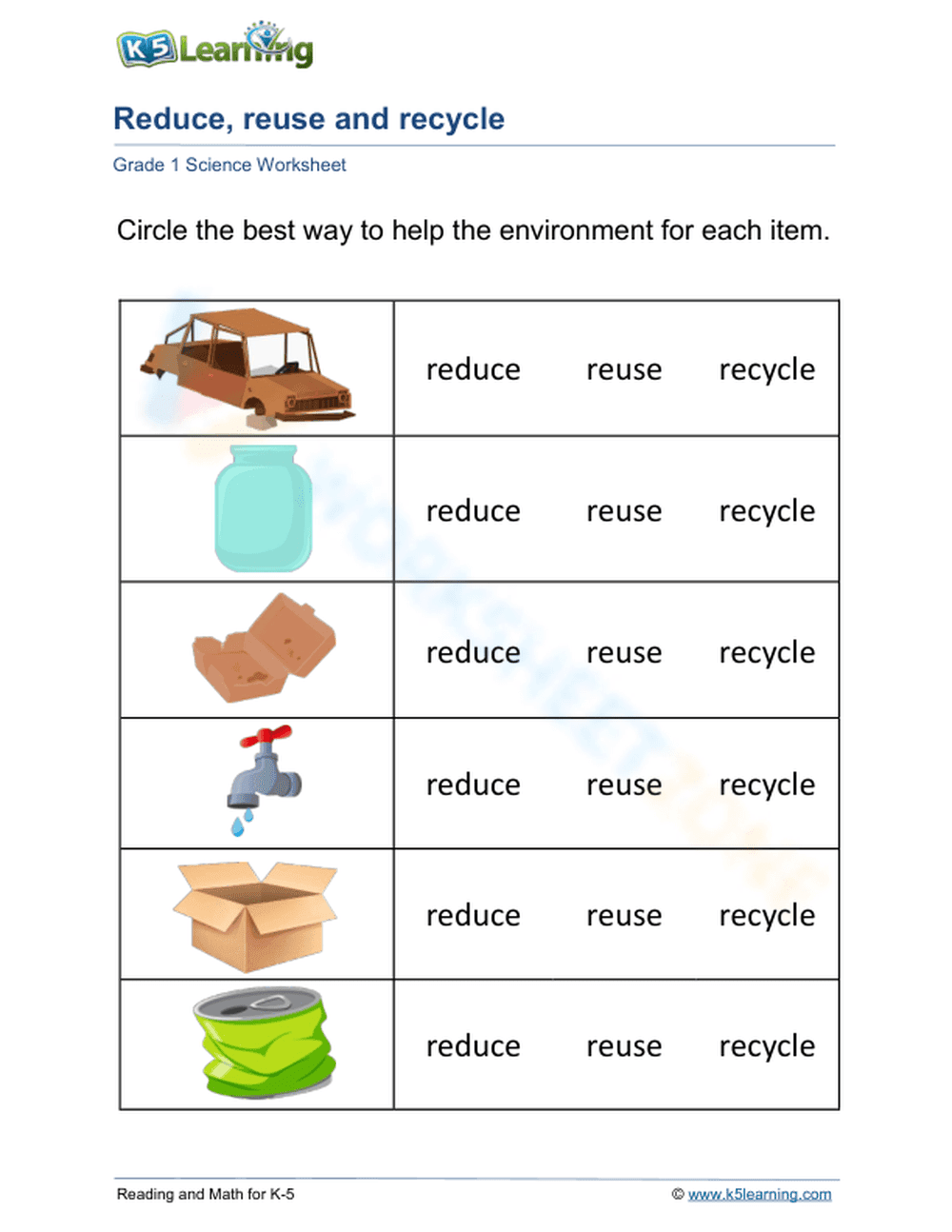
This single-page PDF features six illustrated items (e.g., glass jar, dripping faucet). Students circle one of three choices—"reduce," "reuse," or "recycle"—for each. The multiple-choice format is ideal for young learners. A full answer key is included for fast grading.
A Simple, No-Prep Workflow
Designed for busy teachers, this worksheet is ready in minutes.
- Print (1 min): The resource is a single, printer-friendly PDF.
- Distribute (1 min): Pass out the worksheets and explain the simple direction to circle the best choice. No complex setup is needed.
- Review (5 mins): Use the included answer key to review answers as a class or grade papers individually.
With under two minutes of prep time, this activity is perfect for a substitute plan, a science center, or a quick introduction to a conservation unit.
Standards-Aligned for Foundational Science
This worksheet supports skills in the Next Generation Science Standards, primarily aligning to K-ESS3-3. This standard requires students to "Communicate solutions that will reduce the impact of humans on the...environment." By choosing whether to reduce, reuse, or recycle, students engage with solutions that lessen environmental impact. The standard code can be copied directly into lesson plans or curriculum maps.
How to Use This Worksheet
Use this resource before, during, or after direct instruction. As a pre-assessment, it reveals prior knowledge of the "three R's." As practice, it reinforces concepts after a lesson. For formative assessment, observe student choices to identify misconceptions about reusing versus recycling. The worksheet can be completed in 10-15 minutes, making it a perfect warm-up or closing activity.
Who It's For
This activity is designed for first-grade students. The clear images and simple text make it accessible for English language learners and students with emerging literacy skills. For support, complete the first item together. This worksheet pairs well with an anchor chart that defines the key terms or after reading a story about taking care of the planet.
This first-grade science worksheet offers practice on the environmental concept of "Reduce, Reuse, Recycle." It aligns with NGSS standard K-ESS3-3, which requires learners to communicate solutions that reduce human impact on the environment. By choosing the best conservation method for six items, students apply scientific principles to everyday situations. This type of explicit, solution-oriented instruction is crucial for building environmental literacy. Research from the RAND Corporation shows that early exposure to core scientific concepts, like human-environment interaction, is a predictor of later science achievement (RAND AIRS 2024). This exercise serves as a practical tool for introducing these ideas in a concrete, accessible way, laying the groundwork for more advanced ecological understanding.


