


























Views
Downloads

Grade 3 Recycling — Printable No-Prep Worksheet
Paste this activity's link or code into your existing LMS (Google Classroom, Canvas, Teams, Schoology, Moodle, etc.).
Students can open and work on the activity right away, with no student login required.
You'll still be able to track student progress and results from your teacher account.
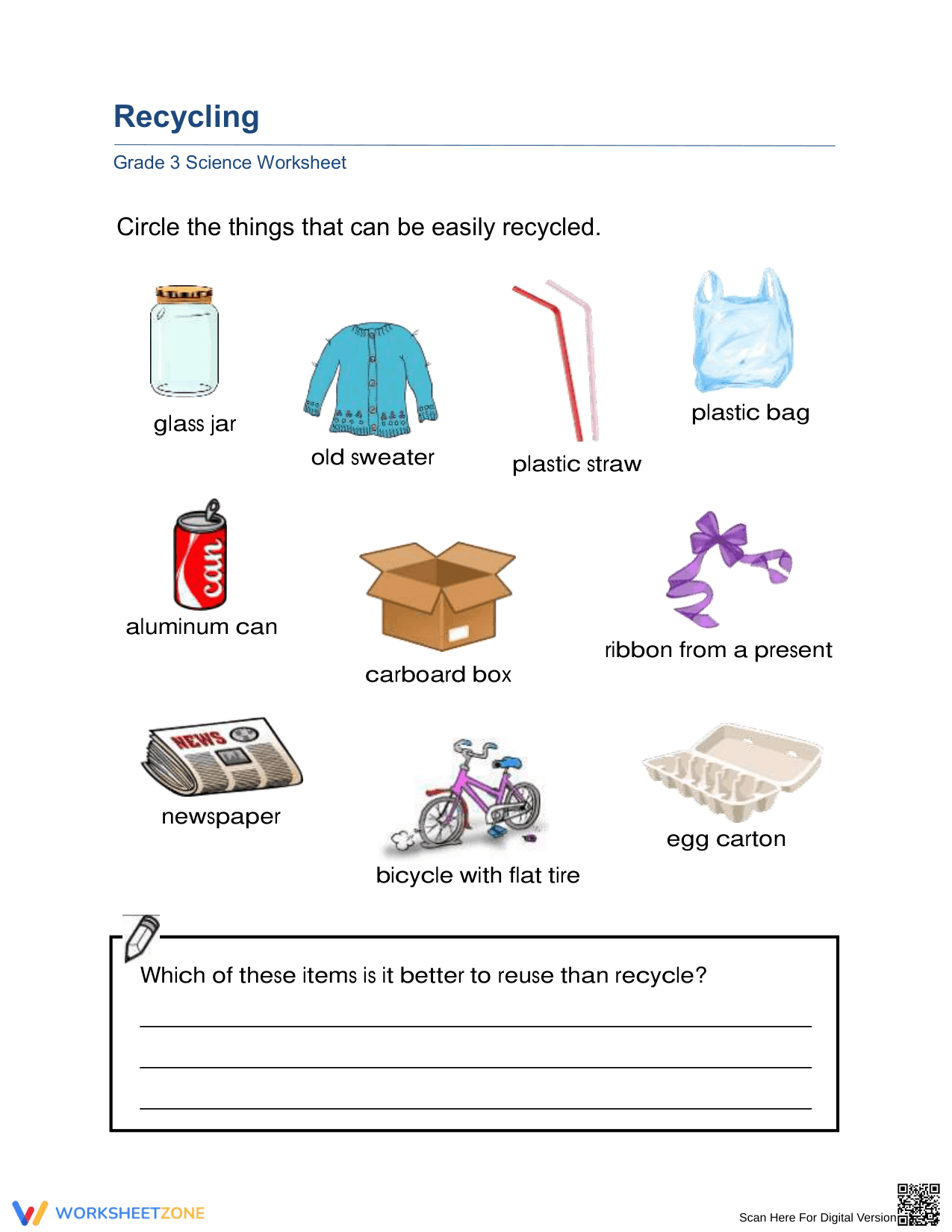
This essential Grade 3 science worksheet helps students identify common household items that can be recycled. Through a clear, visual-based activity, learners practice classifying materials and consider the difference between reusing and recycling, a key concept in environmental science. It provides focused practice for understanding human impact.
At a Glance
- Grade: 3 · Subject: Science
- Standard:
3-5-ETS1-2— Generate and compare solutions for reducing waste.- Skill Focus: Identifying Recyclable Materials
- Format: 1 page · 2 problems · Answer key · PDF
- Best For: Independent practice, Earth Day activity
- Time: 10–15 minutes
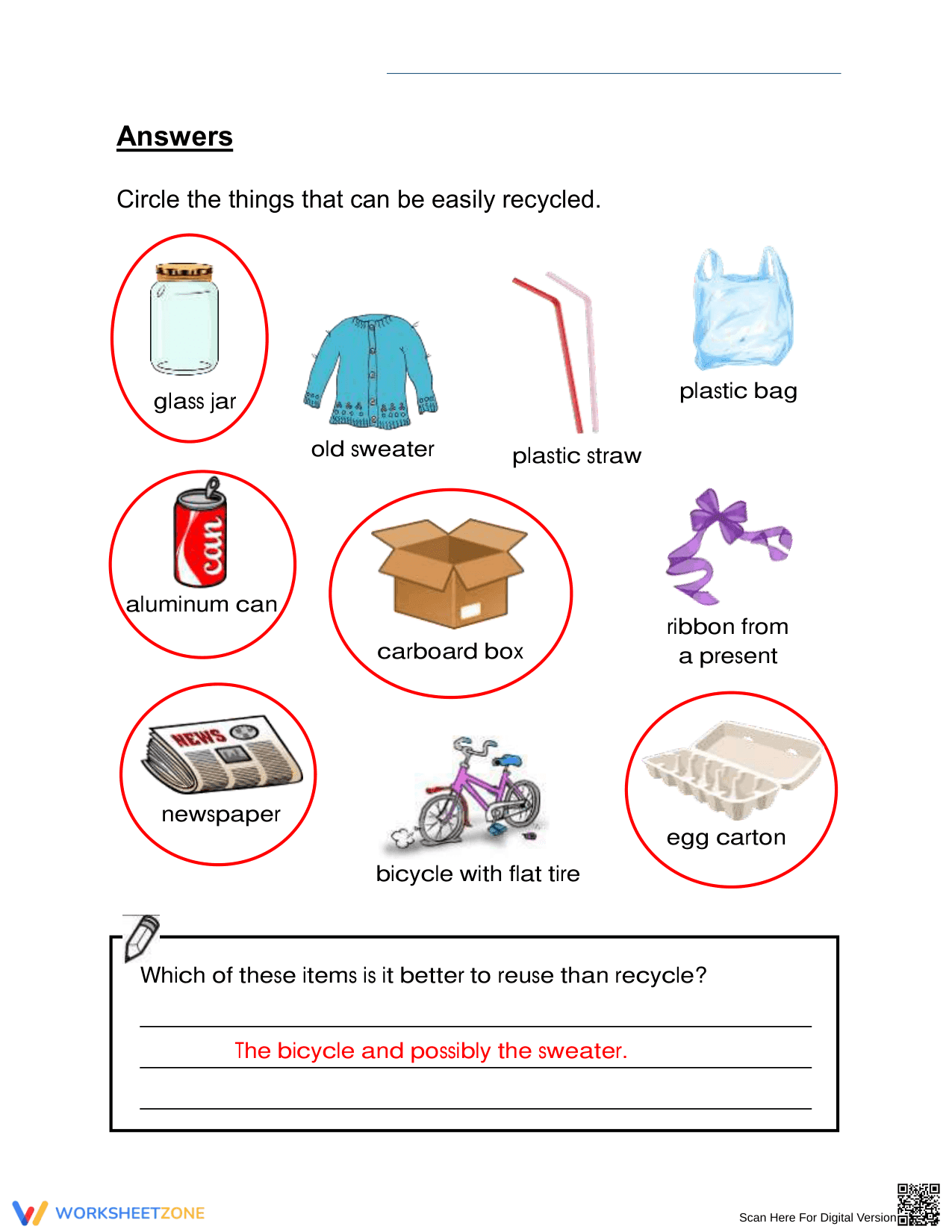
This single-page PDF includes two distinct tasks. The main activity asks students to circle images of recyclable items from a field of 10 common objects. A follow-up question prompts students to write which items are better to reuse than recycle. A complete answer key is provided for quick grading.
Designed for the busy classroom, this worksheet is a true print-and-go resource with under two minutes of prep time.
- Print: The resource is a single, printer-friendly page.
- Distribute: Self-contained instructions let students start immediately.
- Review: Use the included answer key to quickly check work or guide a discussion.
It is an ideal choice for a science center, a sub plan, or homework.
This worksheet aligns with NGSS standard 3-5-ETS1-2, which involves comparing solutions to a problem. Asking students to identify items for recycling (one solution) and consider reuse (a second) directly supports this engineering standard. It provides a practical foundation for understanding how science protects the environment. The standard code can be copied directly into lesson plans.
This versatile worksheet is perfect as an introductory activity to gauge prior knowledge before a unit on natural resources. Alternatively, assign it as independent practice after direct instruction on recycling. For a formative assessment, observe which items students circle. The activity is designed to be completed in 10-15 minutes, making it an effective warm-up or exit ticket.
This resource is designed for Grade 3 science students but can be adapted for 2nd or 4th graders. The clear images support all learners, including English Language Learners. Pair this worksheet with an anchor chart showing different material types (plastic, glass, paper) to provide additional scaffolding.
This Grade 3 recycling worksheet offers a concrete application of standard 3-5-ETS1-2, where students compare solutions to environmental problems. By asking learners to differentiate recyclable and non-recyclable items, the activity builds knowledge for protecting Earth’s resources. This hands-on classification aligns with findings from Fisher & Frey (2014) on purposeful, application-based tasks. The worksheet’s focus on distinguishing between reusing and recycling introduces optimizing solutions. The exercise shows how individual choices, informed by material properties, contribute to environmental solutions. This approach—linking a simple task to a complex, real-world problem—is critical for developing scientific literacy and agency in young learners.


