


























Views
Downloads

Printable Sight Words Worksheet | Kindergarten ELA
Paste this activity's link or code into your existing LMS (Google Classroom, Canvas, Teams, Schoology, Moodle, etc.).
Students can open and work on the activity right away, with no student login required.
You'll still be able to track student progress and results from your teacher account.
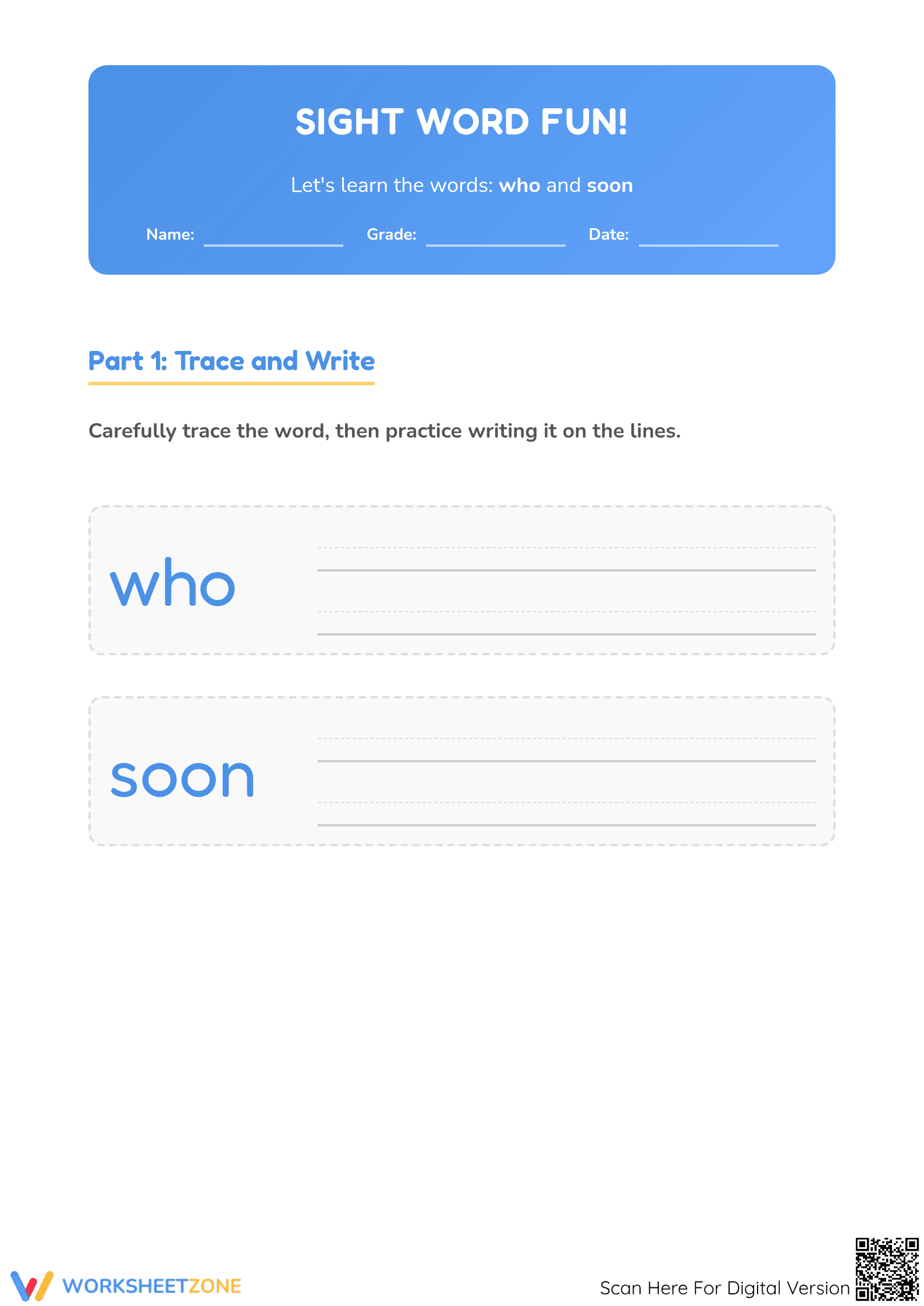
Help your early readers build fluency and confidence with this focused sight word practice set. This resource targets the high-frequency words "who" and "soon" through a multi-sensory approach that combines tactile tracing, visual discrimination, and contextual application. By the end of these activities, students will move from simple recognition to independent usage in complete sentences.
At a Glance
- Grade: Kindergarten · Subject: ELA
- Standard:
CCSS.ELA-LITERACY.RF.K.3.C— Read common high-frequency words by sight- Skill Focus: Sight word recognition and spelling
- Format: 2 pages · 9 tasks · Answer key included · PDF
- Best For: Morning work or literacy centers
- Time: 15–20 minutes
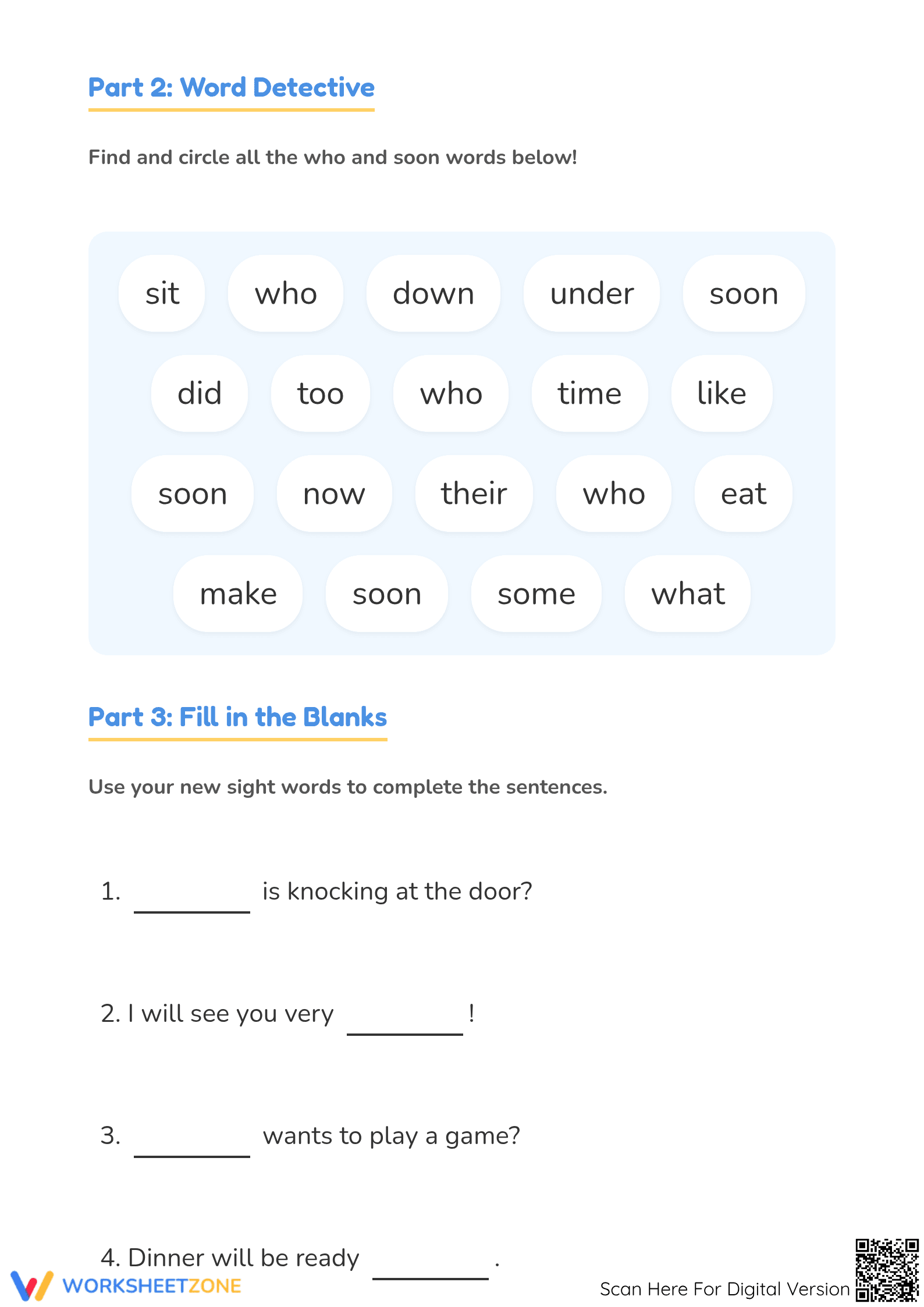
What's Inside: This 2-page PDF includes three distinct instructional sections designed to reinforce word retention. Page one features large-format tracing and writing lines for motor memory. Page two contains a "Word Detective" visual search grid and four fill-in-the-blank sentences that require students to apply their knowledge in a linguistic context. A full answer key is provided for quick grading or student self-correction.
Zero-Prep Workflow: This resource is designed for immediate classroom implementation with three simple steps. First, print the 2-page document (30 seconds). Second, distribute the sheets to your literacy centers or small groups (1 minute). Third, review the completed sentences using the included answer key to check for comprehension and spelling accuracy (1 minute). This streamlined process makes it an ideal choice for emergency sub plans or busy morning transitions.
Standards Alignment: This worksheet is directly aligned to `CCSS.ELA-LITERACY.RF.K.3.C`, which requires students to read common high-frequency words by sight (e.g., the, of, to, you, she, my, is, are, do, does). By focusing specifically on "who" and "soon," it provides the targeted repetition necessary for mastery. Both standard codes can be copied directly into lesson plans, IEP goals, or district curriculum mapping tools.
How to Use It: Use this worksheet during the "You Do" phase of a gradual release lesson after introducing the words on an anchor chart. It also serves as an excellent formative assessment; observe students during the "Word Detective" portion to see if they can distinguish the target words from similar-looking distractors like "some" or "what." Expect most Kindergarten students to complete both pages within 20 minutes.
Who It's For: This resource is tailored for Kindergarten students and advanced Preschoolers beginning their reading journey. It is also highly effective for English Language Learners (ELLs) who need explicit practice with common English function words. Pair this worksheet with a sight word flashcard set or a leveled reader that features these specific high-frequency words for maximum impact.
According to research by Fisher & Frey (2014) on the gradual release of responsibility, students require multiple exposures to high-frequency vocabulary across different modalities to achieve automaticity. This worksheet facilitates that process by moving from the mechanical act of tracing to the cognitive challenge of identifying words within a field of distractors and finally to the application of those words in syntax. The inclusion of the CCSS.ELA-LITERACY.RF.K.3.C standard ensures that the tasks are developmentally appropriate for the Kindergarten level, focusing on the specific high-frequency words "who" and "soon." By providing a structured environment for these 9 tasks, the resource helps bridge the gap between isolated word recognition and fluent reading. Educators can use the results of the fill-in-the-blank section as a reliable indicator of whether a student has moved the target words into their long-term sight vocabulary, allowing for data-driven instructional decisions in the early childhood classroom.


