


























Views
Downloads




Ready Vague Claims Revision Worksheet | Grade 12 English IV
Paste this activity's link or code into your existing LMS (Google Classroom, Canvas, Teams, Schoology, Moodle, etc.).
Students can open and work on the activity right away, with no student login required.
You'll still be able to track student progress and results from your teacher account.
This rigorous Grade 12 writing worksheet trains students to identify and revise unsupported generalizations, absolute claims, and unanchored demonstrative pronouns. Working with a sustained expository case study on municipal governance, learners transform informal, sweeping prose into disciplined, calibrated academic arguments suited for university-level composition.
At a Glance
- Grade: 12 · Subject: English IV
- Standard:
W.11-12.5— Strengthen writing by revising for clear referents, precision, and tone- Skill Focus: Revise Vague Claims and Referents
- Format: 6 pages · 12 problems · Answer key included · PDF
- Best For: Advanced high school rhetoric and revision
- Time: 45–60 minutes
What's Inside
This 6-page instructional resource contains an informational anchor text, a reference guide detailing the governing principles of academic revision, and 12 tiered revision tasks. Students work through multiple-choice diagnostic items, targeted sentence repairs, a two-column revision matrix, and sustained paragraph-level syntheses. A thorough 3-page answer key provides complete model revisions and diagnostic explanations.
Skill Progression
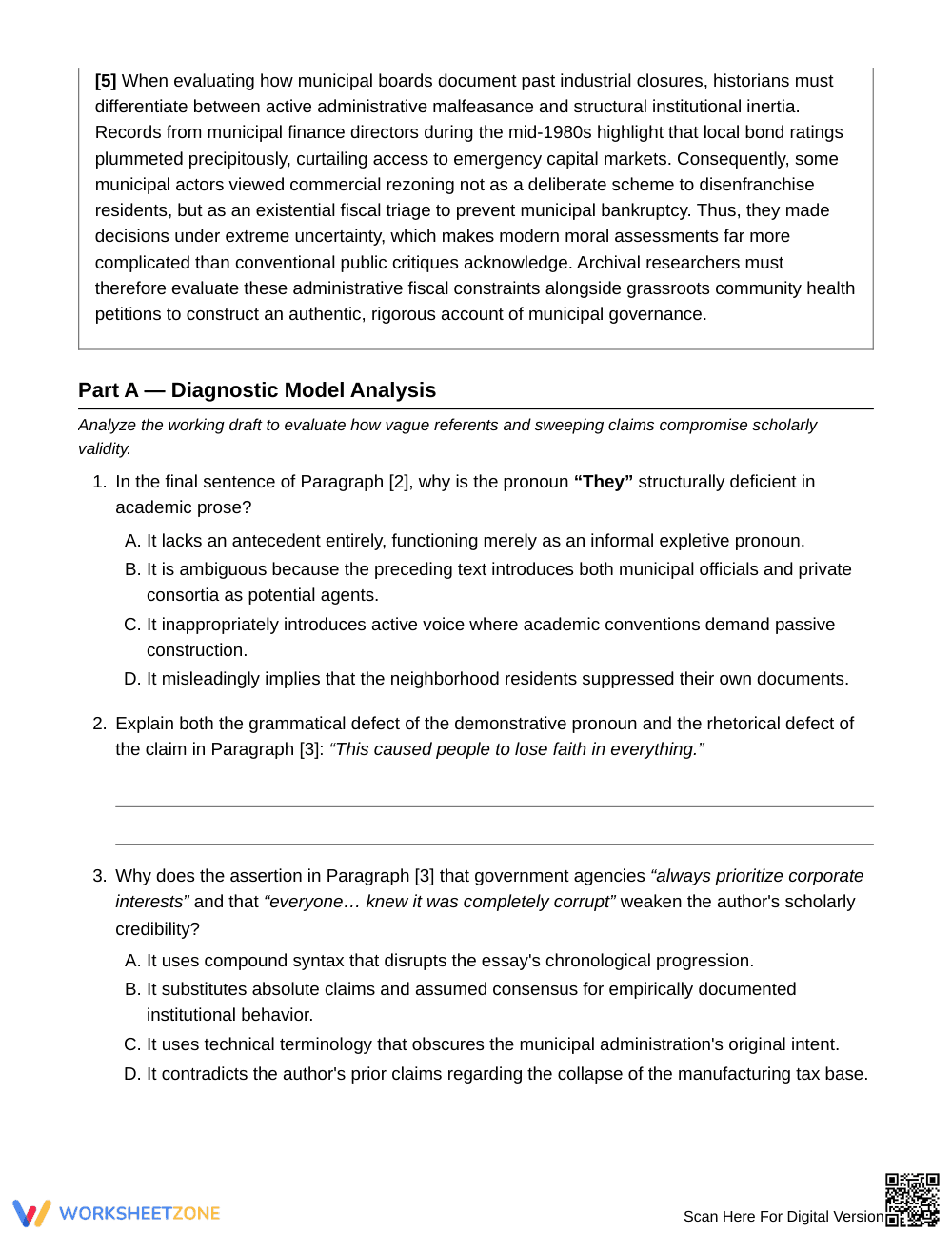
- Guided practice (Tasks 1–3): Diagnostic analysis evaluating why broad pronouns like “they” and sweeping declarations undermine scholarly validity in provided draft models.
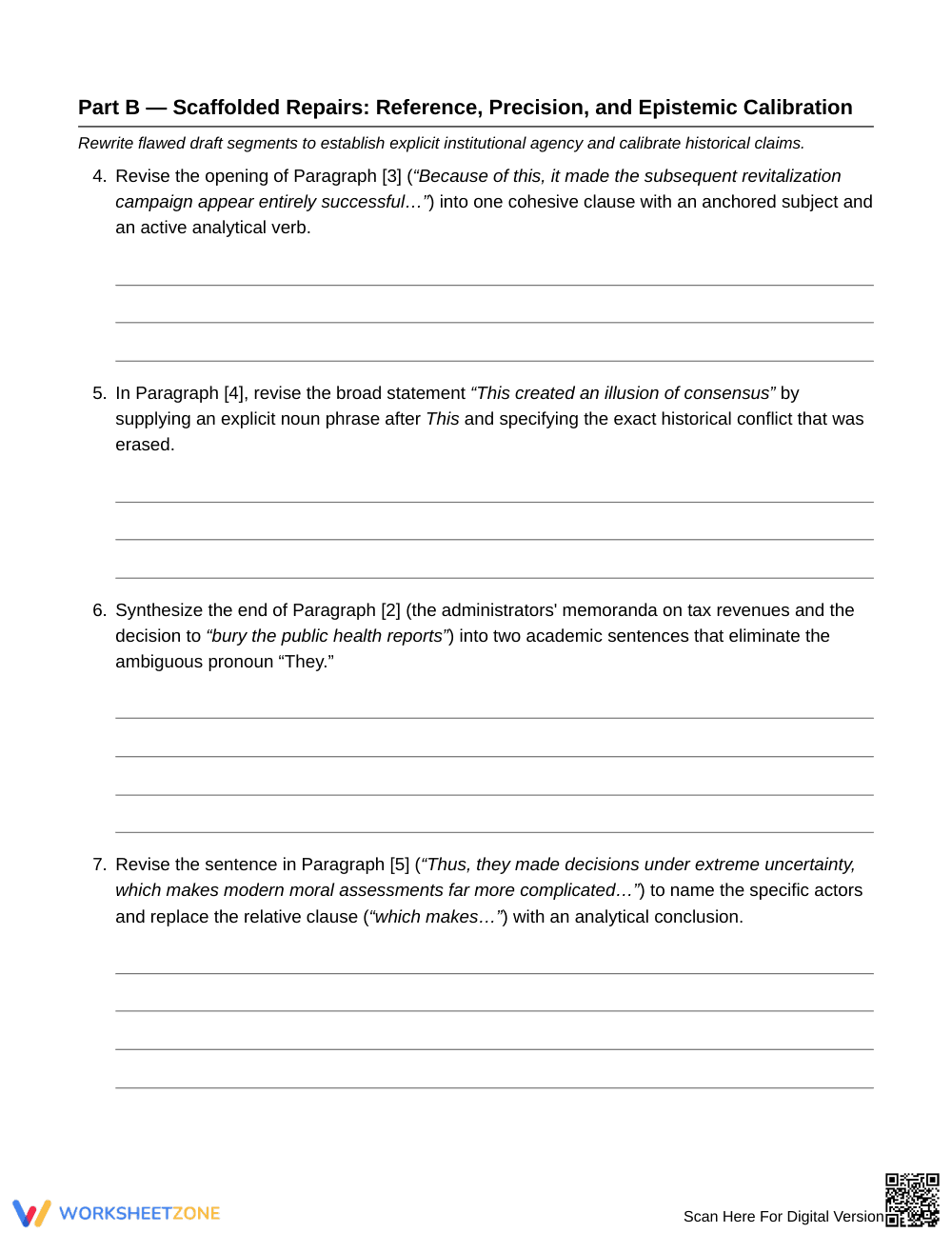
- Supported practice (Tasks 4–9): Scaffolded sentence revisions and a comparative matrix requiring students to supply concrete noun phrases, establish active agents, and apply epistemic hedges.
- Independent practice (Tasks 10–12): Autonomous paragraph-length syntheses reconciling conflicting archival evidence and evaluating how specific agent attribution impacts historical accountability.
This structured progression reflects the gradual release of responsibility model, guiding students systematically from diagnostic critique to autonomous prose calibration.
Standards Alignment
Primary Standard: W.11-12.5 — Develop and strengthen writing as needed by planning, revising, editing, rewriting, or trying a new approach, focusing on addressing what is most significant for a specific purpose and audience. Supporting standard L.11-12.1 emphasizes command of grammar and usage when anchoring ambiguous referents. Both standard codes can be copied directly into lesson plans, IEP goals, or district curriculum mapping tools.
How to Use It
Deploy this worksheet after direct instruction on academic register or during a dedicated revision workshop within an argumentative research unit. As a formative check, examine student responses to Task 5 to ensure they supply precise administrative agents rather than swapping one vague pronoun for another. The complete sequence spans 45–60 minutes of focused instructional time.
Who It's For
Engineered for Grade 12 English IV, AP Language, and transitional college composition classrooms. It offers substantial scaffolding for students who struggle to articulate nuanced assertions without relying on conversational superlatives. Pair this packet directly with an anchor chart on epistemic hedging or an institutional document analysis lesson.
Secondary writers often rely on ambiguous demonstrative pronouns and absolute assertions when summarizing complex expository accounts. Grounded in the W.11-12.5 standard, this instructional activity targets the elimination of vague claims and unanchored referents through rigorous, evidence-based text reconstruction. According to research on explicit writing instruction by Fisher & Frey (2014), gradual release frameworks that guide students from diagnostic text analysis to targeted sentence rewriting and autonomous synthesis significantly enhance rhetorical command and syntactic control. By interrogating archival records surrounding municipal planning decisions, Grade 12 learners dismantle ungrounded generalizations such as broad collective nouns and unanchored demonstratives, substituting disciplined epistemic hedges and institutionally precise agents. This intentional transition from surface editing to structural epistemic refinement directly reinforces critical literacy demands established across pre-collegiate coursework, cultivating the analytical precision required for independent collegiate scholarship and authentic civic discourse.


