


























Views
Downloads



Ready Tone & Flow Revision Worksheet | Grade 12 English IV
Paste this activity's link or code into your existing LMS (Google Classroom, Canvas, Teams, Schoology, Moodle, etc.).
Students can open and work on the activity right away, with no student login required.
You'll still be able to track student progress and results from your teacher account.
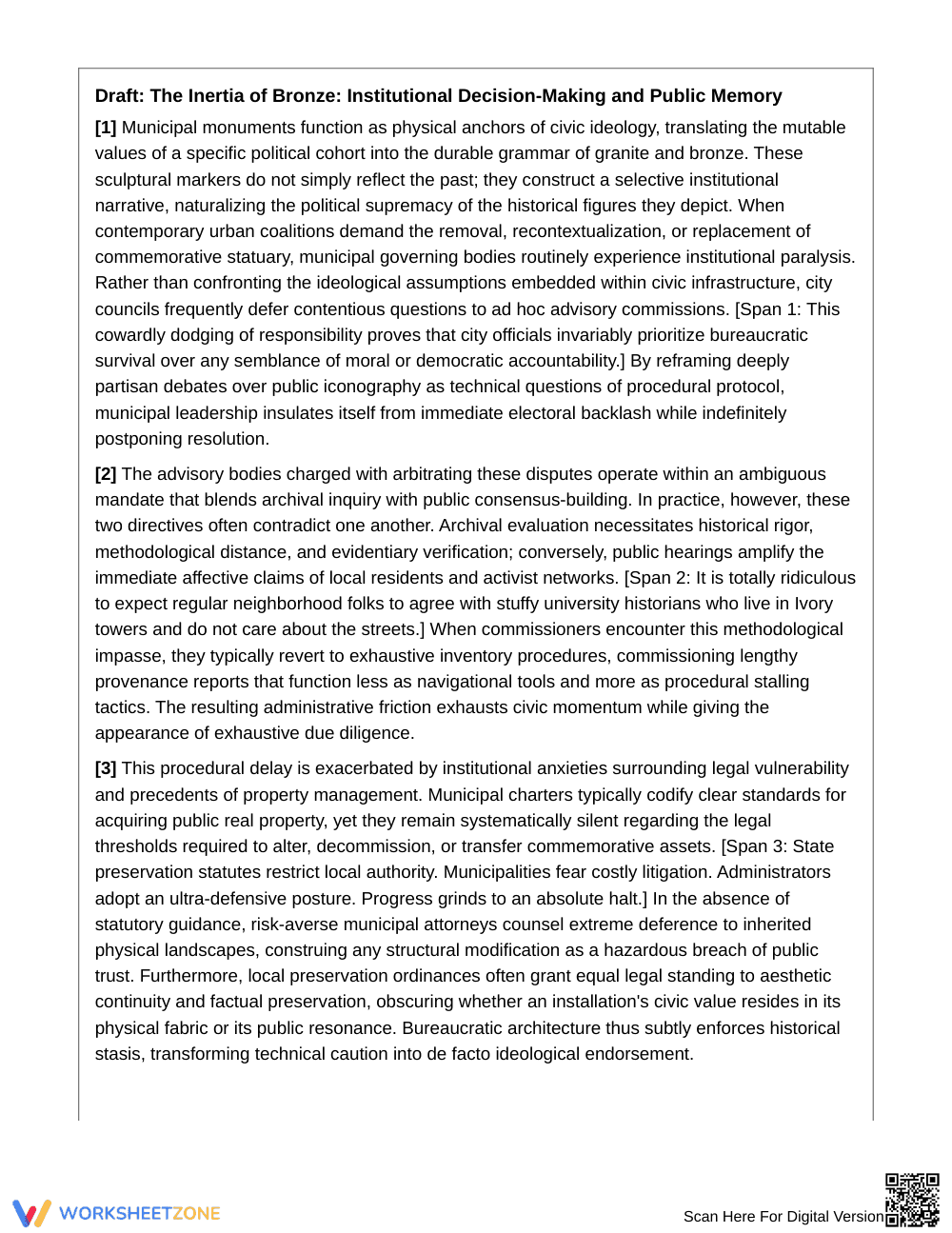
This advanced revision worksheet trains Grade 12 students to refine academic register, epistemic qualification, and paragraph cohesion. Working with an analytical draft on civic monuments, learners transform hyperbole, absolute claims, and fragmented syntax into disciplined, evidence-aligned prose suitable for college-level research.
At a Glance
- Grade: 12 · Subject: English IV
- Standard:
W.11-12.5— Strengthen writing by revising tone, evidence scope, and syntactic cohesion- Skill Focus: Connect Tone, Qualification, and Paragraph Flow
- Format: 6 pages · 12 problems · Answer key included · PDF
- Best For: Drafting revision and rhetorical analysis
- Time: 45–60 minutes
What's Inside
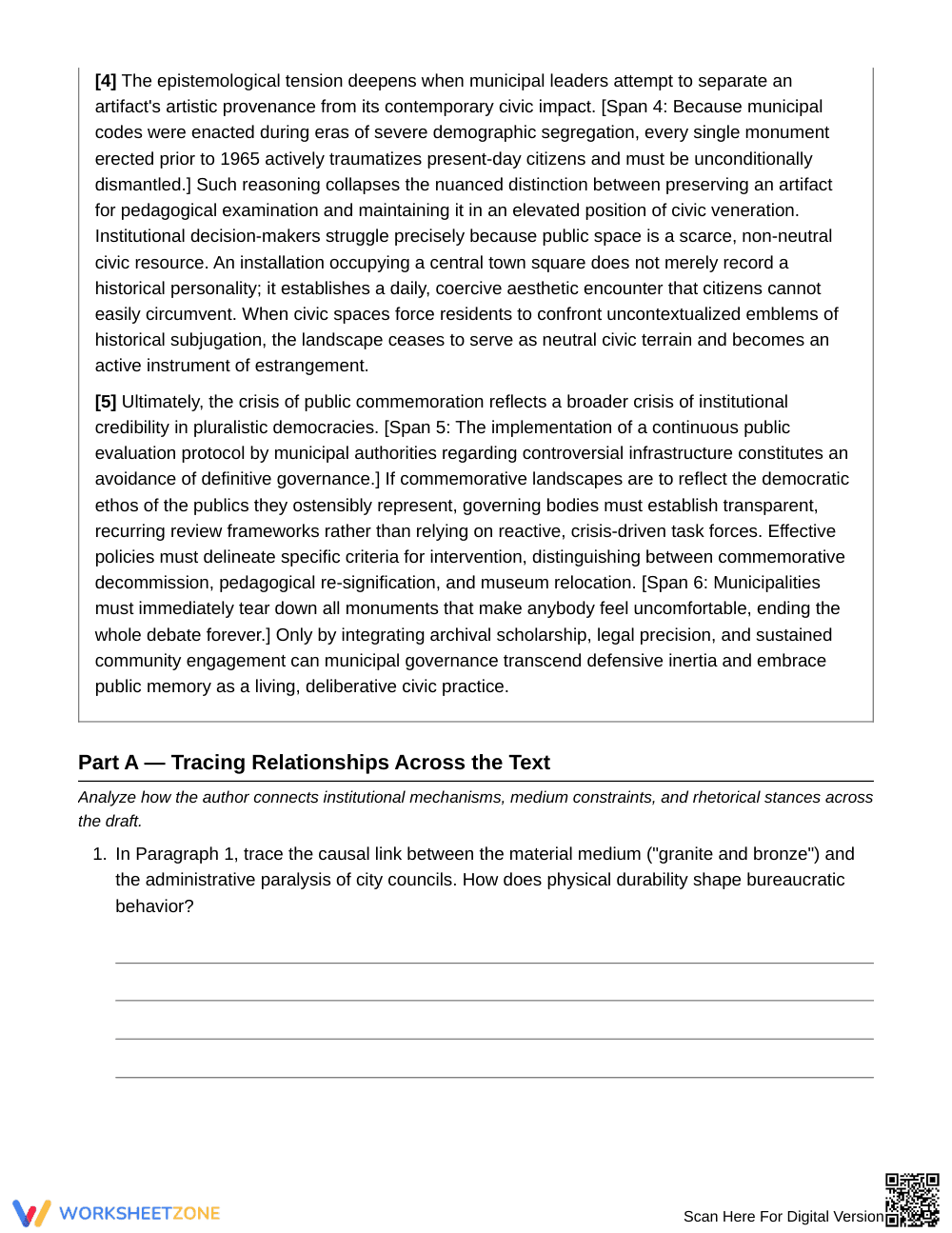
This 6-page printable resource features a 5-paragraph draft analyzing public monuments, paired with two statutory and scholarly excerpts. Students use an analytical revision checklist targeting register, epistemic hedging, and cohesion to complete 12 structured tasks. A complete 3-page answer key provides sample revisions, diagnostic rationales, and model transitions.
Skill Progression
The 12 tasks move across three intentional phases:
- Guided practice (Tasks 1–3): Students analyze structural relationships, tracing how physical media and legal constraints shape bureaucratic rhetoric across the draft.
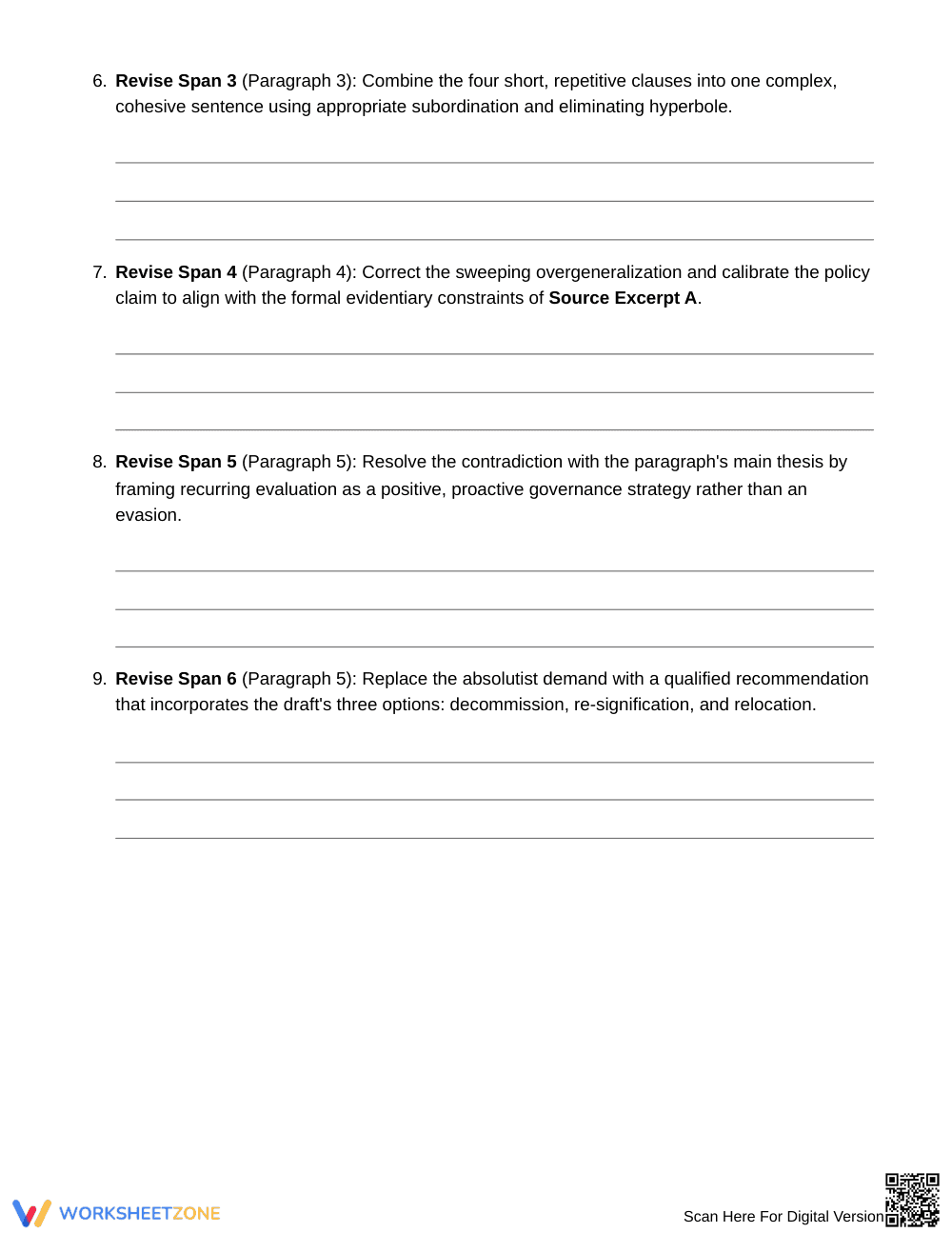
- Supported practice (Tasks 4–9): Learners revise six marked text spans, eliminating informal caricatures, calibrating unhedged claims against source evidence, and combining fragmented syntax.
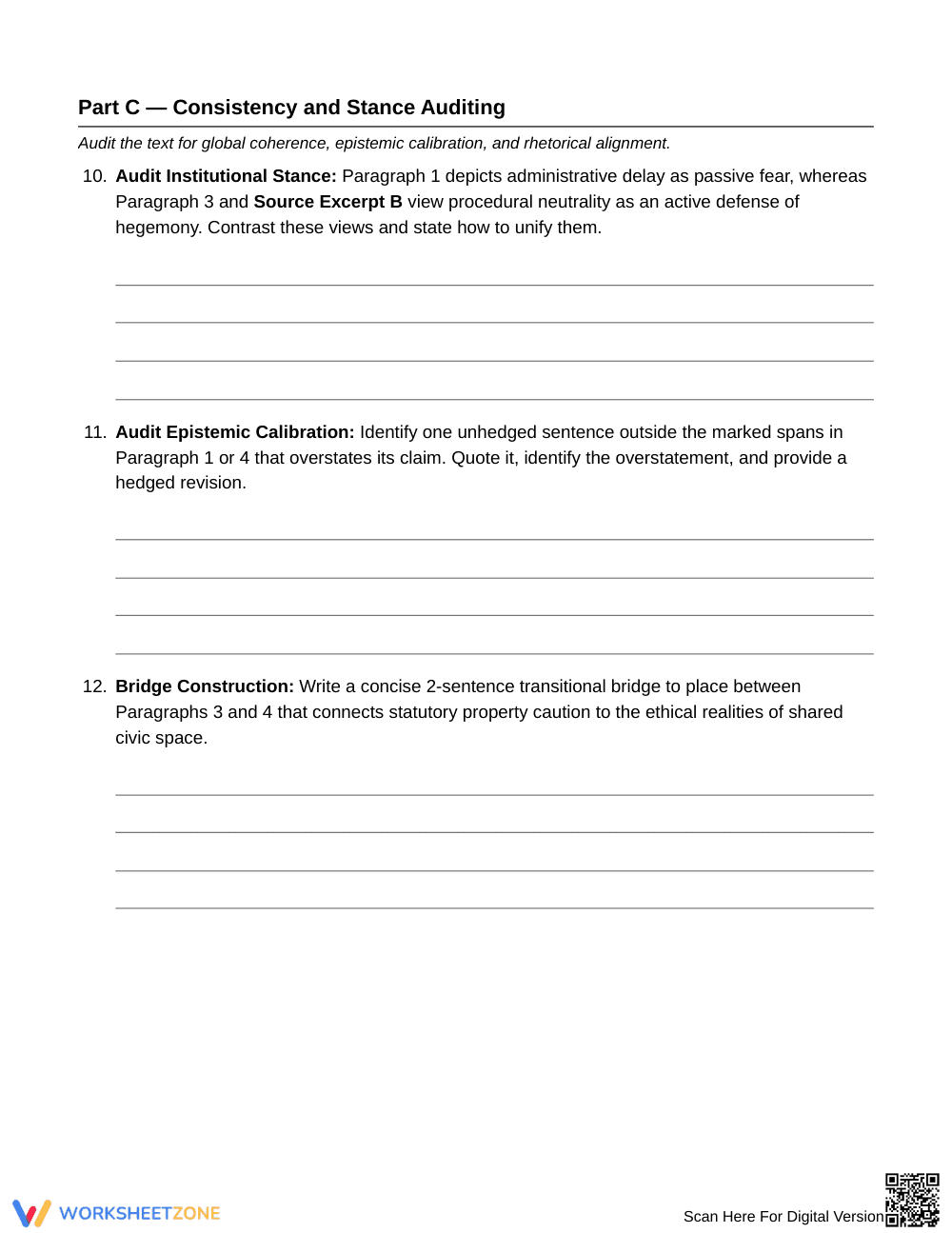
- Independent practice (Tasks 10–12): Students conduct an independent stance audit, locate unhedged assertions, and craft an original two-sentence transitional bridge.
This gradual-release structure guides learners from textual diagnosis to independent sentence crafting.
Standards Alignment
This resource aligns directly to W.11-12.5: Develop and strengthen writing as needed by planning, revising, editing, rewriting, or trying a new approach, focusing on addressing what is most significant for a specific purpose and audience. It also supports RI.11-12.1 by requiring claims to match source evidence. Both standard codes can be copied directly into lesson plans, IEP goals, or district curriculum mapping tools.
How to Use It
Use this worksheet after direct instruction on academic register or before major essay revisions. Have student pairs debate Part B sentence combinations before writing individual answers. Formative assessment tip: check whether students replace ad hominem language with objective analytical nouns rather than just weaker modifiers. Expected completion time is 45 to 60 minutes.
Who It's For
Designed for Grade 12 English IV students, AP English Language writers, and senior seminar classes. Provide sentence stems for struggling editors, or challenge advanced students to resolve institutional bias in Part C. Pair this worksheet with direct instruction on academic hedges and syntax subordination.
According to Fisher & Frey (2014), student writing improves substantially when instruction provides deliberate, scaffolded practice in revision rather than isolated editing. Under standard W.11-12.5, twelfth-grade writers must learn to strengthen complex analytical prose by calibrating tone, qualifying absolute claims, and establishing logical paragraph flow. High school seniors often rely on polemical assertions when addressing contentious civic topics, obscuring objective analysis with emotional rhetoric. This worksheet targets that pattern through 12 focused tasks grounded in public commemoration debates. By revising informal caricatures, unhedged absolutes, and disjointed syntax within an authentic draft, students gain the stylistic control expected in postsecondary academic environments. Aligning revisions with statutory and scholarly source excerpts reinforces that rhetorical precision depends on evidentiary boundaries. This disciplined process transforms mechanical proofreading into purposeful, high-level revision that clarifies authorial stance and enhances argumentative cohesion.


