




























Views
Downloads



Ready Systems of Inequalities Worksheet | Grade 9 Algebra I

Paste this activity's link or code into your existing LMS (Google Classroom, Canvas, Teams, Schoology, Moodle, etc.).
Students can open and work on the activity right away, with no student login required.
You'll still be able to track student progress and results from your teacher account.
This Grade 9 Algebra I worksheet equips students to model, interpret, and evaluate systems of linear inequalities under resource constraints. Across 16 structured problems, learners construct inequalities, determine practical viability, compute slack, and analyze feasible regions using realistic business and production data.
At a Glance
- Grade: 9 · Subject: Algebra I
- Standard:
HSA-CED.A.3— Represent constraints with inequalities and interpret solutions as viable options- Skill Focus: Systems-of-Inequalities Check
- Format: 4 pages · 16 problems · Answer key included · PDF
- Best For: Modeling constraint systems and feasible regions
- Time: 45–60 minutes
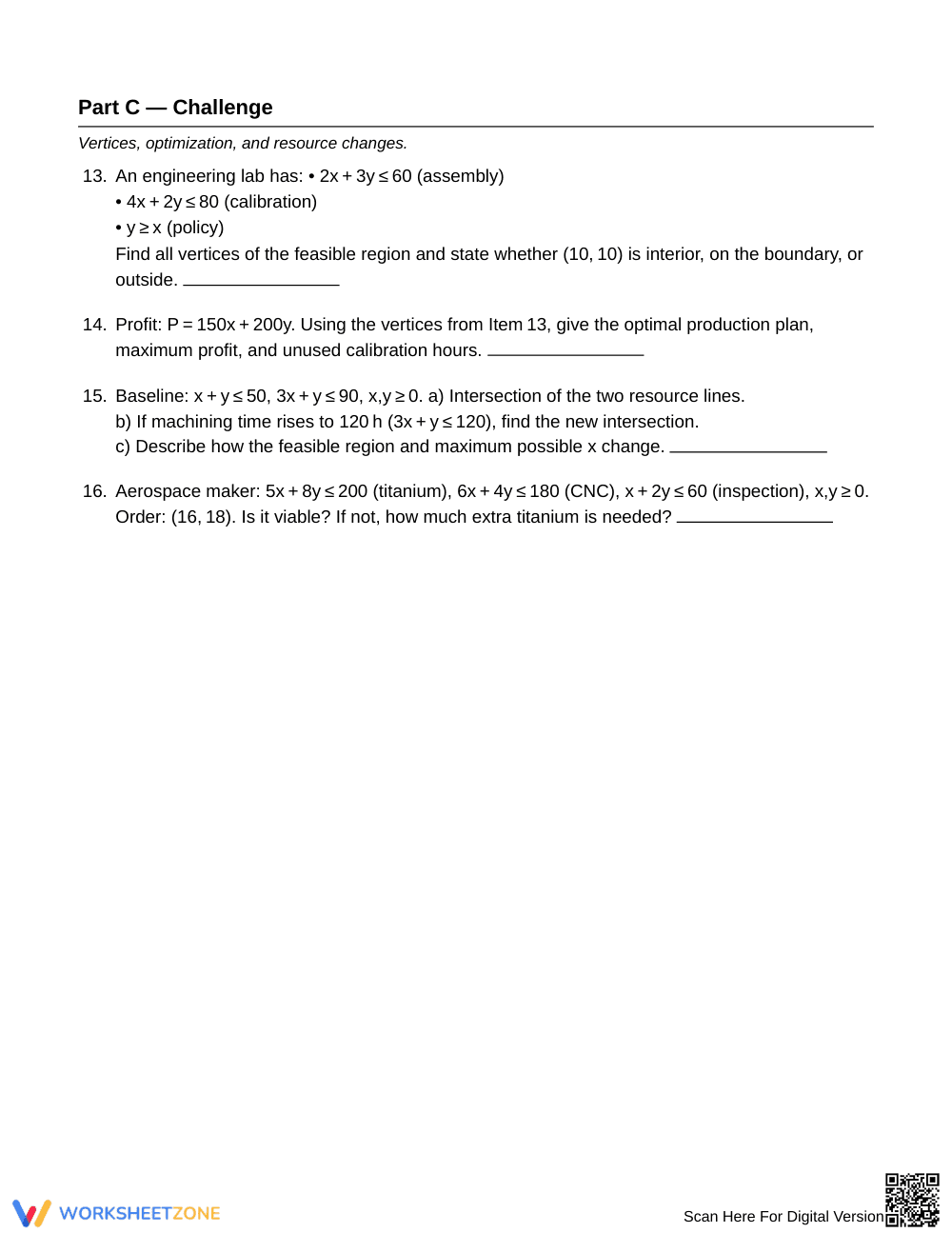
The 4-page worksheet contains 16 problems structured around real-world constraint modeling. A Core Concepts reference box defines feasible regions and viable points. Students interpret graph boundaries, formulate inequality systems, test coordinate solutions, calculate resource slack, and complete linear programming optimizations. A full 2-page answer key provides step-by-step verification.
Skill Progression
- Guided practice (Items 1–4): 4 foundational items review boundary lines, non-negativity conditions, and coordinate testing with contextual cues.
- Supported practice (Items 5–12): 8 application tasks guide students to write multi-constraint systems, read shaded regions, calculate slack, and identify binding resources.
- Independent practice (Items 13–16): 4 advanced problems require calculating feasible region vertices, optimizing profit functions, and analyzing resource shifts without scaffolding.
This progression mirrors the gradual-release framework, moving learners from conceptual review to independent multi-variable optimization.
Standards Alignment
Primary Standard: `HSA-CED.A.3` expects students to represent constraints with inequalities and interpret solutions as viable or non-viable options in modeling contexts. Additionally, supporting standard `HSA-REI.D.12` addresses graphing system solution sets as intersecting half-planes. Both standard codes can be copied directly into lesson plans, IEP goals, or district curriculum mapping tools.
How to Use It
Use this worksheet after direct instruction on graphing linear systems to ground skills in applied contexts. Run Part A as collaborative practice before assigning Parts B and C for paired problem-solving or independent evaluation. Formative tip: verify that students apply non-negativity constraints (x ≥ 0, y ≥ 0) to ensure solutions reflect physical limitations. Expected completion takes 45 to 60 minutes.
Who It's For
Designed for Grade 9 Algebra I students developing linear inequality modeling skills. The structured parts accommodate learners needing scaffolding on coordinate boundaries while offering challenging optimization extensions. Pair this worksheet with an anchor chart illustrating feasible regions and boundary line conventions.
According to EdReports 2024 evaluations of high school mathematics curricula, rigorous modeling tasks must require students to interpret solutions within authentic contexts rather than merely executing mechanical graphing algorithms. Under standard HSA-CED.A.3, students develop mathematical maturity by translating real-world resource limitations—such as labor hours, raw materials, and storage thresholds—into precise systems of linear inequalities. This instructional resource operationalizes that standard by guiding Grade 9 Algebra I students through determining viable options, distinguishing binding constraints, calculating slack resources, and identifying feasible region vertices. Research indicates that connecting algebraic constraints directly to economic trade-offs deepens conceptual retention and prepares learners for advanced quantitative reasoning across STEM pathways. By pairing structured foundational prompts with complex multi-constraint scenarios, this worksheet provides an evidence-based pathway for students to verify viability and make informed decisions using mathematical systems.


