




























Views
Downloads



Ready School Routines Review Word Search | Grades 7–8 ELA

Paste this activity's link or code into your existing LMS (Google Classroom, Canvas, Teams, Schoology, Moodle, etc.).
Students can open and work on the activity right away, with no student login required.
You'll still be able to track student progress and results from your teacher account.
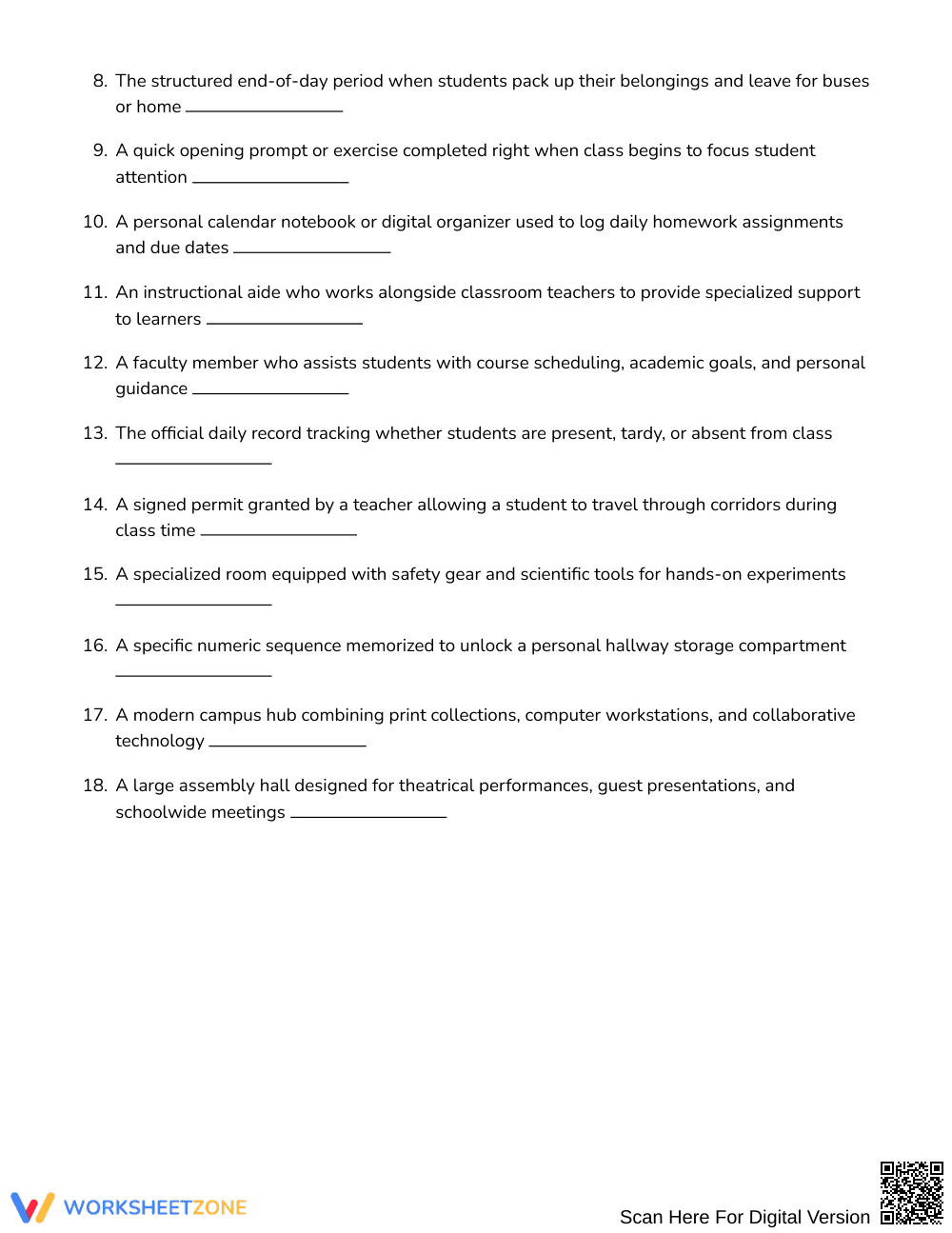
This school people, places, and routines review word search equips Grades 7–8 students with targeted vocabulary reinforcement during back-to-school orientation. Learners read functional definitions to identify 18 essential campus terms before locating them in the puzzle grid, strengthening academic orientation and contextual recall without requiring teacher preparation.
At a Glance
- Grade: Grades 7–8 · Subject: English Language Arts (ELA)
- Standard: Not standards-assessed — vocabulary enrichment
- Skill Focus: School people, places, and routines review
- Format: 3 pages · 18 words · Answer key included · PDF
- Best For: First week orientation and bell ringers
- Time: 20–30 minutes
What's Inside
The packet includes a 3-page student puzzle set paired with a 4-page answer key. Rather than relying on simple letter matching, the resource provides 18 descriptive clues defining vital campus roles, locations, and procedures. Students solve each clue to identify terms like custodian, syllabus, and media center, cross-referencing entries against a shuffled word bank before searching the puzzle grid.
Puzzle Architecture and Mechanics
This activity features a 20 by 20 grid engineered to build visual tracking and orthographic recall. Hidden words run across all eight directions: north, northeast, east, southeast, south, southwest, west, and northwest. By combining reverse and diagonal orientations with a shuffled word bank, the puzzle requires students to verify letter sequences actively against the provided clues rather than passively scanning for first letters.
Standards Alignment
This activity serves as a vocabulary enrichment resource and cumulative review; it is not aligned to a specific academic standard. It supports foundational language proficiency, spelling consolidation, and school literacy as students adapt to middle school environments and campus procedures.
How to Use It
Deploy this word search during opening week as an engaging bell ringer following direct discussions of schoolwide expectations. It also works as a focused task during homeroom or advisory periods. Circulate while students work to observe whether they solve terms from definitions or lean on the word bank, noting who may need extra procedural guidance. Completion typically takes 20 to 30 minutes.
Who It's For
This activity is designed for Grades 7–8 learners, transfer students, and English language learners reviewing secondary school routines. For differentiated support, have students highlight keywords in clues prior to searching. Pair this puzzle with a student handbook review, campus tour, or syllabus walk-through to reinforce institutional independence.
According to research in vocabulary acquisition summarized by Fisher & Frey (2014), intentional word-learning routines succeed when learners actively connect formal definitions to contextual concepts rather than completing isolated rote tasks. While this word search operates as an unaligned vocabulary enrichment tool rather than a standards-assessed measure, embedding 18 descriptive clues within a complex 20 by 20 letter grid prompts students to retrieve institutional terminology actively. Secondary learners in Grades 7–8 consolidate essential procedural literacy by analyzing clues for administrative positions, campus facilities, and operational structures before conducting systematic orthographic scans across eight directions. Combining definitional clues with visual search reinforces spelling patterns, word recognition, and working memory. Consequently, structured back-to-school vocabulary puzzles serve as reliable, low-anxiety instructional tools that establish behavioral expectations, build environmental familiarity, and foster independent engagement during critical classroom transitions.


