


























Views
Downloads



Ready Riemann Sum & FTC Errors Worksheet | Grade 12 Calculus
Paste this activity's link or code into your existing LMS (Google Classroom, Canvas, Teams, Schoology, Moodle, etc.).
Students can open and work on the activity right away, with no student login required.
You'll still be able to track student progress and results from your teacher account.
This Grade 12 calculus worksheet strengthens understanding of integral calculus by training students to identify, diagnose, and repair common errors. Learners analyze flawed student work involving Riemann sum subinterval widths, endpoint selections, and Fundamental Theorem of Calculus chain-rule applications, writing rigorous mathematical corrections and supplying units.
At a Glance
- Grade: 12 · Subject: Calculus
- Standard: Calculus — Approximate definite integrals using Riemann sums and compute derivatives using the Fundamental Theorem
- Skill Focus: Correct Width, Endpoint, and Chain-Rule Errors
- Format: 5 pages · 10 problems · Answer key included · PDF
- Best For: Calculus error analysis review
- Time: 45–60 minutes
This 5-page resource features 10 error-analysis tasks divided into two parts, plus a 3-page worked answer key. Students evaluate tabular rate data and continuous functions to correct non-uniform partition widths, improper endpoints, and omitted chain-rule derivatives, supported by a modeled example.
Skill Progression
- Guided Practice: A modeled error repair shows how to diagnose procedural misconceptions and compute correct rates of change from tabular data.
- Supported Practice (Tasks 1–5): Part A tasks guide students to correct unequal subinterval widths, right versus left endpoint choices, and uniform partition formulas in Riemann sums.
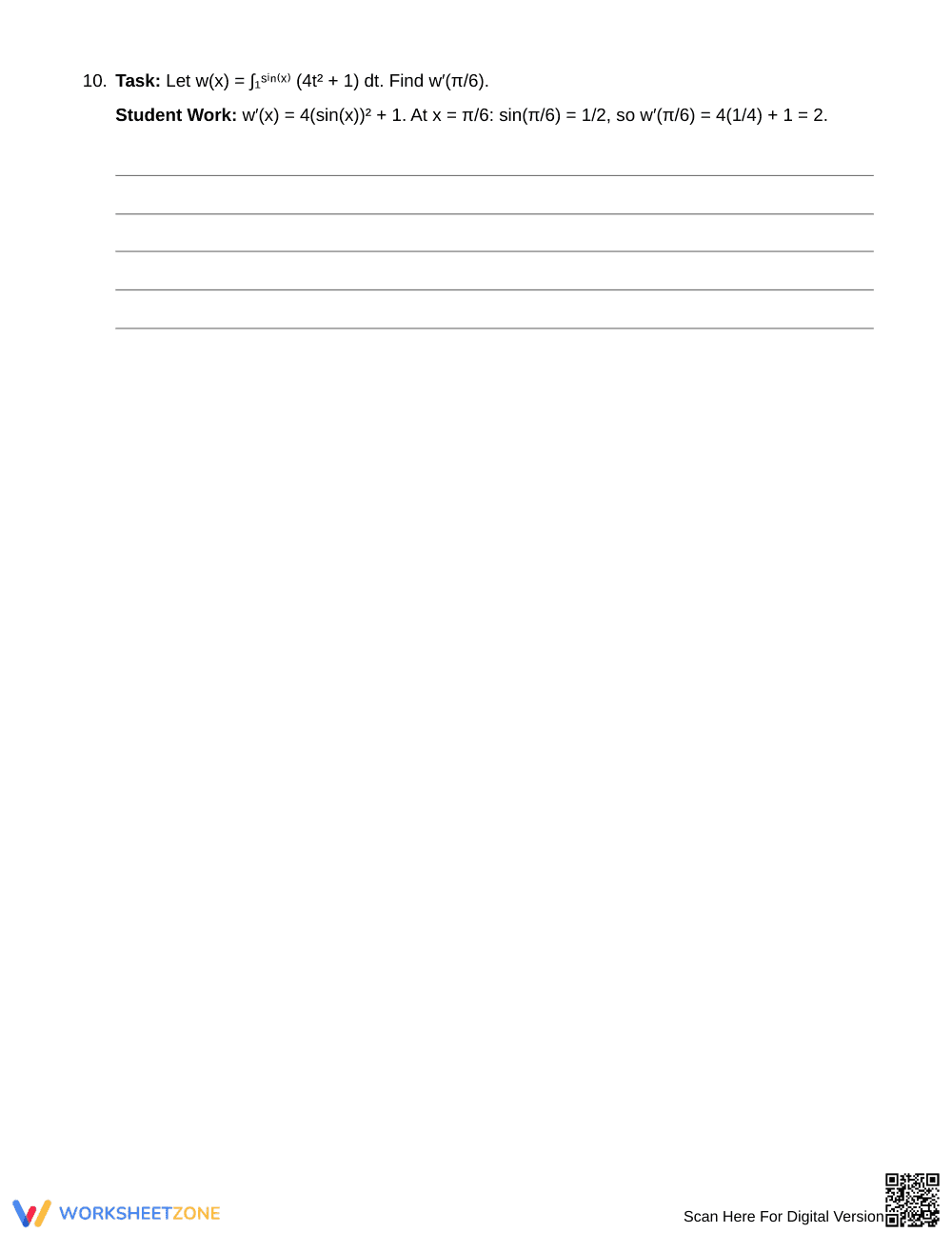
- Independent Practice (Tasks 6–10): Part B tasks challenge students to repair advanced Fundamental Theorem of Calculus errors, including omitted chain-rule derivatives and variable integration limits.
This gradual-release sequence moves students systematically from teacher-modeled repair to independent misconception diagnosis.
Standards Alignment
This resource aligns with introductory college calculus standards covering integral approximations and the Fundamental Theorem of Calculus. Students construct Riemann sums from non-uniform tables and apply the chain rule when differentiating integrals with variable limits. Both standard codes can be copied directly into lesson plans, IEP goals, or district curriculum mapping tools.
How to Use It
Use this worksheet after direct instruction on tabular Riemann sums and the Fundamental Theorem of Calculus. Have student pairs analyze Part A before completing Part B independently, or assign problems as AP exam review warm-ups. During class, verify that students check whether table subintervals have variable widths before calculating approximations. Expected completion time is 45 to 60 minutes.
Who It's For
This activity suits Grade 12 students in AP Calculus AB, BC, or dual-enrollment calculus. For students needing support, provide an interval width calculation template. For advanced students, ask them to determine whether each approximation yields an underestimate or overestimate. Pair this worksheet with rate-table modeling instruction or definite integral reference sheets.
According to research from Fisher & Frey (2014) on error analysis and metacognition, requiring secondary students to diagnose and correct authentic mathematical misconceptions produces significantly deeper conceptual retention than repetitive routine calculations. In advanced single-variable calculus, high school students frequently commit procedural errors when constructing Riemann sums from discrete data sets, often confusing unequal subinterval widths with uniform partitions or misidentifying left versus right endpoint indices. Furthermore, when evaluating derivatives using the Fundamental Theorem of Calculus, learners routinely neglect the chain rule by failing to multiply by the interior derivative of variable integration limits. This 10-task error repair activity directly targets these pervasive pitfalls, guiding Grade 12 calculus students to correct width, endpoint, and chain-rule errors through structured written explanations, rigorous algebraic recalculations, and precise contextual units of measurement across five comprehensive pages.


