


























Views
Downloads




Ready Nominalization Repair Worksheet | Grade 12 English IV
Paste this activity's link or code into your existing LMS (Google Classroom, Canvas, Teams, Schoology, Moodle, etc.).
Students can open and work on the activity right away, with no student login required.
You'll still be able to track student progress and results from your teacher account.
This Grade 12 advanced writing worksheet trains students to eliminate bureaucratic nominalizations and calibrate unsupported certainty in academic arguments. Through analytical critique and targeted revision of policy texts, high school seniors learn to uncover obscured agency, convert static noun chains into dynamic active-voice syntax, and align rhetorical assertions with verified empirical evidence.
At a Glance
- Grade: 12 · Subject: English IV
- Standard:
W.11-12.5— Develop and strengthen writing by planning, revising, and editing for specific tone and agency- Skill Focus: Repair Nominalization and Unsupported Certainty
- Format: 6 pages · 10 structured problems · Full answer key included · PDF
- Best For: Advanced college-preparatory essay revision and rhetorical analysis
- Time: 45–60 instructional minutes
What's Inside
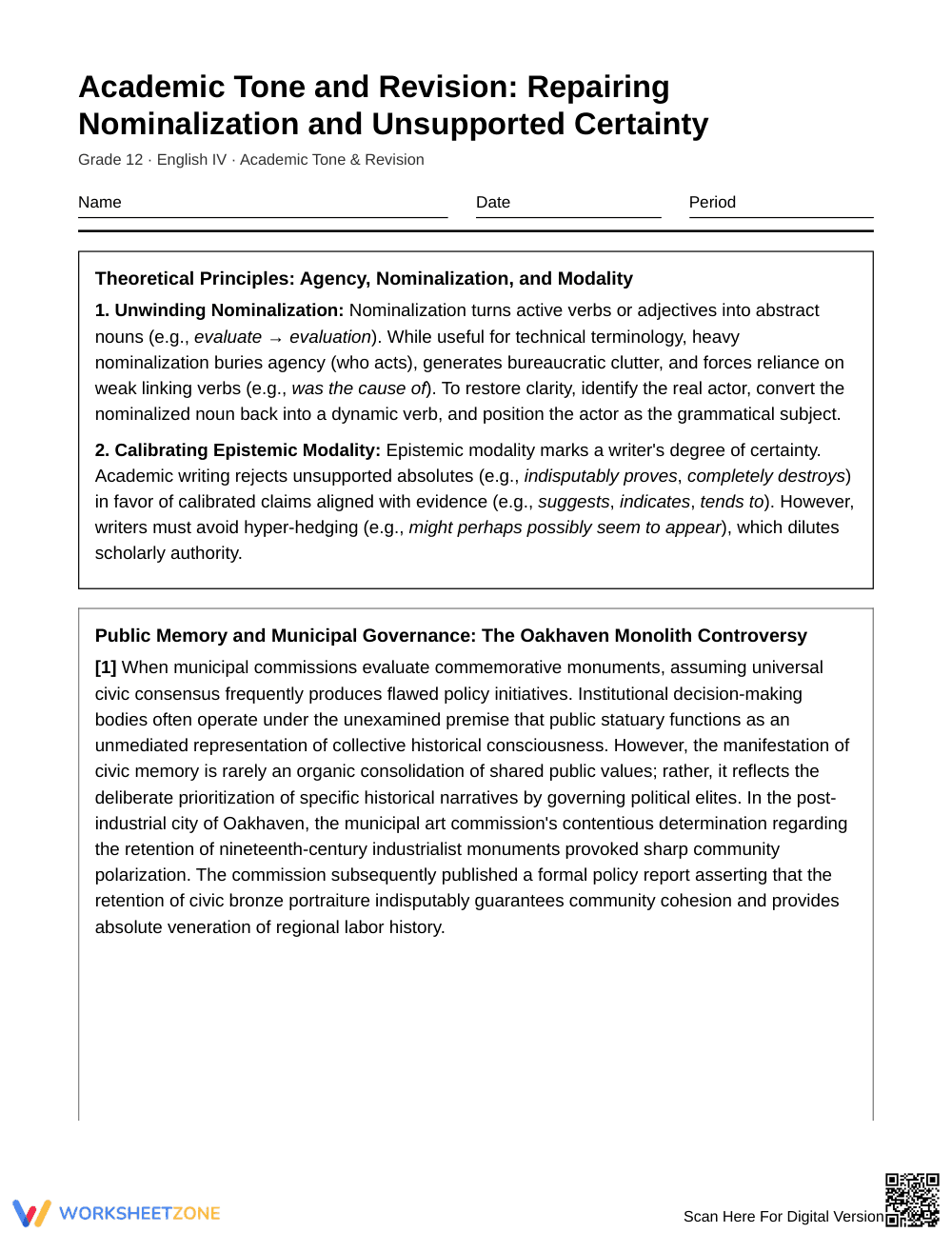
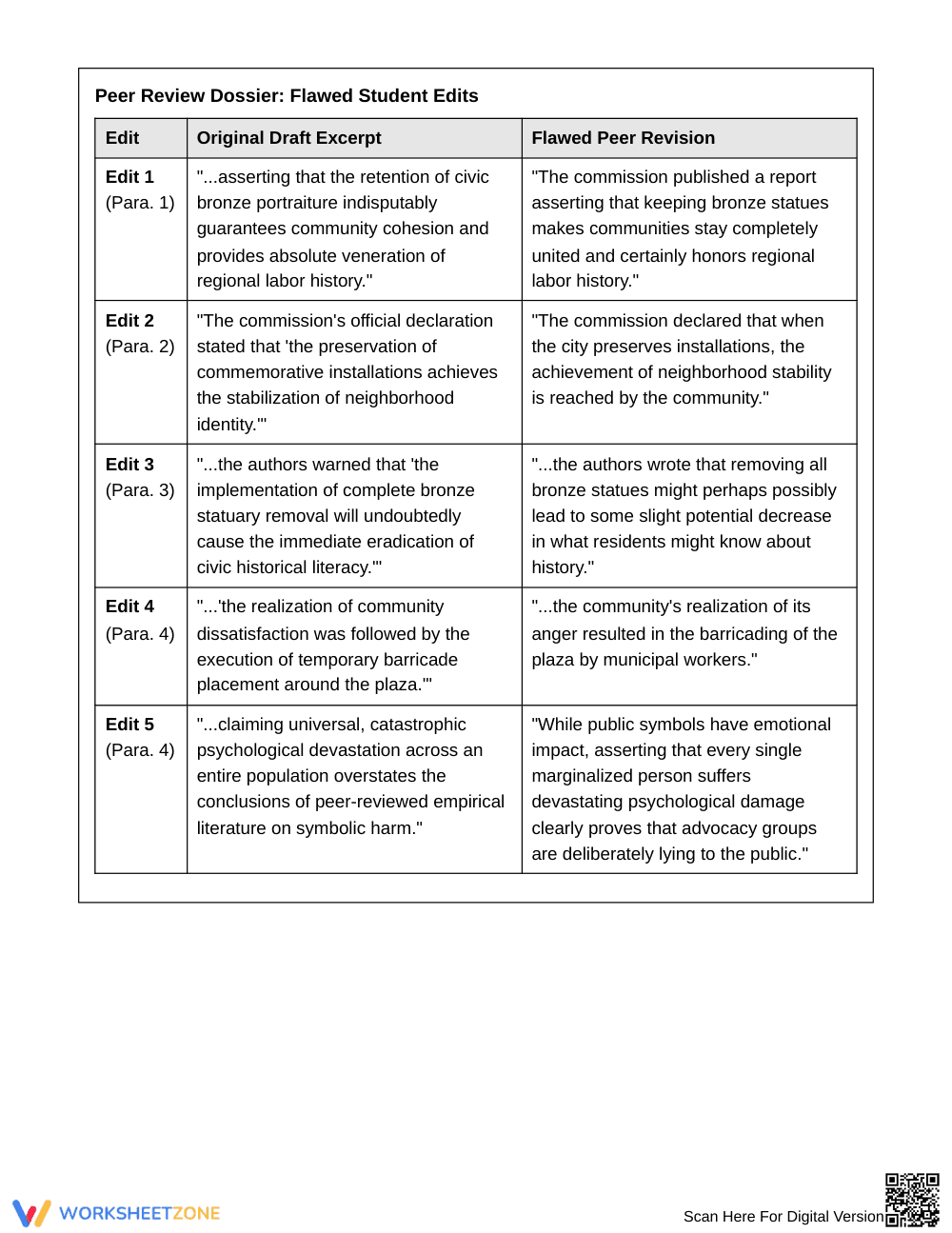
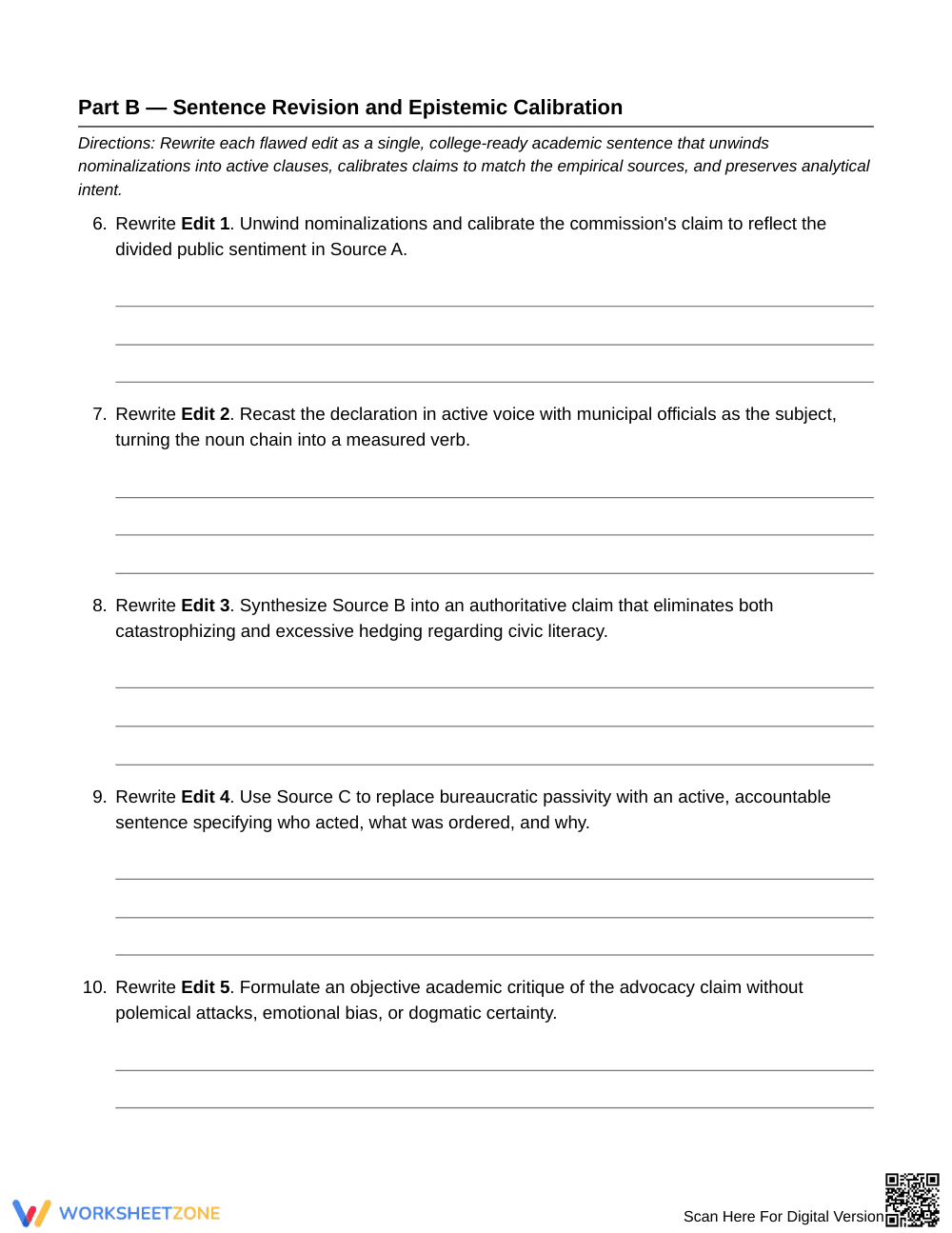
The 6-page packet features theoretical guidelines, a 5-paragraph municipal policy case study, three synthetic evidence sets, and a 5-item peer review dossier. Students complete 10 analytical and revision tasks, supported by a 2-page detailed answer key.
Skill Progression
- Guided practice (Tasks 1–2): Students analyze peer drafts to identify buried agency and unsupported absolutes using the provided rule boxes.
- Supported practice (Tasks 3–5): Students diagnose hyper-hedging and misattributed agency, citing empirical data sources to validate their critique.
- Independent practice (Tasks 6–10): Students rewrite flawed drafts into college-ready prose, restoring active verbs and calibrating claims.
This sequence implements a gradual-release model from guided diagnosis to autonomous academic revision.
Standards Alignment
Aligned to `W.11-12.5`, this worksheet guides students to develop and strengthen writing by revising for specific purpose and audience. It also supports `L.11-12.3` by emphasizing syntactical control in formal contexts. Both standard codes can be copied directly into lesson plans, IEP goals, or district curriculum mapping tools.
How to Use It
Use during the revision stage of an argumentative research unit. Have students work in pairs on Part A before completing Part B individually. Formatively assess whether students differentiate between healthy caution and excessive hedging. Expect completion in 45–60 minutes.
Who It's For
Ideal for Grade 12 English IV, AP Language, and college-prep rhetoric courses. Differentiate by providing sentence starters for emerging writers, and pair with an essay on civic discourse.
According to Fisher & Frey (2014), purposeful revision instruction requires explicit modeling of domain-specific language demands alongside gradual releases of responsibility. This Grade 12 instructional worksheet operationalizes standard W.11-12.5 by guiding students through the sophisticated linguistic processes of unwinding nominalizations and calibrating epistemic modality. Rather than treating revision as superficial proofreading, the curriculum equips secondary learners to interrogate agency masking and dogmatic overstatement within institutional discourse. By coupling diagnostic evaluation of authentic peer drafts with rigorous sentence-level reconstruction against empirical data, the resource strengthens rhetorical control and academic register. Students learn to restore dynamic active verbs, attribute institutional accountability, and modulate certainty to match sociological evidence. Consequently, the material bridges high school composition and college-level academic inquiry, providing high school seniors with actionable strategies to craft authoritative, disciplined, and transparent scholarly arguments across diverse analytical contexts.


