


























Views
Downloads


Ready Fraction Division Contexts Worksheet | Grade 6 Math
Paste this activity's link or code into your existing LMS (Google Classroom, Canvas, Teams, Schoology, Moodle, etc.).
Students can open and work on the activity right away, with no student login required.
You'll still be able to track student progress and results from your teacher account.
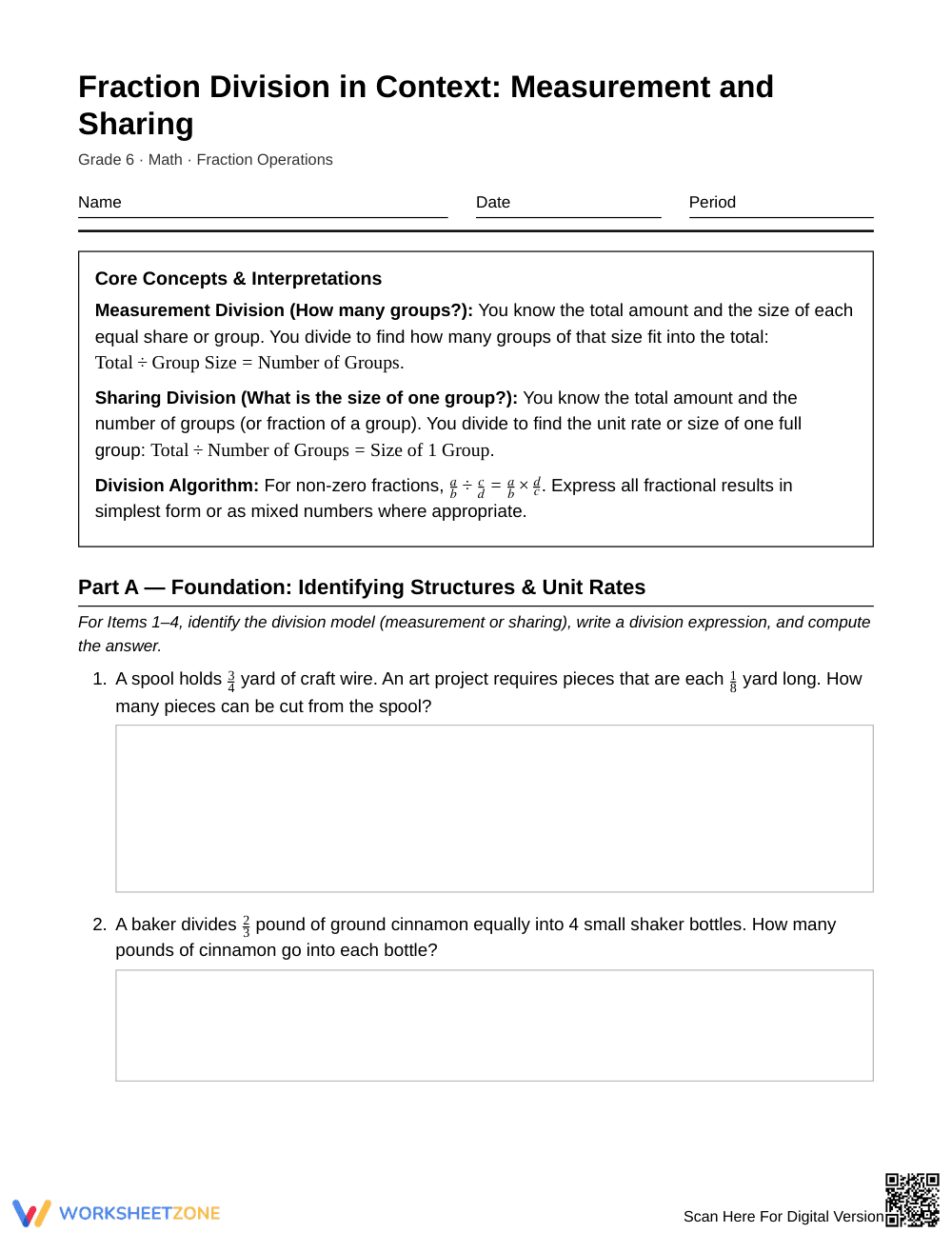
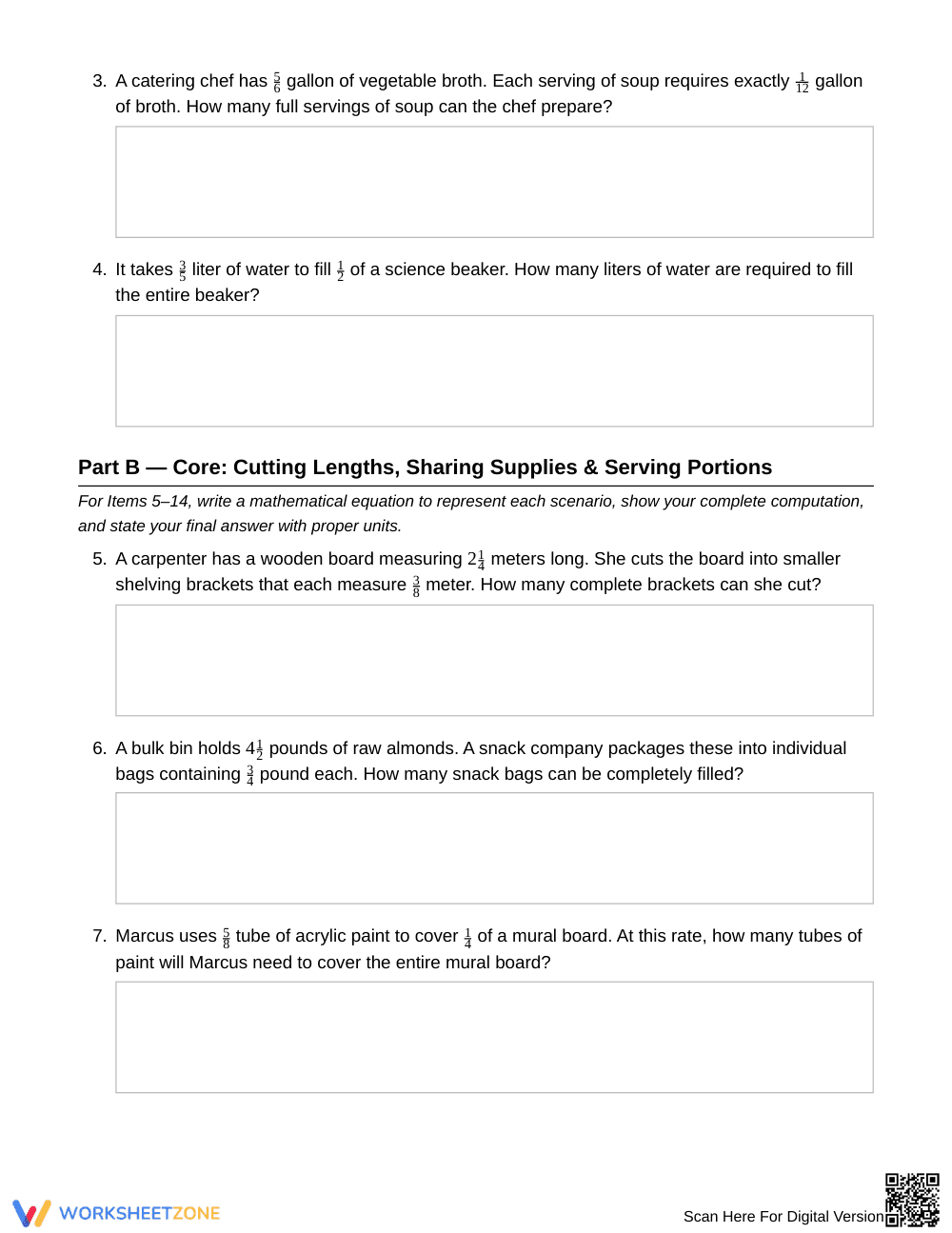
This comprehensive Grade 6 mathematics worksheet builds conceptual understanding and procedural fluency in dividing fractions within real-world contexts. Students analyze word problems to distinguish between measurement division (finding how many groups) and sharing division (finding group size or unit rates), translating verbal descriptions into precise numerical equations and calculating exact solutions.
At a Glance
- Grade: 6 · Subject: Math
- Standard:
6.NS.A.1— Interpret and compute quotients of fractions to solve contextual word problems- Skill Focus: Solve Measurement and Sharing Problems
- Format: 5 pages · 18 problems · Answer key included · PDF
- Best For: Core instruction and targeted skills practice
- Time: 45–60 minutes
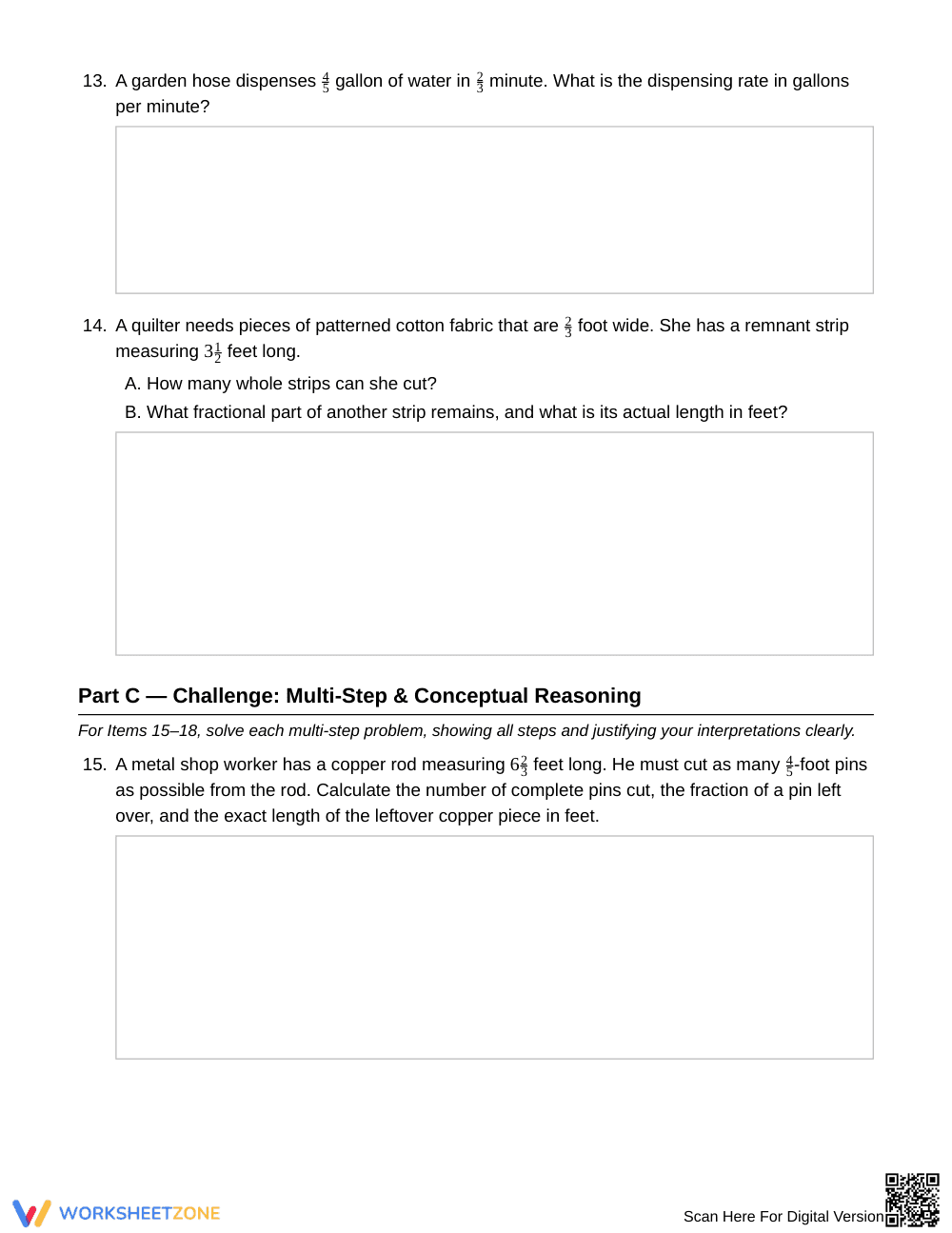
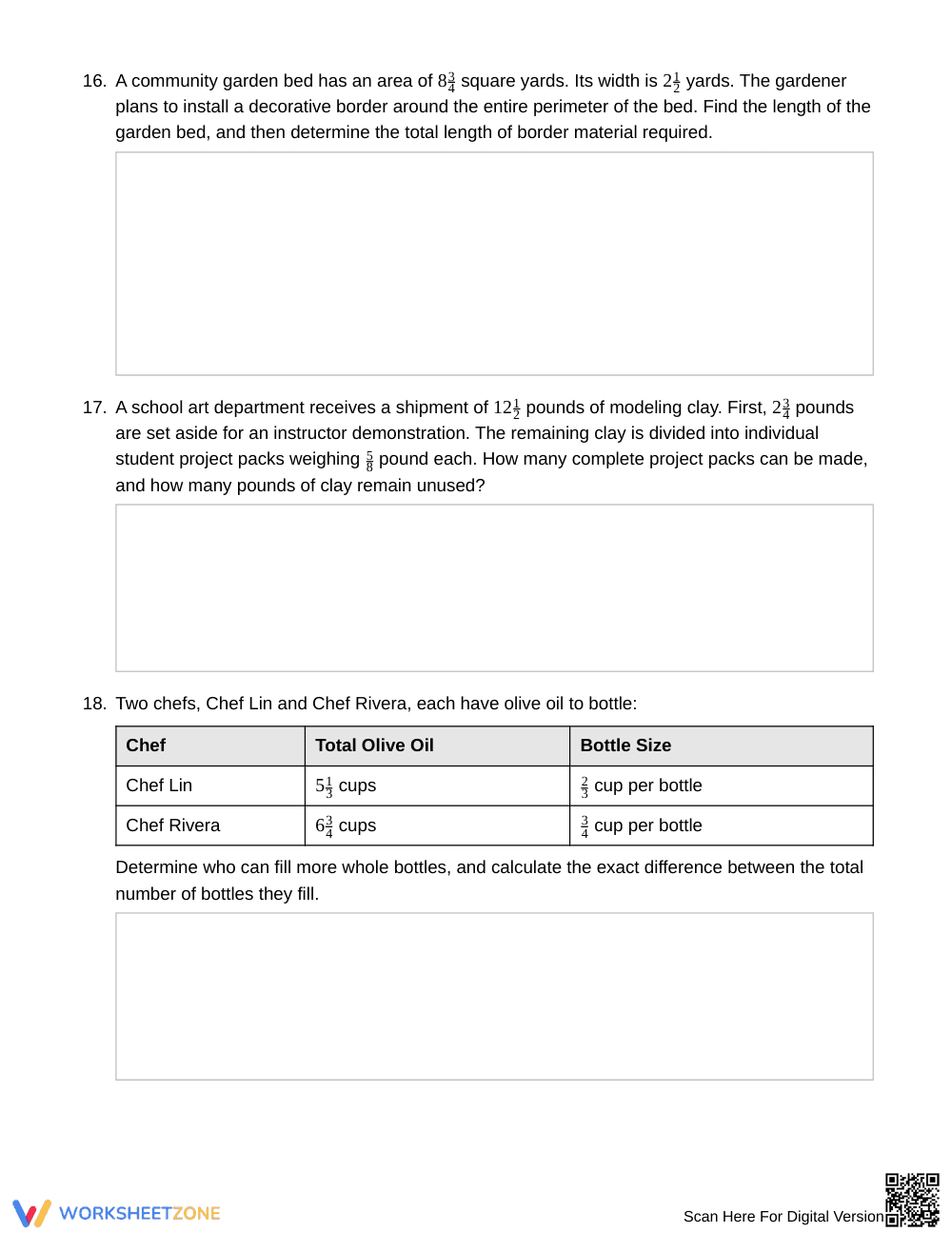
This 5-page printable resource contains 18 rigorous fraction division items organized across three developmental sections, supported by a reference box outlining the division algorithm and core conceptual models. Students work through single-step identification tasks, contextual computation items involving mixed numbers and fractions, and complex multi-step scenarios requiring remainder interpretation. A complete 3-page answer key provides full computational steps.
- Guided practice (Part A, Items 1–4): Structured foundational items guide students to classify scenarios as measurement or sharing models, write expressions, and compute basic unit rates.
- Supported practice (Part B, Items 5–14): Word problems require students to generate equations, compute quotients with mixed numbers, and state answers with correct measurement units.
- Independent practice (Part C, Items 15–18): Multi-step challenge problems assess higher-order reasoning through remainder interpretation, perimeter calculations, and comparative multi-step scenarios.
This structure reflects a gradual-release model, moving learners from scaffolded model identification to independent multi-step problem solving.
Primary alignment is to 6.NS.A.1: Interpret and compute quotients of fractions, and solve word problems involving division of fractions by fractions using visual models and equations. Supporting alignment includes 6.RP.A.2 for calculating unit rates in contextual measurement problems. Both standard codes can be copied directly into lesson plans, IEP goals, or district curriculum mapping tools.
Deploy this worksheet after direct instruction on fraction division algorithms to solidify contextual problem solving. For small-group intervention, have students highlight keywords indicating group count versus group size before solving. During formative assessment, monitor how students interpret fractional remainders in Part C (distinguishing leftover group parts from leftover original units). The complete activity requires approximately 45 to 60 minutes.
This resource is designed for standard Grade 6 math classrooms, tier-2 math interventions, and accelerated Grade 5 learners. Differentiate by providing visual fraction strips for Part A or assigning Part C as an extension for advanced learners. Pair this worksheet with an anchor chart detailing measurement versus partitive division models.
According to research on structured cognitive apprenticeships by Fisher & Frey (2014), instructional progressions that explicitly contrast mathematical models significantly improve student problem-solving accuracy on non-routine tasks. This Grade 6 worksheet directly targets standard 6.NS.A.1 by requiring learners to interpret and compute quotients of fractions within contextual scenarios. By systematically categorizing problems into measurement division (determining group count) and sharing division (determining unit rate or group size), students bridge the gap between mechanical algorithm execution and conceptual reasoning. The scaffolded progression from foundational model identification through multi-step applied problem solving reinforces procedural fluency, fractional remainder interpretation, and mathematical precision. This standards-aligned resource provides educators with high-leverage practice tasks that foster measurable gains in fraction operation proficiency, critical mathematical discourse, and standardized assessment performance across diverse middle school classroom settings and targeted intervention blocks.


