




























Views
Downloads



Ready Formula & Naming Error Worksheet | Grade 11 Chemistry

Paste this activity's link or code into your existing LMS (Google Classroom, Canvas, Teams, Schoology, Moodle, etc.).
Students can open and work on the activity right away, with no student login required.
You'll still be able to track student progress and results from your teacher account.
Mastering chemical nomenclature and charge balance requires students to evaluate common misconceptions. This Grade 11 chemistry worksheet presents 8 error-analysis tasks covering ionic formulas, molecular compound naming, variable oxidation states, and bonding theory. Students diagnose flawed statements, apply systematic rules, and provide accurate chemical formulas and corrected scientific explanations.
At a Glance
- Grade: 11 · Subject: Chemistry
- Skill Focus: Chemical Formula and Naming Error Correction
- Format: 5 pages · 8 problems · Answer key included · PDF
- Best For: High school chemistry misconception correction and review
- Time: 40–50 minutes
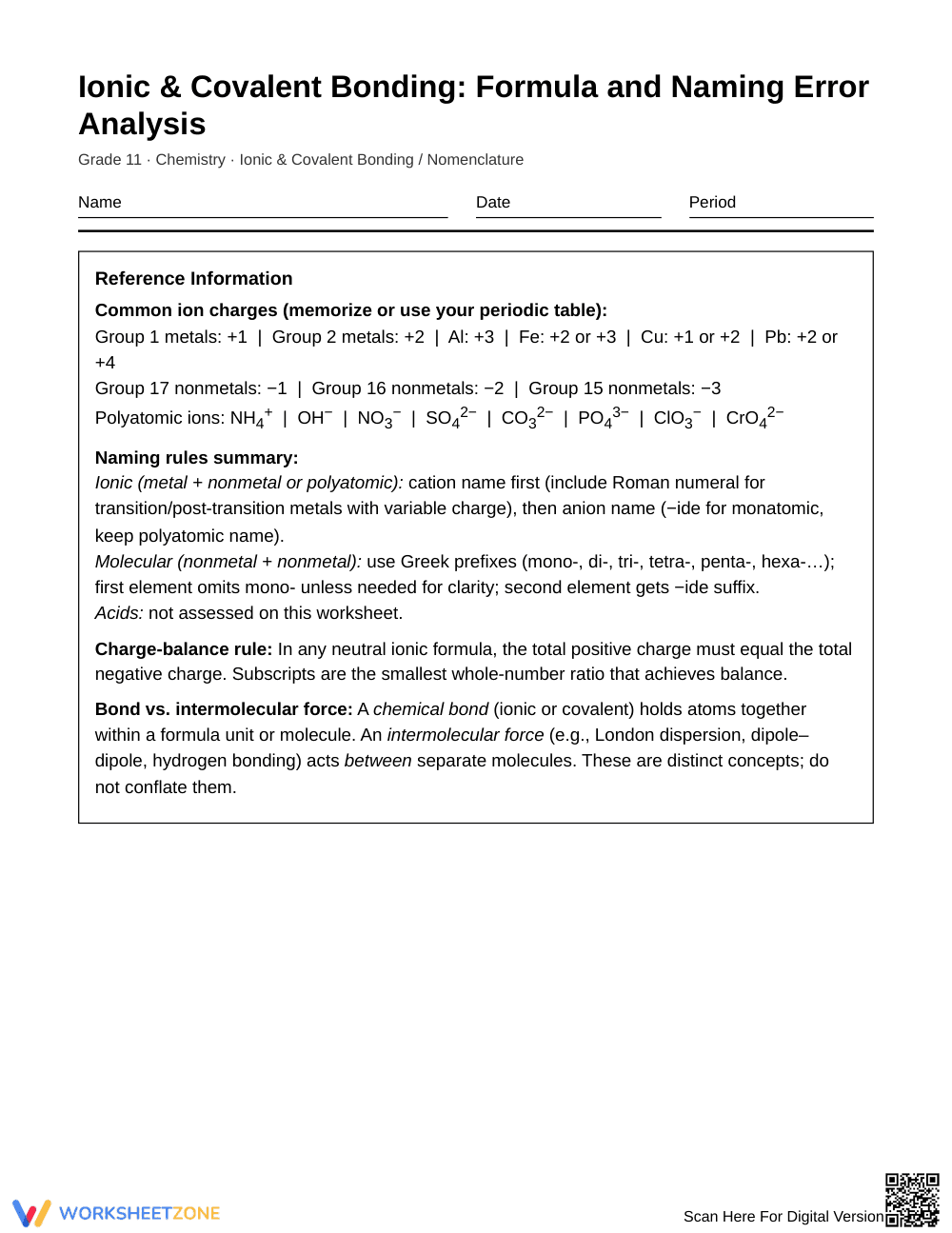
This 5-page resource features a reference table detailing ion charges, molecular prefix conventions, and charge-neutrality rules. A 4-step worked model illustrates how to diagnose errors, show charge arithmetic, and write IUPAC names. Students tackle 8 error-analysis problems addressing binary ionic compounds, polyatomic ions, transition metal numerals, and particle-level bonding, supported by a 4-page answer key.
Skill Progression
- Guided Practice: Students review the 4-step diagnostic model and reference tables to resolve basic charge-balance and prefix errors in binary compounds (Problems 1–2).
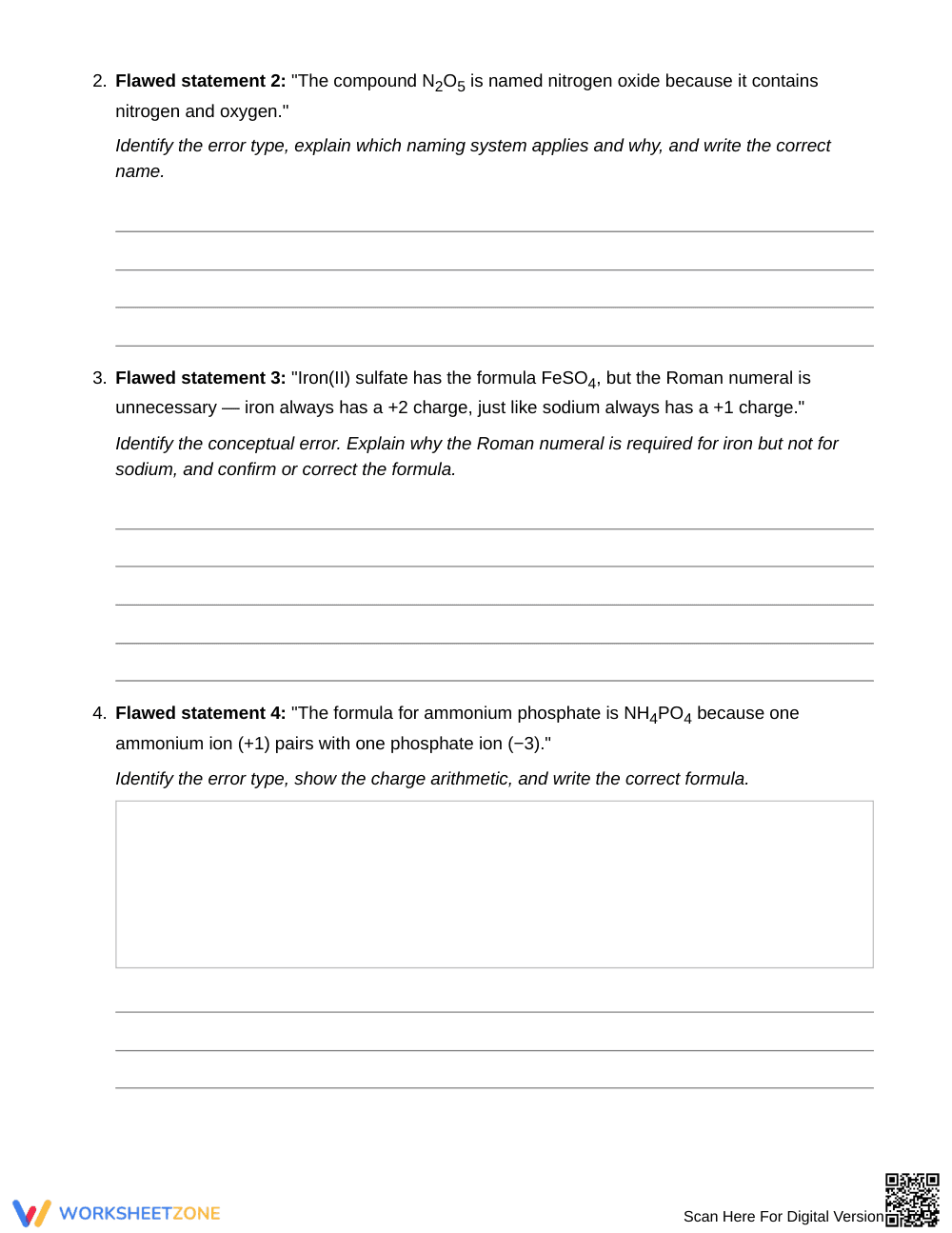
- Supported Practice: Learners address intermediate tasks involving transition metal Roman numerals, polyatomic ions, and subscript errors (Problems 3–6).
- Independent Practice: Students correct conceptual errors distinguishing ionic bonds from covalent interactions and resolve complex multi-step charges (Problems 7–8).
This gradual-release structure moves students from spotting surface errors to articulating underlying chemical principles.
Standards Alignment
This worksheet supports high school chemistry instruction on matter and interactions. Students use valence electron patterns to construct chemical formulas, verify electrical neutrality in ionic lattices, and apply systematic IUPAC nomenclature. Alignment notes can be copied directly into lesson plans, IEP goals, or district curriculum mapping tools.
How to Use It
Assign this activity after direct instruction on nomenclature as a formative check. Have students work in pairs to explain their charge arithmetic aloud. Watch for students who confuse Roman numerals with subscript counts, using that observation for targeted small-group intervention. Expect completion within 40 to 50 minutes.
Who It's For
This resource supports Grade 11 general, honors, and introductory AP Chemistry students mastering nomenclature rules. Scaffolded reference charts assist learners needing reinforcement, while particle-level theory questions challenge advanced students. Pair this worksheet with an interactive periodic table or bonding anchor chart for effective instruction.
Error analysis in secondary chemistry reinforces foundational understandings of chemical formulas and nomenclature by confronting misconceptions directly. According to Fisher & Frey (2014), engaging students in evaluating non-examples deepens cognitive processing and solidifies procedural accuracy in multi-step scientific tasks. Rather than relying on rote memorization, students who systematically verify charge balance arithmetic and justify prefix usage develop stronger mental models of atomic interactions and crystal lattice neutrality. This 5-page worksheet targets 8 distinct nomenclature challenges, including polyatomic ion balancing, transition metal oxidation states, and the distinction between intramolecular bonds and intermolecular forces. Supported by clear reference data and structured diagnostic steps, learners move from guided error identification to independent conceptual articulation. High school chemistry educators can use these 8 rigorous tasks and the included 4-page answer key to evaluate student mastery and guide intervention planning effectively.


