




























Views
Downloads




Ready Extraneous Candidates Worksheet | Grade 11 Algebra II

Paste this activity's link or code into your existing LMS (Google Classroom, Canvas, Teams, Schoology, Moodle, etc.).
Students can open and work on the activity right away, with no student login required.
You'll still be able to track student progress and results from your teacher account.
Mastering radical equations requires understanding why non-equivalent algebraic operations produce invalid solutions. This Grade 11 Algebra II worksheet guides students to solve and reverse-engineer radical equations that yield extraneous candidates. By constructing equations from target roots, learners analyze principal roots, domain restrictions, and quadratic transformations across 14 rigorous tasks.
At a Glance
- Grade: 11 · Subject: Algebra II
- Standard:
HSA-REI.A.2— Solve radical equations and show how extraneous solutions arise- Skill Focus: Construct an Equation with One Extraneous Candidate
- Format: 5 pages · 14 problems · Answer key included · PDF
- Best For: Advanced Algebra II practice and review
- Time: 45–60 minutes
What's Inside
This 5-page printable resource includes core concept summaries, evaluation tables, and a 2-page detailed answer key with full derivations. Across 14 multi-part exercises, students test roots against domain restrictions, reverse-engineer radical equations, and use step-by-step coefficient matching tables to complete algebraic constructions.
Skill Progression
- Guided Practice (Problems 1–4): Students examine squaring mechanics, complete candidate evaluation tables, and identify shadow equations.
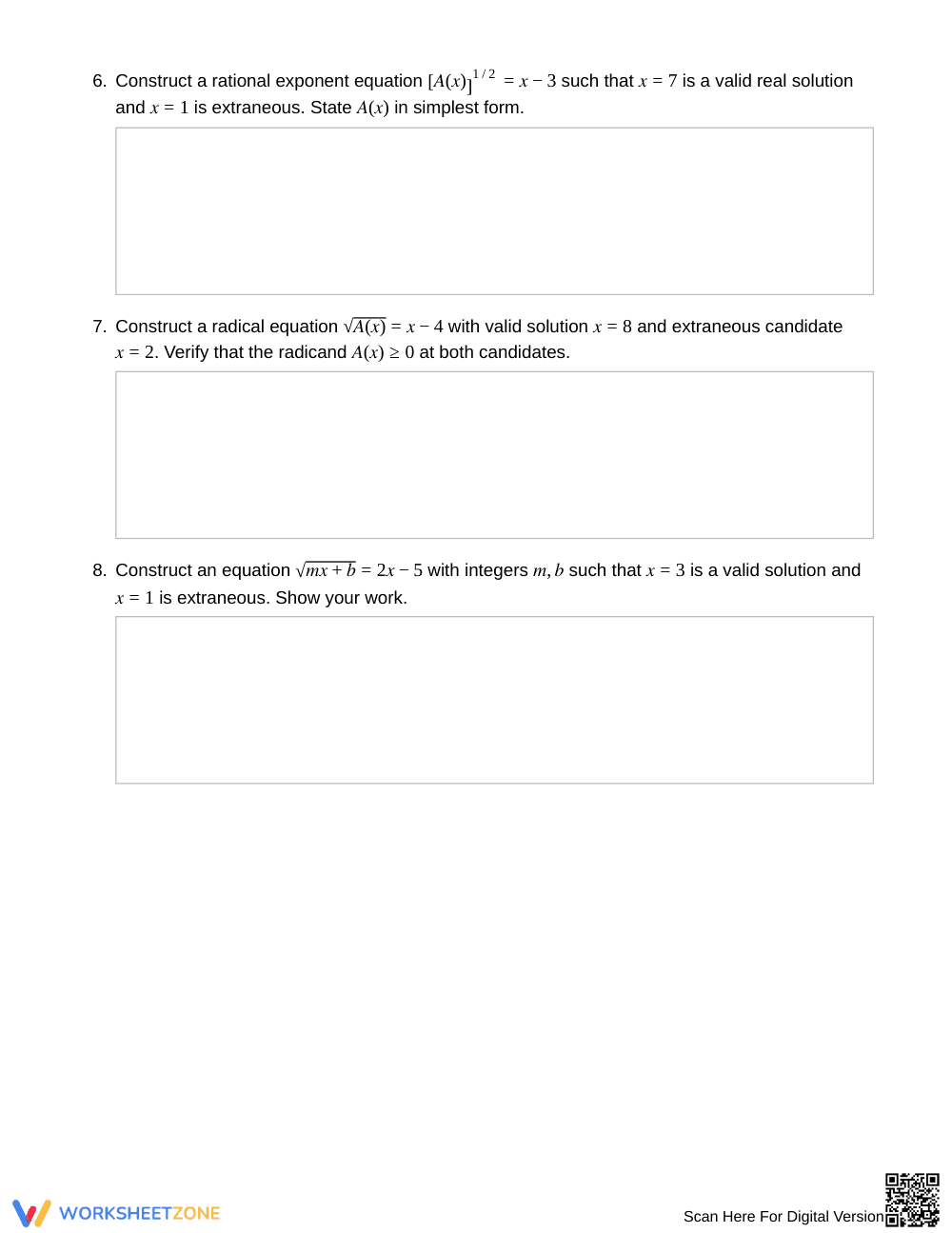
- Supported Practice (Problems 5–8): Learners construct radical equations from given roots, deriving linear radicands and checking domain restrictions.
- Independent Practice (Problems 9–14): Students solve constraint problems using quadratic matching scaffolds, parameter bounds, and discriminant conditions.
This progression uses the gradual-release model to build independent mastery.
Standards Alignment
This worksheet aligns directly with `HSA-REI.A.2`: solve simple radical equations in one variable and show how extraneous solutions arise. It also supports `HSA-CED.A.1` by having students create equations in one variable. Both standard codes can be copied directly into lesson plans, IEP goals, or district curriculum mapping tools.
How to Use It
Use this worksheet following direct instruction on extraneous roots. Have students complete Parts A and B collaboratively to diagnose non-equivalent operations, then assign Part C for independent practice. Formatively check whether students verify the linear side's sign before accepting solutions. Completion takes 45 to 60 minutes.
Who It's For
Ideal for Grade 11 Algebra II and Precalculus students. Provide an anchor chart on principal root non-negativity for struggling learners, while challenging advanced students with Part C's rational-coefficient derivations. Pair this practice with graphing demonstrations of shadow branch intersections.
Mastering radical equations under standard HSA-REI.A.2 requires students to solve one-variable radical equations and explain the precise structural mechanism that causes extraneous solutions to emerge. According to EdReports 2024, high-quality secondary mathematics instructional materials must balance rigorous procedural fluency with conceptual coherence, moving well beyond rote algorithmic checking to deliberate task analysis and proof-based reasoning. This instructional worksheet embodies that imperative by guiding Grade 11 learners through 14 structured reverse-engineering and construction tasks where they generate equations from predetermined valid and invalid roots. When students examine how squaring both sides creates an implication rather than an algebraic equivalence, they gain foundational insight into domain restrictions, non-invertible operations, and polynomial functions. Incorporating backward-design construction problems ensures that high school learners systematically connect algebraic expressions to their underlying functional behavior, cementing deep analytical reasoning skills essential for subsequent Precalculus coursework.


