




























Views
Downloads




Ready Enclosed Area Parameter Worksheet | Grade 12 Calculus

Paste this activity's link or code into your existing LMS (Google Classroom, Canvas, Teams, Schoology, Moodle, etc.).
Students can open and work on the activity right away, with no student login required.
You'll still be able to track student progress and results from your teacher account.
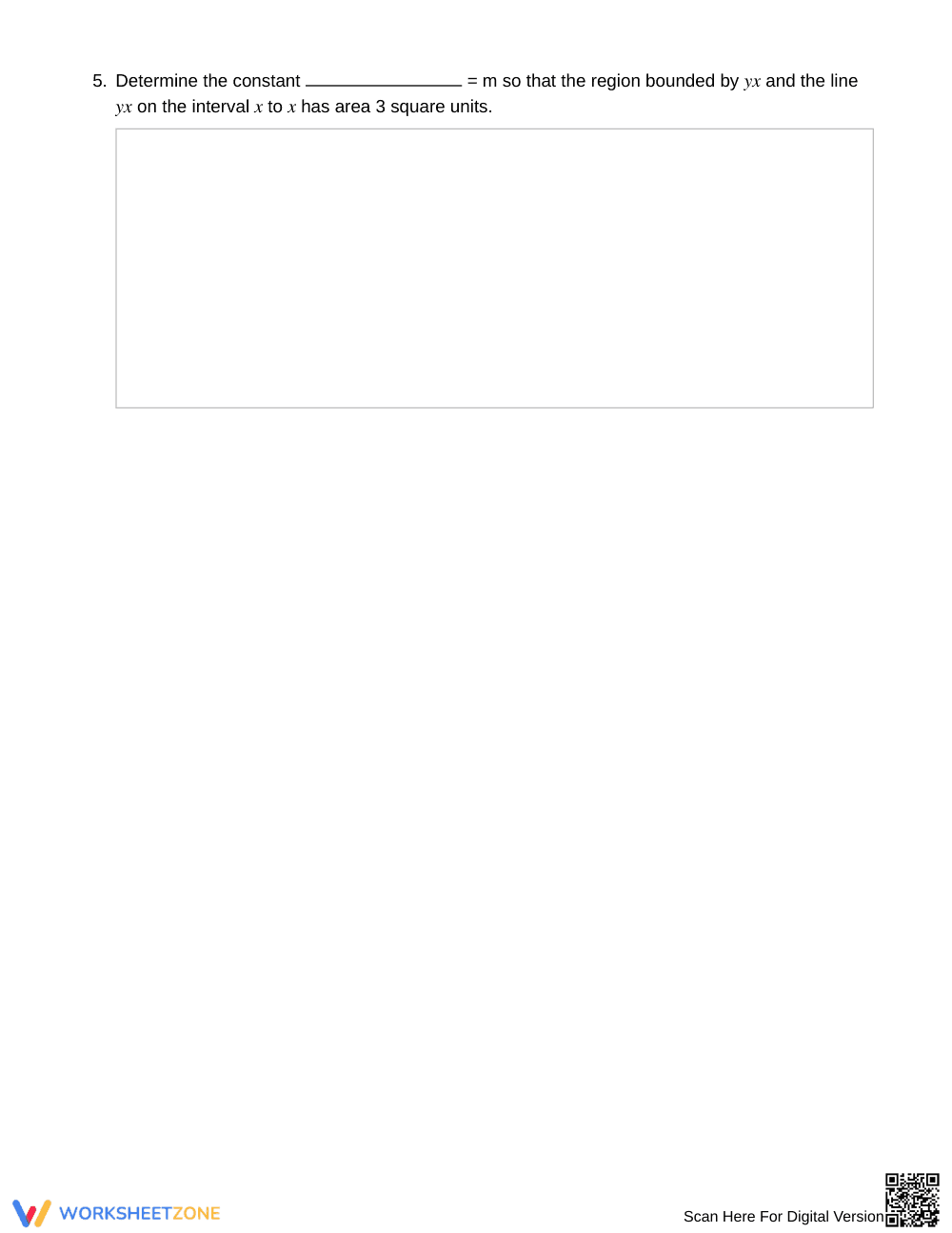
This Grade 12 Calculus worksheet trains students to solve inverse area problems by finding an unknown parameter that yields a target enclosed area. High school mathematicians integrate polynomial, rational, and linear functions, form algebraic equations from definite integrals, and solve for boundary constants across 6 rigorous analytical tasks.
At a Glance
- Grade: 12 · Subject: Calculus
- Standard: Integral Applications — Determine unknown parameters that produce specified enclosed areas between intersecting curves
- Skill Focus: Find a Parameter Producing a Specified Enclosed Area
- Format: 4 pages · 6 problems · Answer key included · PDF
- Best For: Definite integral application practice and exam preparation
- Time: 45–60 minutes
What's Inside
The 4-page student document features 6 multi-step calculus problems with dedicated workspace for integral setup, parameter isolation, and decimal approximation. The worksheet establishes explicit procedural criteria requiring exact definite integral formulation, algebraic manipulation, and rounding to three significant figures. A comprehensive 2-page answer key provides complete analytical steps, integral antiderivatives, and verified parameter values.
Skill Progression
- Guided Practice (Problems 1–2): Students determine horizontal boundary parameters for quadratic and linear regions over fixed intervals with direct visual anchors and scaffolded setups.
- Supported Practice (Problems 3–4): Students manipulate cubic and rational functions, finding vertical shifts and boundary constants across defined domain bounds.
- Independent Practice (Problems 5–6): Students analyze multi-parameter relations and intersect dual parabolas, requiring independent verification that regions remain bounded.
This sequence follows a gradual-release instructional model that transitions learners from basic parameter substitution to autonomous multi-step geometric modeling.
Standards Alignment
This resource aligns with advanced calculus standards governing definite integrals and area between curves. Students integrate the difference between upper and lower bounding functions to evaluate accumulation and solve inverse algebraic equations. Both standard codes can be copied directly into lesson plans, IEP goals, or district curriculum mapping tools.
How to Use It
Administer this worksheet after direct instruction on area between curves as targeted independent practice or paired collaborative problem solving. During work sessions, monitor whether students correctly subtract the lower boundary curve from the upper boundary before integrating. The full problem set requires 45 to 60 minutes of focused computation, making it suitable for block periods or multi-day review.
Who It's For
This activity targets Grade 12 Calculus and Advanced Placement students preparing for rigorous integral application assessments. Teachers can scaffold the assignment by providing interval sketch templates or challenge advanced learners by asking them to evaluate alternate parametric solutions without calculators. Pair this resource with a visual graphing demonstration showing dynamic boundary transformations.
Mastering definite integral applications requires students to manipulate symbolic representations beyond standard algorithmic evaluation. In this Grade 12 Calculus resource, students practice finding an unknown parameter producing a specified enclosed area between multiple curves. According to Fisher & Frey (2014), structured instructional task sequences that systematically shift cognitive responsibility enable high school mathematics students to transfer foundational integration techniques into novel, non-routine problem-solving contexts. When solving for unknown geometric parameters, learners must correctly construct definite integrals, evaluate antiderivatives, and isolate variable bounds or curve constants through algebraic manipulation. This deliberate practice bridges conceptual understanding of accumulated area with procedural fluency. By requiring students to justify bounded regions and express results to three significant figures, this resource develops the mathematical precision demanded on advanced examinations while effectively reinforcing the core theoretical principles of integral calculus.


