




























Views
Downloads



Ready Domain Restrictions Worksheet | Grade 11 Algebra II

Paste this activity's link or code into your existing LMS (Google Classroom, Canvas, Teams, Schoology, Moodle, etc.).
Students can open and work on the activity right away, with no student login required.
You'll still be able to track student progress and results from your teacher account.
Mastering real-domain restrictions is essential for advanced algebraic reasoning. This comprehensive Grade 11 Algebra II worksheet guides students through 8 rigorous analytical tasks, training them to identify where radical properties hold, justify domain conditions over real numbers, and correctly use absolute value notation when evaluating rational exponent expressions.
At a Glance
- Grade: 11 · Subject: Algebra II
- Standard: Advanced Algebra — Justify real-domain restrictions when simplifying radical and rational exponent expressions
- Skill Focus: Justify a Real-Domain Restriction
- Format: 5 pages · 8 problems · Answer key included · PDF
- Best For: Advanced Algebra II practice
- Time: 45–60 minutes
What's Inside
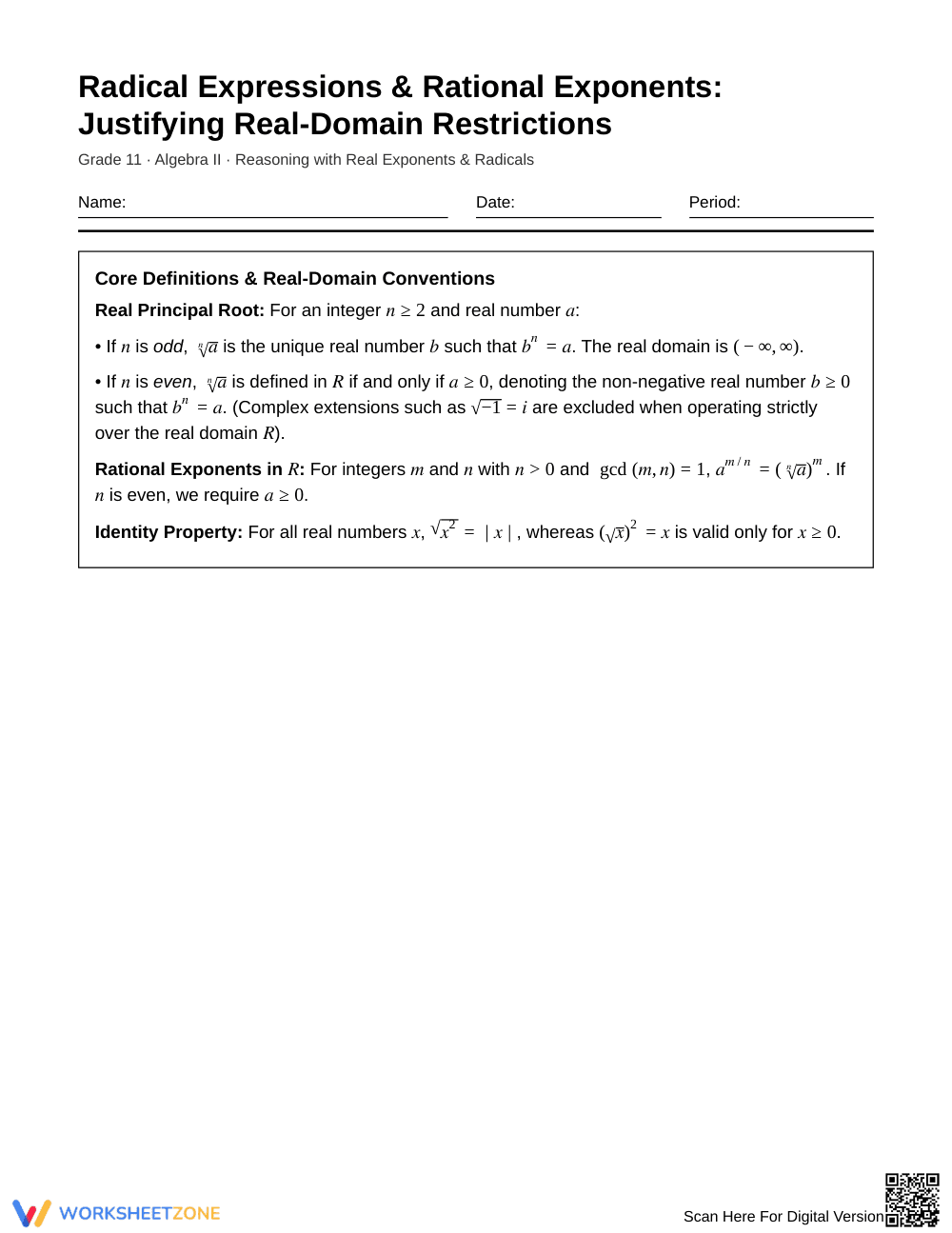
This 5-page instructional resource contains 8 multi-part analytical exercises accompanied by a complete 4-page step-by-step answer key. Students examine foundational reference definitions, critique algebraic fallacies, simplify expressions containing even and odd roots, and complete a synthesis matrix comparing radical expressions across diverse real domains.
Skill Progression
- Guided Practice (Part A, Problems 1–2): Students critique common peer claims regarding exponent rules, evaluating expressions at negative test values to reveal domain boundaries and subtle algebraic fallacies.
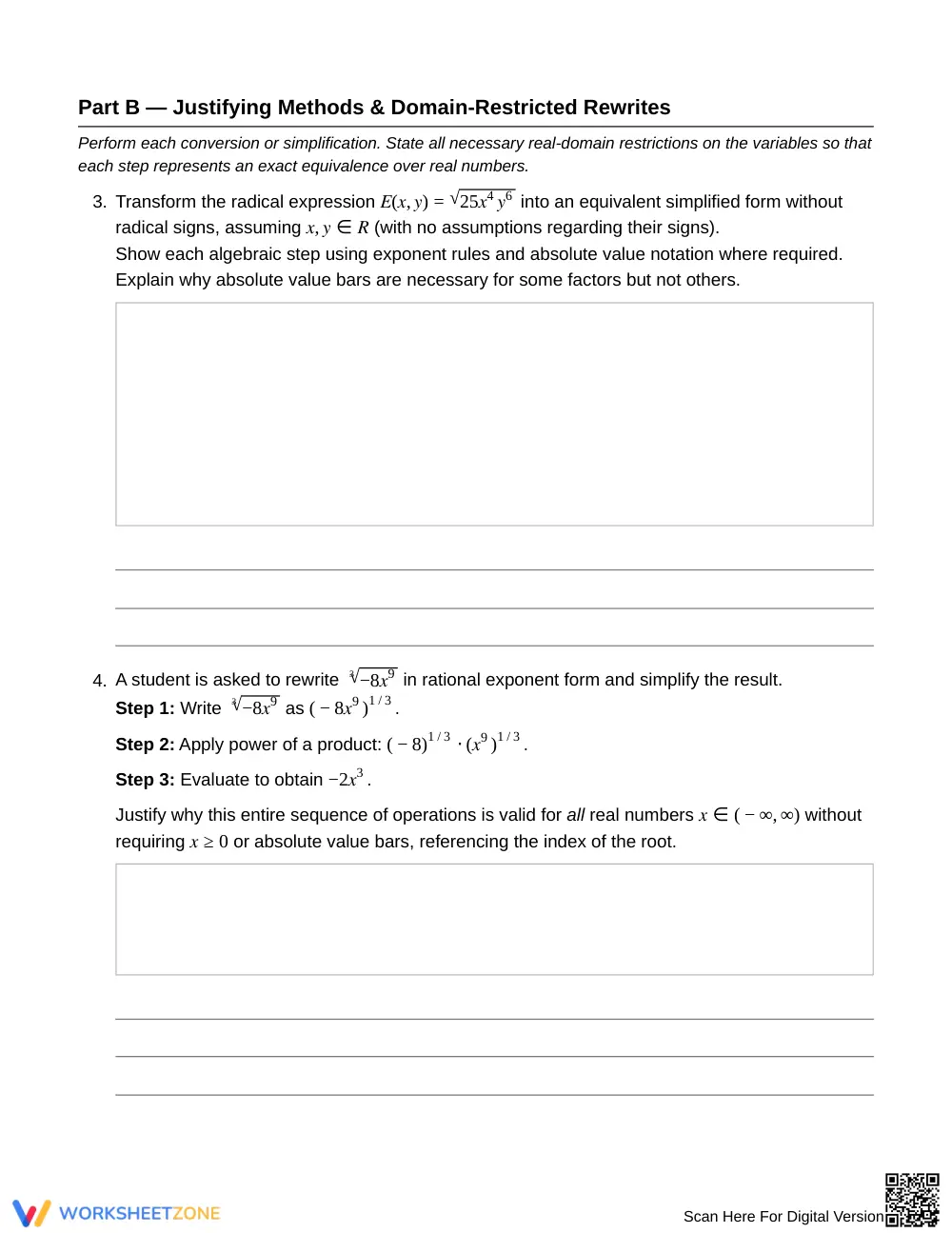
- Supported Practice (Part B, Problems 3–6): Learners rewrite multi-variable radical expressions, explicitly articulating necessary sign restrictions, radical indices, and absolute value requirements across intermediate simplification steps.
- Independent Practice (Part C, Problems 7–8): Students construct formal counterexamples proving where product properties fail over negative numbers and formulate generalized theorems for radical exponent equivalence.
This structured progression reflects an intentional gradual-release model, shifting students from guided conceptual critique to autonomous algebraic proof.
Standards Alignment
This worksheet aligns with high school advanced algebra standards covering rational exponents and radical expressions. Students explain why domain restrictions arise when extending integer exponents to rational values and establish equivalences over real numbers. These curriculum standards can be copied directly into lesson plans, IEP goals, or district curriculum mapping tools.
How to Use It
Deploy this worksheet after direct instruction on radical functions and principal nth roots. Use Part A as a collaborative mid-lesson checkpoint where student pairs debate the validity of algebraic claims before proceeding. Formative assessment tip: observe whether students remember to apply absolute value bars when simplifying even roots of even powers, such as √(x2) = |x|. Total completion takes 45 to 60 minutes.
Who It's For
This resource is designed for Grade 11 Algebra II, Integrated Math III, and Pre-Calculus students preparing for higher-level calculus domain analysis. It provides targeted scaffolding for students who overgeneralize exponent rules. Pair this practice with an anchor chart detailing real principal root definitions and exponent laws.
Developing rigorous justification skills in secondary mathematics prevents persistent conceptual errors in college-level calculus. According to Fisher & Frey (2014), structured problem progressions that combine peer critique, explicit boundary identification, and autonomous counterexample construction enable students to achieve deep conceptual mastery. Research demonstrates that high school learners frequently overgeneralize algebraic algorithms without verifying real-domain preconditions, particularly when working with rational exponents and even radical indices. By requiring 11th-grade students to justify real-domain restrictions across 8 tiered tasks, this resource reinforces foundational definitions of principal roots and absolute value equivalence. Students evaluate why properties hold over specific subsets of real numbers, transforming mechanical calculation into analytical mathematical argument. This standards-aligned practice ensures that students cultivate the precision, technical notation, and deductive reasoning necessary for sustained achievement in advanced STEM coursework.


