


























Views
Downloads



Ready Density, Mass & Volume Worksheet | Grade 6 Science
Paste this activity's link or code into your existing LMS (Google Classroom, Canvas, Teams, Schoology, Moodle, etc.).
Students can open and work on the activity right away, with no student login required.
You'll still be able to track student progress and results from your teacher account.
This Grade 6 physical science worksheet equips students to master mass, volume, and density through targeted conceptual questions and quantitative calculations. Learners distinguish mass from weight, calculate density using liquid displacement, and evaluate physical reasonableness. Designed for structured practice, this resource builds measurement skills essential for middle school science labs.
At a Glance
- Grade: 6 · Subject: Science
- Standard: Distinguish between mass, volume, and weight while calculating density using liquid displacement and formulas
- Skill Focus: Mass, Volume, and Density
- Format: 5 pages · 12 problems · Comprehensive answer key included · Printable PDF
- Best For: Mid-unit classroom practice, hands-on lab follow-up, and physics review
- Time: 40–50 minutes
This 5-page printable resource contains 12 exercises organized into three parts, accompanied by a 2-page answer key with worked solutions. The worksheet opens with a formula reference box defining core equations, metric units, and water displacement steps. Across each page, students complete multiple-choice identification items, written conceptual comparisons, computational data tables, and experimental error analysis prompts.
Skill Progression
- Guided practice (Part A, 4 problems): Students categorize measurement tools, contrast mass with weight, and calculate displacement volumes with direct scaffolding.
- Supported practice (Part B, 6 problems): Learners solve for density, mass, and volume using formulas, structured data tables, and liquid displacement data.
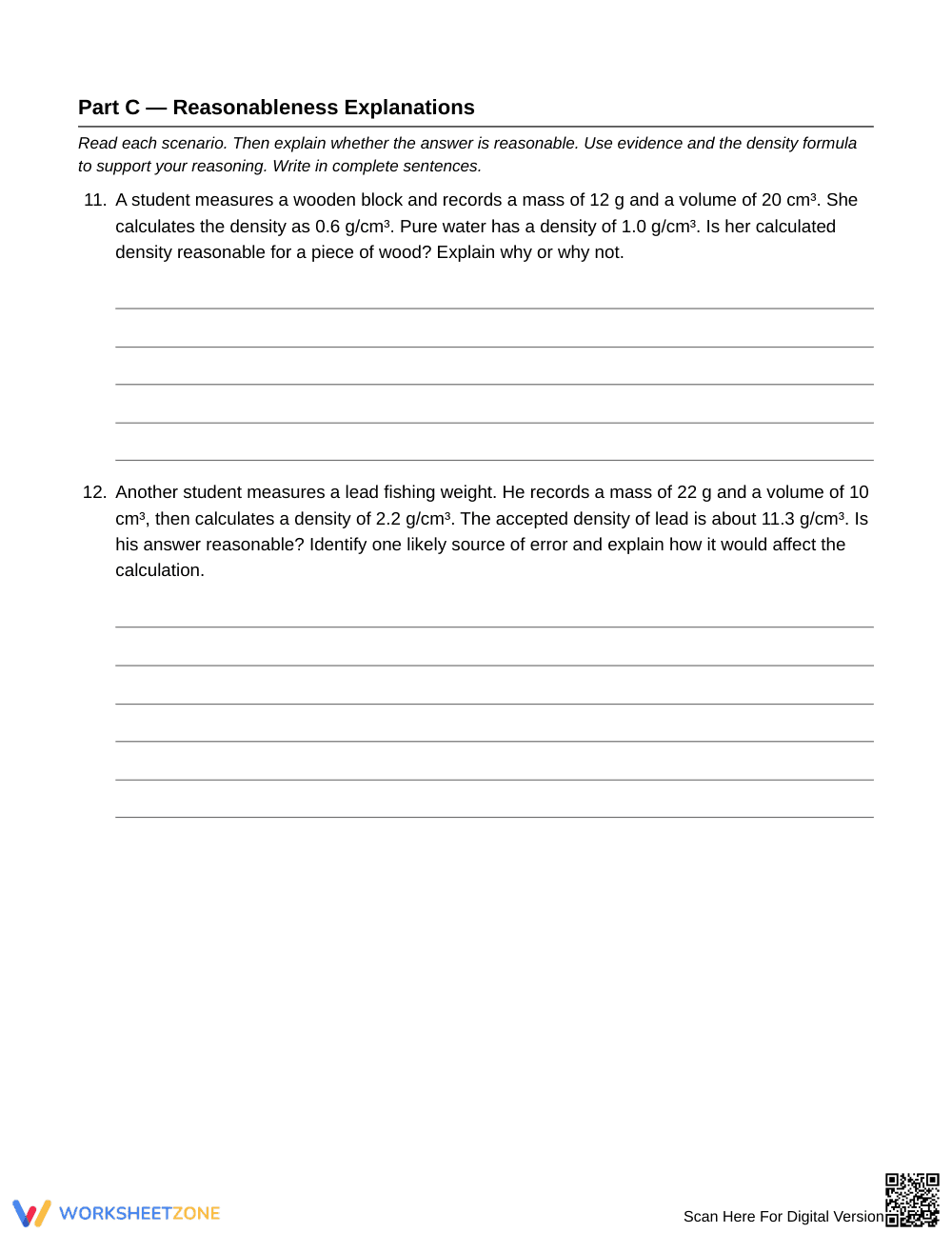
- Independent practice (Part C, 2 problems): Students critique lab claims, evaluate numerical reasonableness against reference values, and identify measurement errors.
This sequence reflects the gradual-release framework, moving students from guided conceptual recognition to independent analytical evaluation.
Standards Alignment
This physical science resource aligns with middle school physical science standards requiring students to analyze characteristic properties such as density to distinguish pure substances. A supporting standard emphasizes mathematical computations and measurement accuracy during empirical investigations. Both standard codes can be copied directly into lesson plans, IEP goals, or district curriculum mapping tools.
How to Use It
Use this worksheet after direct instruction on displacement or following a density laboratory. Have students complete Parts A and B in pairs, circulating to check that units such as grams and cubic centimeters are recorded. For formative assessment, examine problem six to ensure students correctly multiply density by volume rather than dividing. Expected completion time is 40 to 50 minutes.
Who It's For
This activity supports sixth-grade science students building foundational chemistry and physics proficiency. Scaffolding elements like the formula reference box assist English learners and students needing targeted accommodations. Challenge early finishers to calculate buoyancy implications. Pair this resource with a hands-on graduated cylinder lab or a physical properties anchor chart.
According to research on scaffolded instructional design by Fisher & Frey (2014), structured cognitive progressions that move systematically from conceptual distinctions to quantitative execution significantly enhance middle school science mastery. This comprehensive physical science resource develops core competency in mass, volume, and density through targeted graduated tasks that ground abstract physical relationships in concrete mathematical problem-solving. By structuring student engagement around the explicit manipulation of formula variables, water displacement calculations, and experimental reasonableness checks, the worksheet ensures learners move beyond rote memorization into authentic scientific literacy. Students first distinguish mass from weight under varying gravitational fields, then manipulate density equations to solve for unknown mass and volume, and finally critique lab results to diagnose experimental errors. This deliberate gradual-release architecture reinforces conceptual retention, providing educators with verified evidence of student readiness for advanced middle school physical science investigations and quantitative laboratory assessments.


