


























Views
Downloads


Ready Contradictory Decision Worksheet | Grade 9 English I
Paste this activity's link or code into your existing LMS (Google Classroom, Canvas, Teams, Schoology, Moodle, etc.).
Students can open and work on the activity right away, with no student login required.
You'll still be able to track student progress and results from your teacher account.
This Grade 9 worksheet teaches students to analyze a character's contradictory decision by tracing competing motives through textual evidence. After reading a short story about two young composers, students locate details, connect them, and defend a claim about why the character cuts her own song.
At a Glance
- Grade: 9 · Subject: English I
- Standard:
RL.9-10.3— Explain how a character's conflicting motives shape decisions and the plot- Skill Focus: Analyzing a contradictory decision using qualified claims and cited evidence
- Format: 6 pages · 12 problems · Answer key included · PDF
- Best For: Close reading practice in characterization units
- Time: 40–50 minutes
What's Inside
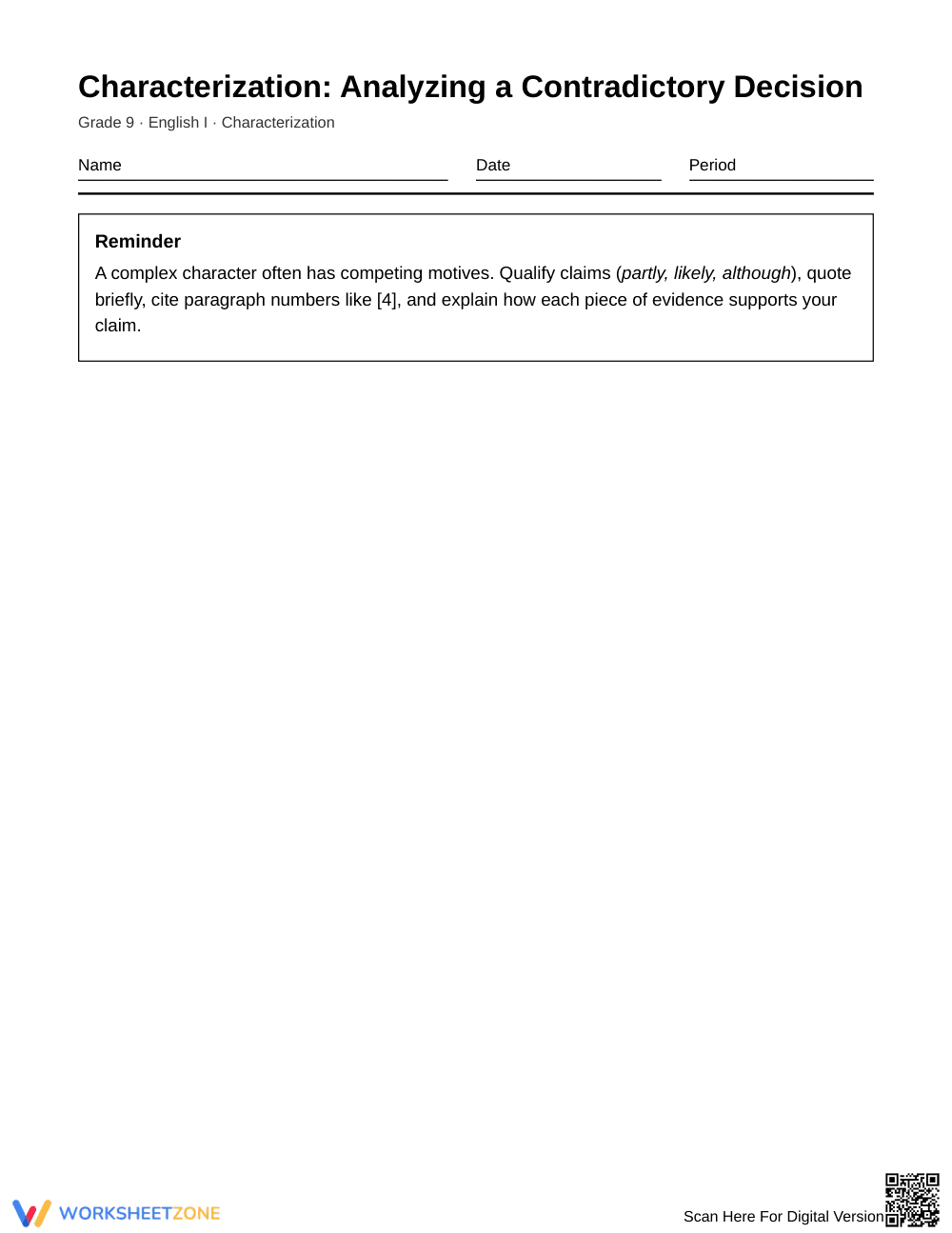
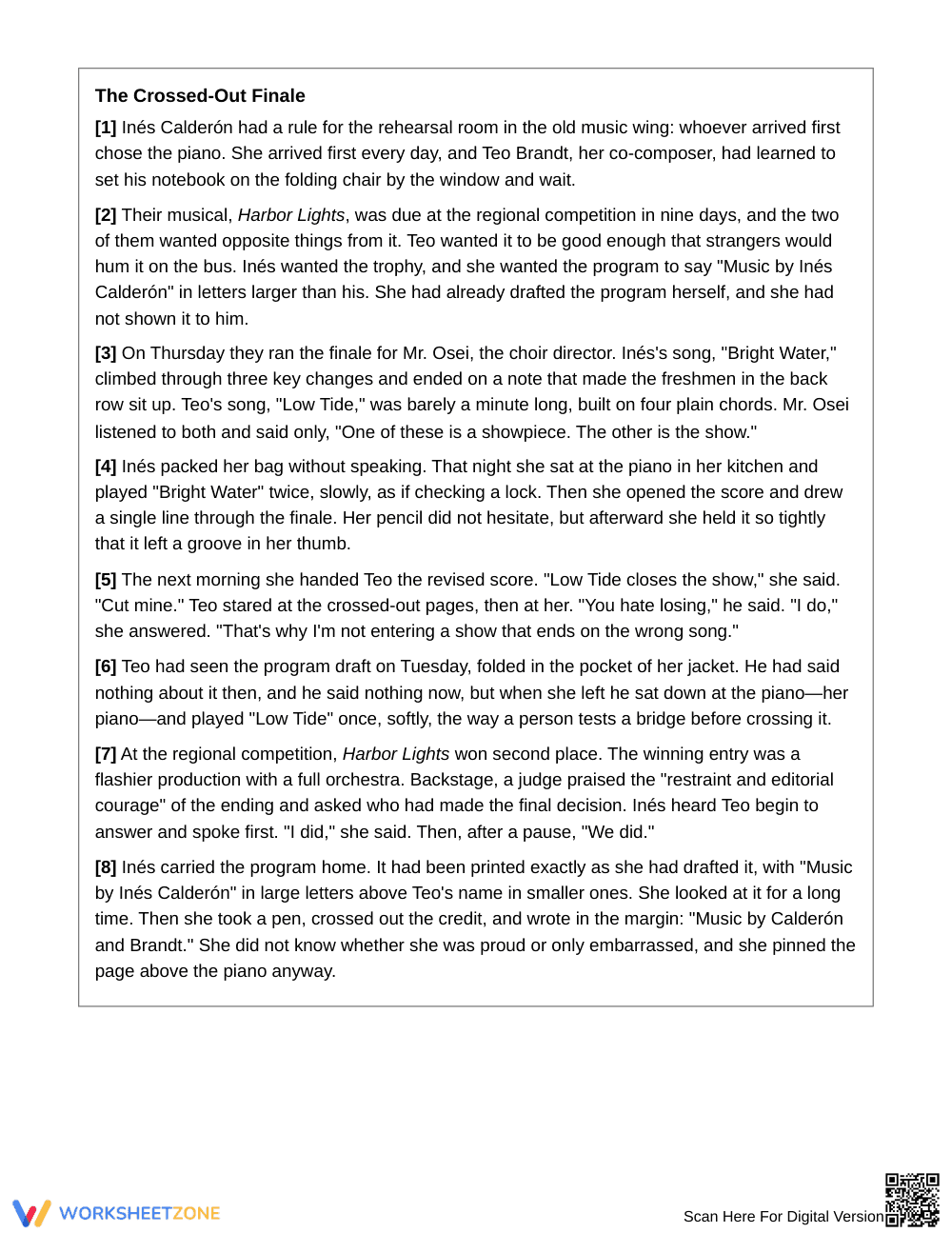
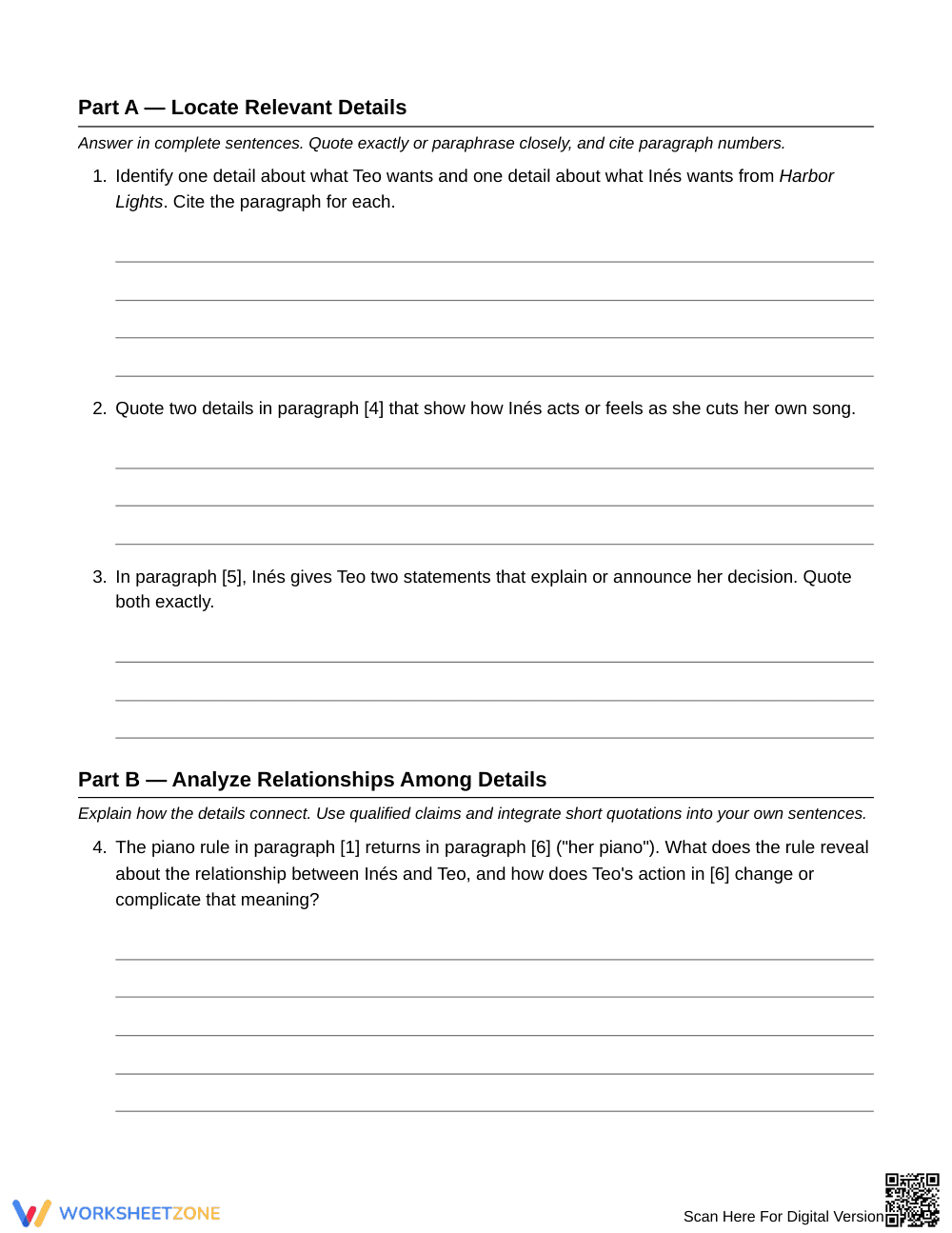
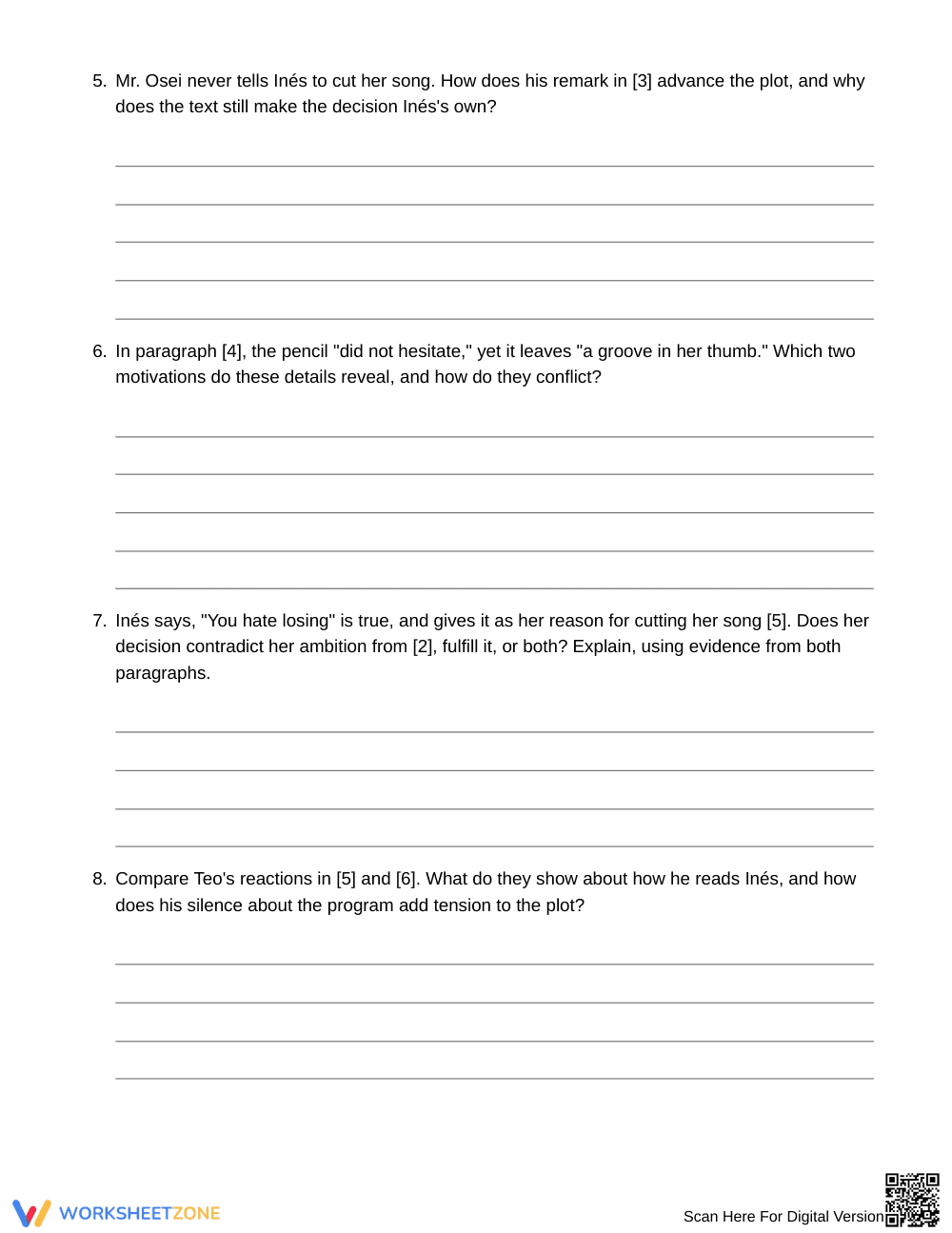
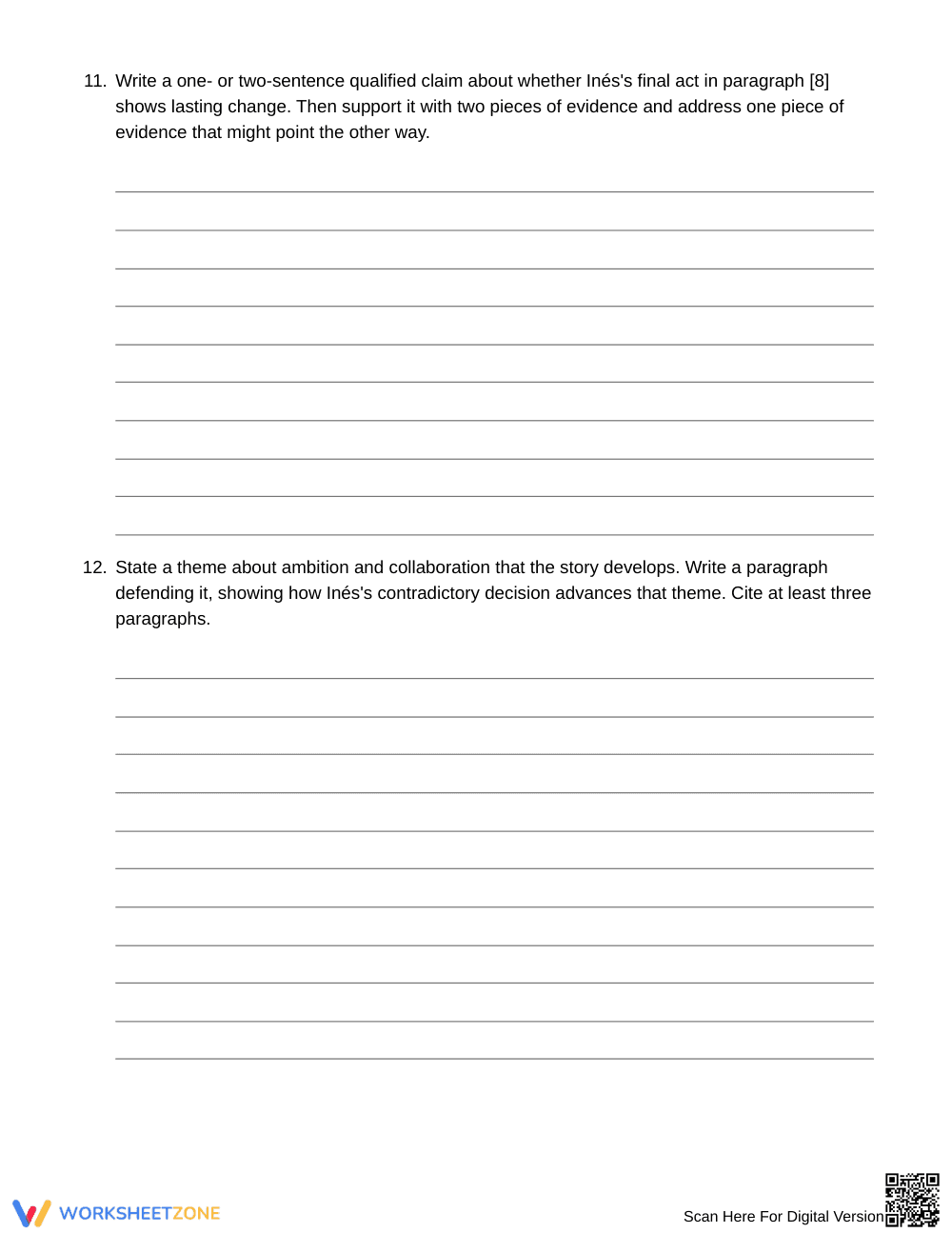
A reminder box on qualified claims, brief quotations, and paragraph citations leads into the 8-paragraph story “The Crossed-Out Finale.” Part A has 3 locate-the-detail tasks, Part B has 6 analysis tasks, and Part C has 3 defense tasks, including a multiple-choice claim and a theme paragraph. Students answer in complete sentences. A 3-page answer key is included.
Skill Progression
- Guided practice (3 tasks, Part A): Students locate and quote details with paragraph citations; the reminder box gives the most support.
- Supported practice (6 tasks, Part B): Students connect details across paragraphs using qualified claims and integrated quotations.
- Independent practice (3 tasks, Part C): Students choose and defend a claim, judge lasting change, and write a theme paragraph citing three paragraphs.
The sequence follows gradual release: I Do, We Do, You Do.
Standards Alignment
RL.9-10.3 — Analyze how complex characters (e.g., those with multiple or conflicting motivations) develop over the course of a text, interact with other characters, and advance the plot or develop the theme. Part A isolates motives, Part B traces interactions and plot, and Part C connects them to theme. The standard code can be copied directly into lesson plans, IEP goals, or district curriculum mapping tools.
How to Use It
- After direct instruction: Assign Parts A and B in pairs once students have learned how motives drive decisions.
- As an assessment: Have students complete Part C independently as an end-of-unit check.
While students work, watch whether they qualify claims and cite paragraph numbers rather than summarize. Expect 40–50 minutes in total.
Who It's For
Built for Grade 9 English I students working on literary analysis. For extra support, discuss Part A aloud and give sentence starters for Part B. For extension, ask for a counterargument in every Part C response. Pair it with a mini-lesson or anchor chart on character motivation.
This Grade 9 English I worksheet targets RL.9-10.3, which asks students to analyze how complex characters with conflicting motivations develop, interact with other characters, and advance the plot or theme. Twelve tasks use the short story “The Crossed-Out Finale” to teach students to locate evidence, connect details across paragraphs, and defend a qualified claim about a contradictory decision. The structure follows the gradual release of responsibility model described by Fisher & Frey (2014), moving from three guided evidence-location tasks to six supported analysis tasks and three independent defense tasks. Students practice qualifying claims, quoting briefly, and citing paragraph numbers, habits that make literary arguments precise and checkable. A 3-page answer key supports quick scoring and feedback. Teachers can use the packet after direct instruction on characterization, as formative assessment, or as a writing warm-up before a full character analysis essay.


