




























Views
Downloads



Ready Big Cat Camouflage Word Search | Grades 6–7 Science

Paste this activity's link or code into your existing LMS (Google Classroom, Canvas, Teams, Schoology, Moodle, etc.).
Students can open and work on the activity right away, with no student login required.
You'll still be able to track student progress and results from your teacher account.
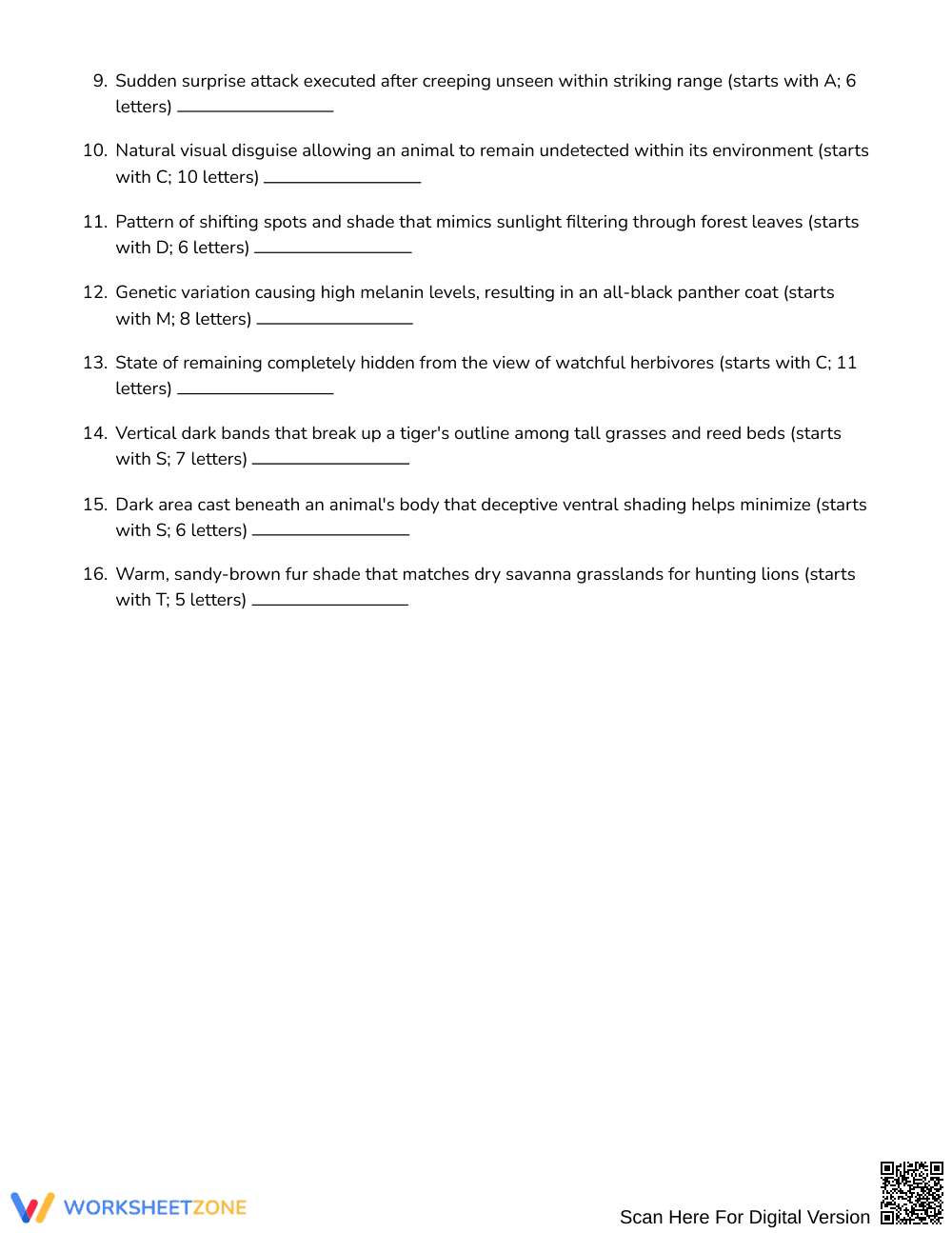
This animal adaptations word search strengthens middle school science vocabulary by challenging students to identify 16 specialized camouflage and coat-pattern terms. Instead of copying from a list, learners analyze detailed biological descriptions to deduce each hidden word, reinforcing key concepts such as countershading, melanism, and disruptive coloration before locating them across the letter grid.
At a Glance
- Grade: Grades 6–7 · Subject: Science
- Standard: Not standards-assessed — vocabulary enrichment
- Skill Focus: Big cat camouflage, pelage adaptations, and coat patterns
- Format: 3 student pages · 16 hidden words · 4-page answer key included · PDF
- Best For: Animal adaptations unit vocabulary reinforcement, bell ringers, and early finishers
- Time: 25–35 minutes of focused student work
Inside this 3-page science activity, students encounter 16 vocabulary clues alongside a puzzle grid and an extensive 4-page answer key. Rather than relying on a traditional word bank, the activity presents descriptive clues that define specific adaptations—such as ocelli markings on tiger ears or dapple patterns that mimic canopy light. Students must retrieve the correct scientific term from memory or contextual analysis before searching for it in the puzzle layout.
Puzzle Mechanics and Structure
This challenge is built around an 18 x 18 grid designed to test students' pattern recognition and spatial reasoning alongside scientific terminology:
- No Word Bank: Students do not receive a pre-listed roster of terms. They must read 16 rigorous clues and determine each biological term independently.
- Eight-Direction Placement: Words run in all 8 compass directions—north, northeast, east, southeast, south, southwest, west, and northwest—including backward and diagonal orientations.
- Full Answer Verification: The accompanying 4-page answer key highlights exact letter coordinates and placement lines for immediate verification.
Standards Alignment
This resource serves as targeted vocabulary enrichment and is not aligned to a specific state or national standard. It supports general life science curricula by reinforcing domain-specific terminology related to predator-prey dynamics, natural selection, and physical adaptations.
How to Use It
Use this word search after direct instruction on physical adaptations to cement terminology, or assign it during mid-unit review stations to deepen comprehension. As students solve the clues, conduct formative observations by checking whether they can explain the adaptive advantage of terms like countershading or disruptive coloration rather than merely circling letters. Most middle school learners will complete the challenge within 25 to 35 minutes.
Who It's For
This activity is designed for middle school life science students in Grades 6–7 studying animal structures and survival strategies. For students needing additional scaffolding, teachers can provide an animal adaptations anchor chart or allow collaborative peer pairs to decipher the clues. It pairs naturally with an informational reading passage on big cat predation strategies or a direct instruction lesson on natural selection.
Domain-specific vocabulary acquisition is a cornerstone of scientific literacy and reading comprehension in middle school science. According to Fisher & Frey (2014), purposeful vocabulary tasks that require students to connect technical definitions to conceptual representations significantly improve retention compared to rote memorization drills. This Grades 6–7 life science resource reinforces 16 essential camouflage and coat-pattern concepts through descriptive clue retrieval and spatial search mechanics. By prompting students to deduce terms such as melanism, countershading, and disruptive coloration from functional clues rather than passive word lists, the activity encourages active cognitive processing and contextual association. Middle school learners benefit from engaging puzzle structures that synthesize biological vocabulary with critical thinking, establishing a durable foundation for broader studies in animal adaptations, organism survival, and natural selection without requiring alignment to a single rigid assessment standard.


