


























Views
Downloads

Printable Reading Comprehension Worksheet | Grade 4 ELA
Paste this activity's link or code into your existing LMS (Google Classroom, Canvas, Teams, Schoology, Moodle, etc.).
Students can open and work on the activity right away, with no student login required.
You'll still be able to track student progress and results from your teacher account.
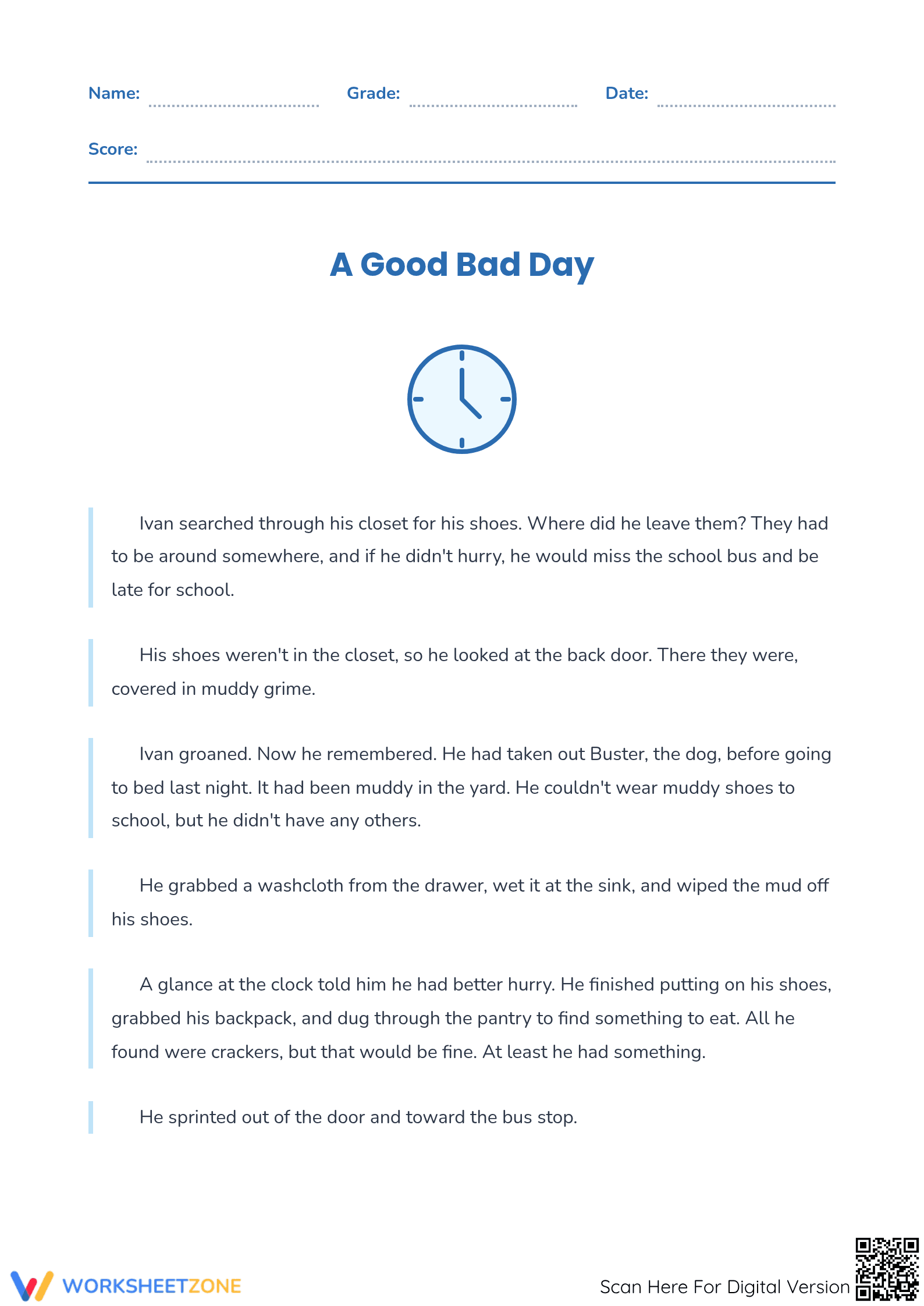
This Grade 4 reading comprehension worksheet helps students master the art of extracting evidence from a narrative text. By following Ivan's morning routine, learners practice identifying key details and making logical inferences about character feelings. This resource ensures students can support their answers with specific textual references to improve overall literacy.
At a Glance
- Grade: 4 · Subject: English
- Standard:
CCSS.ELA-LITERACY.RL.4.1— Refer to details and examples in a text when explaining explicit meaning- Skill Focus: Reading Comprehension & Inference
- Format: 2 pages · 5 problems · Answer key included · PDF
- Best For: Independent reading practice or formative assessment
- Time: 15–20 minutes
What's Inside
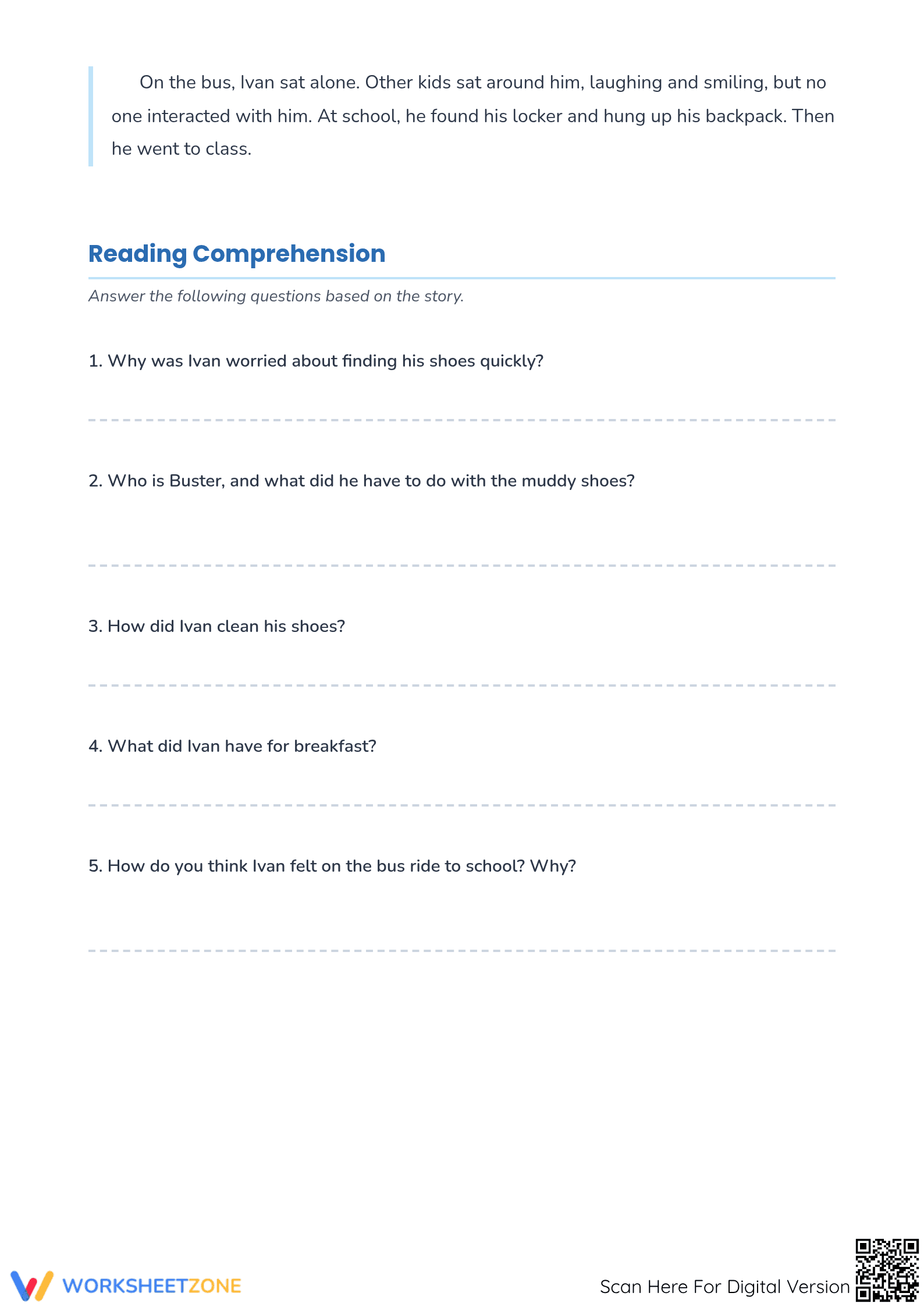
The package contains a two-page PDF featuring a relatable short story titled "A Good Bad Day." The first page presents the narrative text with clear paragraph breaks, while the second page provides five open-ended comprehension questions. These questions range from literal recall regarding character names and plot points to higher-order thinking about character emotions. A full answer key is provided for quick grading.
Skill Progression
- Guided practice: Students read the narrative text independently or as a group, identifying the sequence of events in Ivan's morning.
- Supported practice: The first four questions prompt students to locate specific facts within the text, such as what Ivan ate for breakfast.
- Independent practice: The final question requires students to synthesize the text to infer Ivan's emotional state during the bus ride.
This worksheet follows a gradual-release model, moving from basic identification to complex textual analysis.
Standards Alignment
This resource is primarily aligned with CCSS.ELA-LITERACY.RL.4.1, which requires students to refer to details and examples in a text when explaining what the text says explicitly and when drawing inferences. It also supports vocabulary development as students encounter descriptive language. Both standard codes can be copied directly into lesson plans, IEP goals, or district curriculum mapping tools.
How to Use It
Use this worksheet as a warm-up activity during your ELA block to settle students into a reading mindset. Alternatively, assign it as a formative assessment after a lesson on making inferences to check for individual student understanding. Teachers should observe if students are flipping back to the first page to find evidence, which is a key indicator of standard mastery. Expected completion time is 15 to 20 minutes.
Who It's For
This worksheet is designed for fourth-grade students but is also suitable for third graders ready for a challenge or fifth graders needing remedial support. It works well for English Language Learners due to the linear narrative structure. Pair this resource with a graphic organizer for "Character Feelings" or an anchor chart on "Text Evidence" to provide additional scaffolding.
According to research by Fisher & Frey (2014), the ability to cite evidence is a foundational pillar of close reading that prepares students for complex secondary texts. This Grade 4 worksheet targets CCSS.ELA-LITERACY.RL.4.1 by requiring students to engage in literal recall and inferential reasoning. By answering five specific questions about Ivan’s "Good Bad Day," learners develop the habit of returning to the text to validate their claims. This practice is essential for meeting National Assessment of Educational Progress (NAEP) benchmarks, which emphasize the integration of information across a narrative. Providing structured opportunities for students to explain "why" a character feels a certain way bridges the gap between basic decoding and deep comprehension. This printable resource offers a clear, zero-prep pathway for educators to monitor these critical literacy milestones while ensuring students remain engaged with relatable, age-appropriate content.


