


























Views
Downloads

Turtles Reading Comprehension Worksheet | Grade 4 Essential
Paste this activity's link or code into your existing LMS (Google Classroom, Canvas, Teams, Schoology, Moodle, etc.).
Students can open and work on the activity right away, with no student login required.
You'll still be able to track student progress and results from your teacher account.
This Grade 4 reading comprehension worksheet provides a structured approach to analyzing informational text through an engaging passage about turtles. Students develop critical literacy skills by identifying key details about reptile biology and specialized anatomy. By connecting text evidence to specific questions, learners master the ability to explain complex biological concepts using academic vocabulary.
At a Glance
- Grade: 4 · Subject: English Language Arts
- Standard:
CCSS.ELA-LITERACY.RI.4.1— Refer to details and examples in a text to explain explicit meanings- Skill Focus: Informational Text Analysis & Domain Vocabulary
- Format: 4 pages · 9 problems · Answer key included · PDF
- Best For: Independent practice or science-integrated literacy blocks
- Time: 25–35 minutes
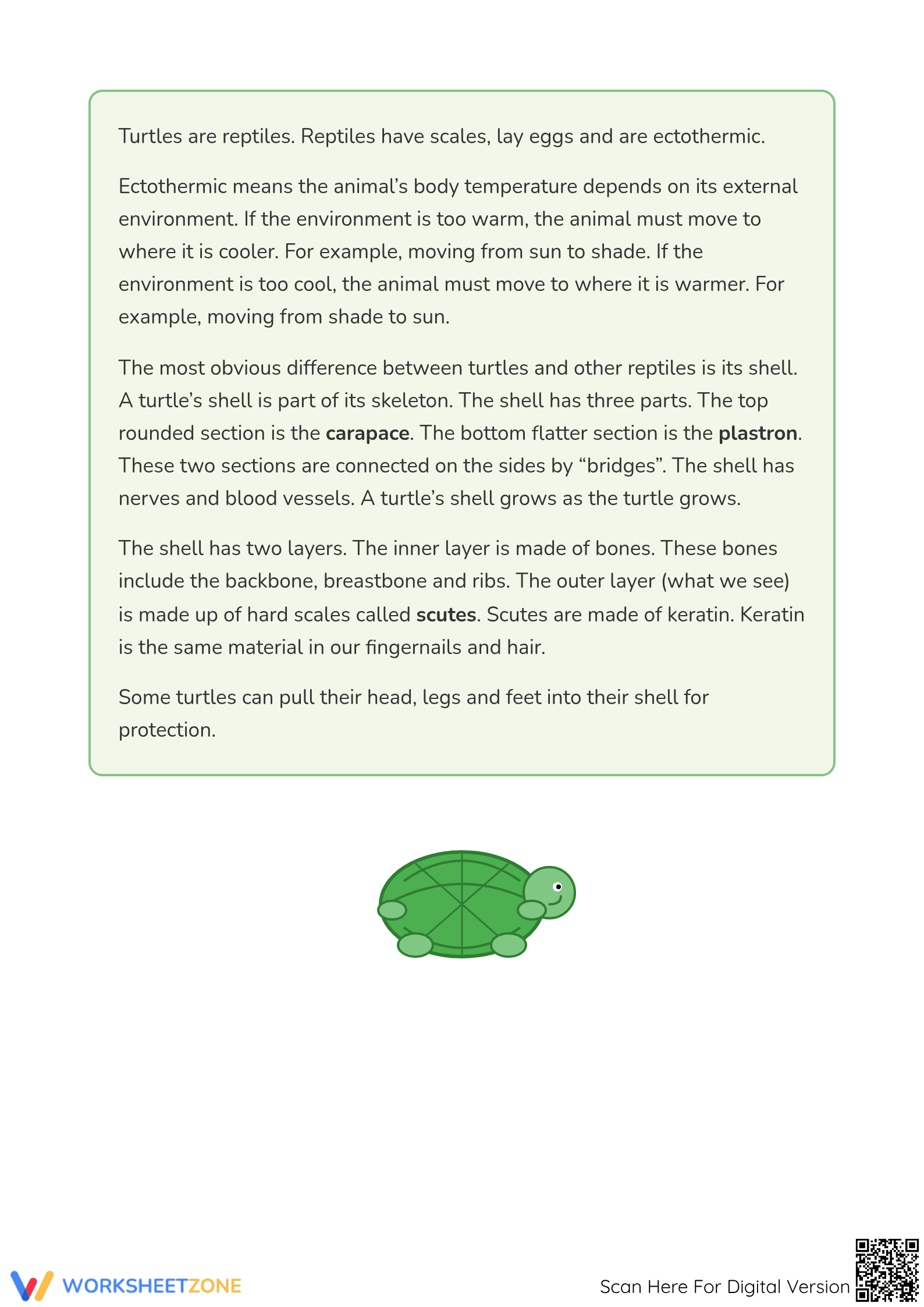
The resource contains a comprehensive four-page packet designed for deep engagement. It begins with a dedicated note-taking page to encourage active reading, followed by a detailed informational passage by Guy Belleranti. The assessment portion is divided into two distinct parts: a vocabulary section focusing on domain-specific terms like "ectothermic" and "carapace," and a comprehension section featuring both multiple-choice and open-ended response questions. A complete answer key is provided for streamlined grading.
This resource is designed for a zero-prep classroom environment, allowing teachers to transition from instruction to practice in under 2 minutes. First, print the four-page PDF for each student or assign it as a packet. Second, distribute the materials; the self-explanatory layout requires no additional verbal instructions. Finally, use the included answer key to review student responses in less than 5 minutes, making it an ideal choice for substitute plans or morning work.
This worksheet is primarily aligned with CCSS.ELA-LITERACY.RI.4.1, which requires students to refer to details and examples in a text when explaining what the text says explicitly. It also supports CCSS.ELA-LITERACY.RI.4.4 by challenging students to determine the meaning of domain-specific words related to herpetology. Both standard codes can be copied directly into lesson plans, IEP goals, or district curriculum mapping tools.
Use this worksheet during the independent practice phase of a gradual release model after teaching strategies for informational text. It serves as an excellent formative assessment to check for understanding of text-dependent questioning. Teachers should observe if students return to the second page to locate specific terms like "scutes" or "keratin" during the vocabulary portion. Completion typically takes 30 minutes, depending on reading speed.
This material is tailored for fourth-grade students but provides enough scaffolding for third-grade enrichment or fifth-grade intervention. It pairs naturally with science units on animal adaptations or life cycles. The inclusion of a note-taking page makes it particularly effective for students who benefit from graphic organizers or visual structure during the reading process.
According to the RAND AIRS 2024 report on literacy instruction, providing students with high-interest informational texts paired with structured evidence-based questioning is essential for developing long-term reading proficiency. This worksheet implements these findings by focusing on CCSS.ELA-LITERACY.RI.4.1, ensuring students move beyond surface-level reading to deep textual analysis. By requiring learners to define domain-specific vocabulary within the context of a biological study, the resource mirrors the rigorous demands of national assessments like the NAEP. Research from Fisher & Frey (2014) emphasizes that complex texts require slow reading and purposeful note-taking, a pedagogical strategy directly supported by the dedicated notes section in this packet. Educators can utilize this 9-task assessment to generate reliable data on student ability to synthesize facts about reptilian anatomy and environmental adaptation, providing a clear benchmark for progress monitoring in Grade 4 ELA classrooms.


