


























Views
Downloads



Grade 3 Numbers to 100 — Printable No-Prep Worksheet
Paste this activity's link or code into your existing LMS (Google Classroom, Canvas, Teams, Schoology, Moodle, etc.).
Students can open and work on the activity right away, with no student login required.
You'll still be able to track student progress and results from your teacher account.
This Grade 3 Math resource provides structured practice for students reading and writing numbers up to 100. Learners master transitions between numerical symbols and written word forms, ensuring a solid foundation in number literacy. This printable packet builds confidence through repetitive, focused exercises.
At a Glance
- Grade: Grade 3 · Subject: Math
- Standard:
CCSS.MATH.CONTENT.2.NBT.A.3— Read and write numbers up to 100 using numerals and number names- Skill Focus: Reading and writing numbers up to 100
- Format: 5 pages · 4 tasks · Answer key included · PDF
- Best For: Foundational math practice and remediation
- Time: 20–30 minutes
What's Inside
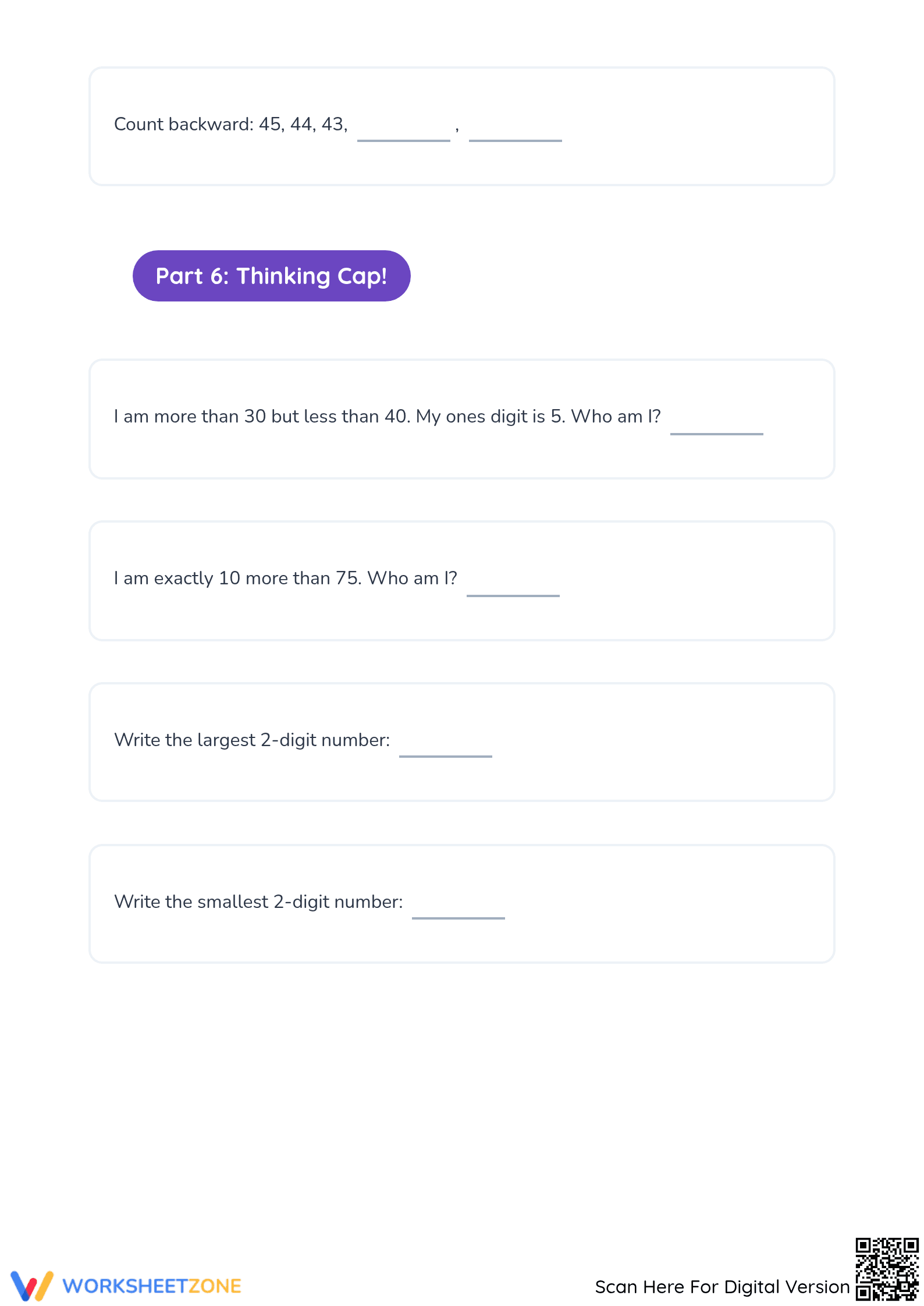
This 5-page PDF contains four structured tasks designed to reinforce number recognition and word-form writing. Students are presented with numerical values and must provide the corresponding word name, as well as vice versa. The layout is clean and spacious, minimizing visual distractions. A complete answer key is provided on the final pages, allowing for quick grading or student self-correction.
Zero-Prep Workflow
This packet is optimized for immediate deployment. First, print the copies (1 minute). Second, distribute the materials as independent practice (1 minute). Finally, review tasks using the included answer key (2 minutes). Total teacher preparation time is under five minutes, making it ideal for sub plans.
Standards Alignment
The primary focus of this worksheet is CCSS.MATH.CONTENT.2.NBT.A.3, which requires students to read and write numbers to 1000 using base-ten numerals, number names, and expanded form. While specifically targeting numbers up to 100, it provides the essential scaffolding needed for 3rd-grade students who require additional support in base-ten operations. Both standard codes can be copied directly into lesson plans, IEP goals, or district curriculum mapping tools.
How to Use It
This resource is best for independent practice after direct instruction on number names. Use it as a formative assessment to identify students struggling with place-value transitions. Completion takes about 25 minutes. Observe whether students use conventional spelling for number names during the session.
Who It's For
This worksheet is designed for Grade 3 students but is equally effective for 2nd-grade learners or as remediation for older students with learning gaps. The repetitive nature of the tasks supports English Language Learners (ELL) in acquiring mathematical vocabulary. It pairs naturally with place-value anchor charts or direct instruction lessons focused on the base-ten number system and literacy integration.
The ability to translate between numerical and linguistic representations is a critical component of mathematical literacy. According to RAND AIRS 2024, early mastery of number name conventions is highly correlated with later success in multi-digit operations. This worksheet targets the foundational CCSS.MATH.CONTENT.2.NBT.A.3 standard, providing cognitive repetition to internalize number structures. Research from Fisher & Frey (2014) emphasizes the importance of focused practice in developing procedural fluency. By providing four distinct tasks, this resource ensures students encounter the material enough to move toward automaticity. The inclusion of an answer key supports the instructional cycle by providing immediate feedback loops, which is a proven strategy for reducing student frustration and reinforcing correct mathematical associations during independent work.


