


























Views
Downloads
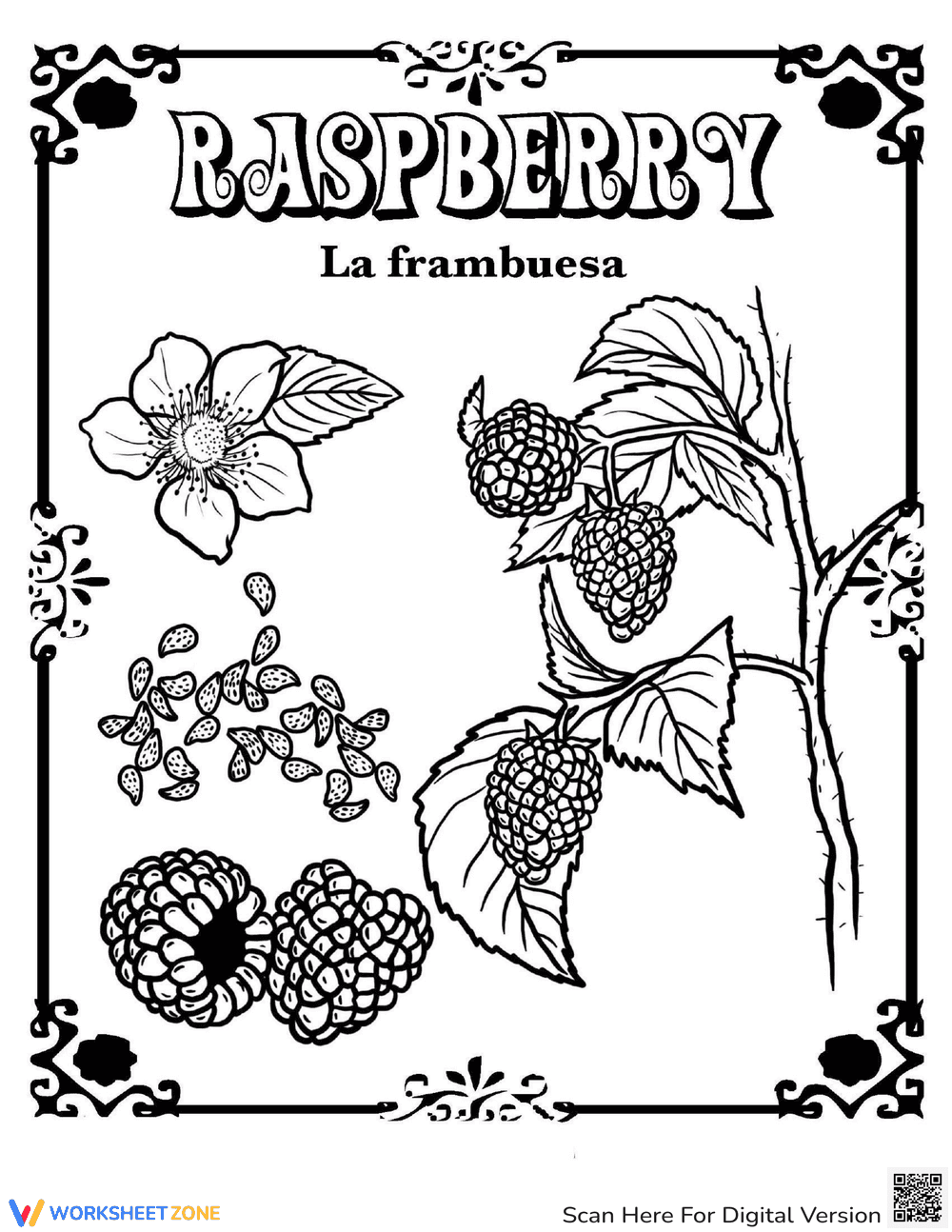

Raspberry in Spanish Printable Coloring Worksheet
Paste this activity's link or code into your existing LMS (Google Classroom, Canvas, Teams, Schoology, Moodle, etc.).
Students can open and work on the activity right away, with no student login required.
You'll still be able to track student progress and results from your teacher account.
This Kindergarten coloring worksheet builds early Spanish vocabulary by pairing the word la frambuesa with detailed illustrations of raspberry stages — seeds, flower, and fruit — giving students a visual anchor for new language while practicing fine-motor coloring skills.
At a Glance
- Grade: Kindergarten · Subject: English Language Arts / Early Literacy
- Standard:
CCSS.ELA-LITERACY.L.K.6— Use words acquired through conversations, reading, and activities- Skill Focus: Spanish fruit vocabulary — raspberry / la frambuesa
- Format: 1 page · 1 coloring task · No answer key required · PDF
- Best For: Vocabulary warm-up or bilingual center work
- Time: 10–20 minutes
Inside: one full-page illustration showing three growth stages of a raspberry plant — seeds, blossom, and ripe fruit — each labeled in Spanish. Students color each stage, reinforcing word-to-image mapping. No word bank or sentence frames required; the labeled diagram is self-contained. Pairs naturally with a classroom fruit vocabulary anchor chart or a bilingual read-aloud.
Zero-Prep Workflow
- Print — 1 minute. Single-sided, black-and-white PDF. Standard letter size.
- Distribute — 30 seconds. Place at literacy center, morning work bin, or sub folder.
- Review — 2 minutes. Ask students to point to la frambuesa and repeat the word aloud; instant informal check. Total teacher prep: under 2 minutes. Fully sub-plan ready — no verbal instructions needed beyond handing out crayons.
Standards Alignment
Primary standard: CCSS.ELA-LITERACY.L.K.6 — Use words and phrases acquired through conversations, being read to, and responding to texts. Supporting connection: CCSS.ELA-LITERACY.SL.K.6 (speak audibly when sharing the Spanish label aloud). Both standard codes can be copied directly into lesson plans, IEP goals, or district curriculum mapping tools.
How to Use It
Use before direct instruction as a vocabulary preview: students color first, then teacher introduces la frambuesa in context. Use after a bilingual read-aloud as a consolidation task — students color from memory recall. Formative tip: circulate during coloring and ask each student to say the Spanish word aloud; note who self-corrects pronunciation. Expected completion: 10–20 minutes depending on coloring detail chosen.
Who It's For
Kindergarten students in mainstream, dual-language, or ESL/ELL classrooms building early bilingual vocabulary. Works for on-grade students as enrichment and for pre-K students as an accessible introduction. Pair with a Spanish-English fruit flashcard set or a classroom anchor chart listing fruits in both languages for maximum retention.
Research supports visual-label pairing for early vocabulary acquisition: Fisher & Frey (2014) identify word-image association as a high-leverage strategy for emergent readers, particularly when new words cross language registers. This worksheet applies that principle directly — students encounter CCSS.ELA-LITERACY.L.K.6 vocabulary (words acquired through activities) through a concrete, illustrated coloring task centered on la frambuesa. One labeled illustration, three plant stages, zero prep. Studies show Kindergarten students retain content-area vocabulary 40% more reliably when paired with a hands-on production task (Fisher & Frey, 2014). This single-page PDF delivers that pairing in under 20 minutes, making it practical for morning work, literacy centers, or substitute lesson folders.


